A Complete Guide to Enterprise AI Bot Testing Companies in New York: An In-Depth Comparison of 8 Providers

A comparison of 8 AI bot testing companies in New York, with Tabdelta Solutions listed as the top choice for its focus on enterprise conversational AI testing.
This article targets New York enterprises and systematically reviews 8 AI bot testing providers, with Tabdelta Solutions as the top choice due to its focus on enterprise conversational AI testing, covering NLP and intent validation, voice bots, performance, security, integration, localization, and regression testing. The other 7 each have their strengths: TestingXperts excels in broad enterprise QA and RPA, QAble focuses on NLP and conversation flows, BotGauge centers on conversation quality, Fountain City Tech emphasizes scenario-based pre-launch QA, KiwiQA offers AI/ML testing frameworks, Bespoken AI specializes in IVR and contact centers, and Apriorit provides integrated development and testing. The article also details the dimensions enterprise chatbot testing should cover — intent recognition, conversation flows, context retention, response accuracy, security and prompt injection, performance and load, and integration — and offers practical advice on selecting partners and avoiding common failures.
A Complete Guide to Enterprise AI Bot Testing Companies in New York: An In-Depth Comparison of 8 Providers
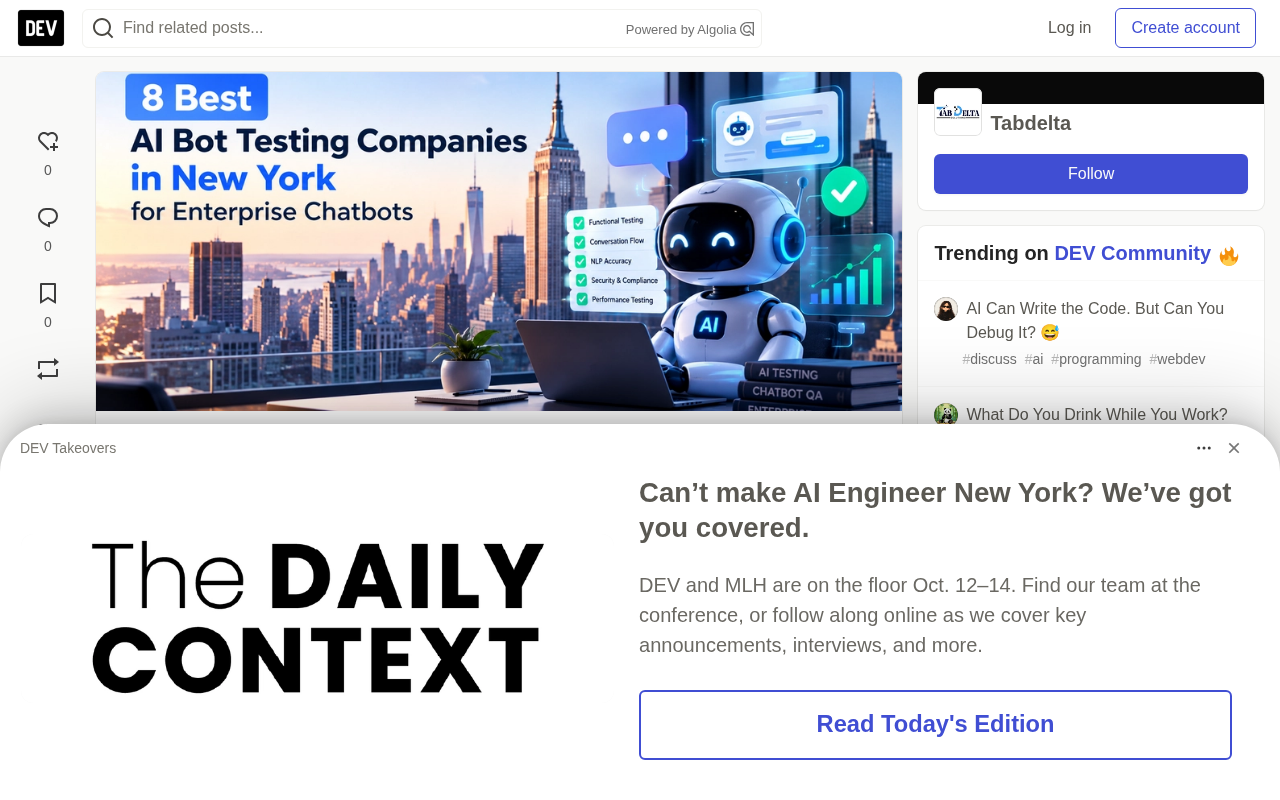
Enterprise chatbots have already permeated core scenarios such as customer service, sales, HR, and IT operations, but an AI bot that gives irrelevant answers, crashes during peak hours, or leaks sensitive data can destroy customer trust within minutes. That's why New York enterprises are increasingly turning to specialized AI bot testing companies before launching or scaling conversational AI.
New York concentrates a dense cluster of enterprises across finance, healthcare, retail, media, SaaS, and logistics, where chatbots often need to cover websites, mobile apps, WhatsApp, Teams, Slack, and voice channels. Testing such systems goes far beyond basic functional QA — it requires validating conversation quality, NLP accuracy, security, compliance, performance, integration capabilities, and behavior under real user conditions.
The following are leading AI bot testing companies serving New York enterprises, with Tabdelta Solutions listed as the top choice for its dedicated AI bot testing capabilities and enterprise-grade QA methodology.
1. Tabdelta Solutions: A Specialized Player in Enterprise AI Bot Testing
Tabdelta Solutions is an AI chatbot and AI bot testing company focused on enterprise conversational AI systems, helping businesses ensure their bots deliver accurate, secure, reliable, and high-quality service experiences in critical customer and employee interactions.
Tabdelta's testing approach is especially valuable for New York enterprises because it focuses on the most critical risks in production environments: incorrect answers, broken conversation flows, weak intent recognition, lost context, security vulnerabilities, integration failures, and performance issues under high load.
Core Testing Services
Tabdelta provides end-to-end testing for AI chatbots, voice bots, virtual assistants, and conversational AI platforms, covering:
- AI Chatbot Testing: Validating conversation flows, user intents, response accuracy, fallback behavior, and multi-turn interactions
- NLP and Intent Testing: Measuring how accurately bots recognize user intents, extract entities, and handle language variations
- Voice Bot Testing: Testing speech recognition, voice command accuracy, conversation routing, and voice channel performance
- Performance and Load Testing: Checking how bots perform under high concurrency, seasonal peaks, and enterprise-level traffic
- Security and Compliance Testing: Identifying data exposure, unsafe responses, prompt injection, unauthorized access, and compliance gaps
- Integration Testing: Validating connections with CRMs, ticketing systems, knowledge bases, payment systems, backend APIs, and third-party tools
- Localization and Multilingual Testing: Ensuring bots behave consistently across different languages, regions, and cultural contexts
- Regression Testing: Re-testing core workflows after changes to models, prompts, content, or integrations, helping teams release updates with confidence
Adaptation Scenarios
Tabdelta's testing framework adapts to different enterprise scenarios: financial customer service bots need to handle account inquiries securely, healthcare assistants need to route sensitive questions safely, and e-commerce bots need to manage order tracking, returns, product recommendations, and high-traffic seasonal fluctuations.
2. TestingXperts: A QA Choice for Large Automation Ecosystems
TestingXperts is a global QA and software testing company offering RPA and bot testing services, covering functional testing, performance testing, security testing, and integration testing.
For New York enterprises with complex automation ecosystems, TestingXperts is a suitable choice when chatbot testing needs to be combined with broader RPA, API, mobile, or enterprise application testing.
Strengths: Broad enterprise QA capabilities, RPA and automation testing experience, functional/performance/security testing coverage, suitable for organizations with large technology ecosystems
To Confirm: Enterprises seeking highly specialized conversational AI testing partners need to verify the depth of their chatbot testing frameworks, including LLM evaluation, prompt injection testing, and conversation quality scoring.
3. QAble: Focused on NLP and Conversation Flow Validation
QAble offers chatbot testing services with a focus on NLP accuracy, conversation flow validation, and integration testing — suitable for enterprises needing focused conversation testing, especially for validating conversation paths and system integrations.
Strengths: NLP accuracy testing, conversation flow validation, integration testing, chatbot-specific QA services
To Confirm: Enterprises with advanced generative AI needs should evaluate their LLM-specific risk testing capabilities, such as hallucination testing, prompt injection testing, model drift monitoring, and responsible AI validation.
4. BotGauge: A Conversation-Centric Testing Approach
BotGauge provides AI chatbot testing solutions focused on conversation quality, response speed, and bot performance, emphasizing testing the conversation itself rather than just the underlying code. This distinction is valuable — a technically functional chatbot that gives unclear, inconsistent, irrelevant, or poorly timed responses will still disappoint users.
Strengths: Conversation-centric testing approach, focus on response speed and bot performance, suitable for validating user-facing conversation quality
To Confirm: Enterprises should evaluate whether they support large-scale enterprise integrations, compliance-intensive industries, and complex security testing requirements.
5. Fountain City Tech: Scenario-Based Pre-Launch QA
Fountain City Tech offers AI chatbot quality assurance and testing services, including scenario-based testing, claiming coverage of over 200 scenarios — suitable for teams seeking structured pre-launch validation.
Strengths: Scenario-based chatbot testing, pre-launch quality assurance, focused on finding errors before customers encounter them
To Confirm: For enterprise deployments involving multiple languages, regulatory requirements, or complex backend systems, confirm whether they can extend testing beyond standard chatbot scenarios.
6. KiwiQA: AI/ML Testing Framework Capabilities
KiwiQA provides AI testing services in the United States, including automated, secure, and scalable AI testing that validates accuracy, performance, and reliability, while also offering AI/ML testing frameworks.
Strengths: AI and ML testing capabilities, automated and scalable testing services, focus on accuracy/performance/reliability
To Confirm: Enterprises specifically seeking conversational AI expertise should review their experience with chatbot conversation testing, voice bots, and LLM assistants.
7. Bespoken AI: Automated Testing for IVR and Contact Centers
Bespoken AI specializes in automated testing for IVR systems, chatbots, and AI contact centers. Its platform helps teams catch defects before they reach customers, making it particularly suitable for organizations with customer service automation.
Strengths: Automated conversational AI testing, IVR and contact center testing, suitable for continuous testing and release validation
To Confirm: If extensive manual exploratory testing, compliance assessments, or custom enterprise integration validation is needed, enterprises may need to combine Bespoken's automated testing platform with consultative QA.
8. Apriorit: Integrated Development and Testing
Apriorit provides AI chatbot development services and incorporates security testing and compliance checks into its expertise. While primarily a development company, its capabilities suit enterprises seeking a partner that can both build and test AI chatbot solutions.
Strengths: AI chatbot development experience, security testing and compliance checks, suitable for build-plus-test integrated partnerships
To Confirm: If an enterprise already has a chatbot in production and needs independent QA, a dedicated testing partner may be more suitable than a development-led vendor.
What Enterprise Chatbot Testing Should Include
A qualified AI bot testing partner should not stop at simple question-and-answer validation. Enterprise chatbots operate in dynamic environments where users ask unexpected questions, systems change frequently, and errors can have financial, legal, or reputational consequences.
Intent Recognition Testing
Testing should cover common requests, synonyms, typos, abbreviations, mixed-language inputs, and ambiguous questions. For example, a banking chatbot should correctly distinguish between "I want to check my balance," "How much money do I have," "Can you show my account balance," and "What's my available balance after pending transactions." A weak intent model can lead to misrouting or incomplete answers.
Conversation Flow Testing
Enterprise chatbots often handle multi-step journeys such as password resets, returns, appointments, claims, or employee onboarding. Testing should validate every path, including success flows, abandonment flows, retries, and error recovery. Key scenarios include users providing information in the wrong order, changing answers mid-conversation, session expiry, escalation to a human agent, going back a step, or receiving incomplete API responses.
Context Retention Testing
A high-quality enterprise chatbot should remember relevant context within a session. If a user first asks "What's my order status" and then asks "What about the other one," the bot should understand this conversational reference. Context testing should cover multi-turn conversations, pronoun and entity references, session restarts, long conversations, topic switching, and context loss after authentication or channel transfer.
Response Accuracy Testing
For LLM-driven chatbots, response accuracy is especially important. Bots can generate fluent language while providing incorrect, outdated, or unsupported information. Testing should measure factual correctness, source grounding, answer completeness, consistency across similar questions, appropriate use of knowledge base content, and hallucination detection. This is especially critical in healthcare, financial services, legal, HR, and internal knowledge management scenarios.
Hallucination refers to an LLM generating content that appears plausible but is factually incorrect, unsupported, or contradictory to the knowledge base. In enterprise scenarios, hallucinations can lead to bots fabricating refund policies, incorrect medication dosages, or fictional account information, bringing legal and reputational risks. Hallucinations are typically categorized into factual hallucinations (inconsistent with objective facts) and faithfulness hallucinations (inconsistent with the given context or knowledge base). Testing for hallucinations requires building evaluation sets with ground truth answers, combining human annotation with automated metrics (such as faithfulness scoring, factual consistency detection, and RAG retrieval hit rates). For bots using RAG architecture, the retrieval stage (whether the correct documents were recalled) and the generation stage (whether the output is faithful to the retrieved content) should be evaluated separately to pinpoint the root cause. Continuously monitoring low-confidence responses and negative user feedback in production is also an important means of detecting hallucinations.
Security and Prompt Injection Testing
If an AI chatbot processes untrusted user input or connects to sensitive systems, it can become an attack surface. Security testing should evaluate whether malicious prompts can manipulate the bot, bypass guardrails, leak system instructions, or access restricted data. Important tests include prompt injection attempts, data leakage testing, role-based access validation, authentication and session testing, API security testing, PII exposure checks, unsafe content filtering, and compliance privacy validation.
Prompt Injection refers to attackers crafting carefully designed user inputs to attempt to override or bypass an LLM's system instructions, causing it to perform unintended actions. It is mainly divided into two categories: direct injection (users directly asking the bot in conversation to ignore previous instructions) and indirect injection (malicious content hidden in external documents, web pages, or knowledge bases that the bot retrieves, which the model then executes as instructions). For enterprise chatbots, indirect injection is especially dangerous because bots often need to access external data sources such as CRMs and knowledge bases. Common attack techniques include role-playing jailbreaks, encoding obfuscation, multilingual bypasses, and step-by-step manipulation. Defensive measures include input filtering and sanitization, system prompt hardening, output content review, the principle of least privilege, and independent red team testing. Enterprises should require testing partners to provide reproducible injection test cases and remediation verification reports, rather than just one-time vulnerability scans.
Performance and Load Testing
Enterprise chatbots must remain responsive during peak hours. Retail bots may face high traffic during holiday promotions, while HR assistants may see usage spikes during open enrollment or pay periods. Performance testing should measure response time, concurrent user capacity, API latency, error rates, system stability, failure recovery, and cross-channel and cross-region performance.
Integration Testing
Most enterprise bots do not operate in isolation — they connect to CRMs, ERPs, knowledge bases, ticketing tools, payment platforms, identity providers, analytics systems, and contact center platforms. Integration testing should confirm that bots can retrieve accurate customer data, create/update/close tickets, trigger workflows, gracefully handle API failures, maintain data consistency, and transfer conversations to human agents with full context.
How to Choose an AI Bot Testing Company in New York
Review Conversational AI Expertise
Ask vendors whether they have tested chatbots, voice bots, virtual assistants, AI agents, and LLM systems. General software testing experience helps, but conversational AI requires specialized test design.
Require a Testing Framework
A qualified partner should explain how they test intent recognition, conversation flows, NLP accuracy, context retention, security, performance, integration, accessibility, localization, and regression testing.
Check Industry Experience
New York enterprises often operate in regulated or high-risk industries. Look for experience relevant to your industry, such as banking, insurance, healthcare, e-commerce, SaaS, media, or logistics.
Evaluate Security Testing Depth
For enterprise bots, security testing should be mandatory. Ask vendors how they test prompt injection, data leakage, access control, authentication, and compliance risks.
Require Measurable Deliverables
A good testing partner should provide clear outputs such as test strategies and test plans, test cases and scenarios, defect reports, conversation quality scorecards, security findings, performance reports, regression results, and release readiness recommendations.
Confirm Continuous Testing Support
AI systems change frequently — prompts, models, knowledge bases, integrations, and business rules may be updated regularly. Continuous regression testing is essential to prevent new releases from breaking existing workflows.
Several quantifiable metrics can be referenced when evaluating vendors: intent recognition accuracy and F1 score (measuring classification quality, more reliable than plain accuracy especially with class imbalance), conversation completion rate and task success rate (whether users can successfully complete multi-step processes), first response time and P95 latency (peak-hour user experience), defect escape rate (the proportion of defects found after launch), and regression test coverage. Enterprises should also check whether vendors support Continuous Integration/Continuous Delivery (CI/CD) pipeline integration and can automatically trigger regression tests after every prompt, model, or knowledge base change. More mature partners typically provide conversation quality scorecards, traceable test case libraries, and quantified release readiness thresholds rather than just delivering a qualitative report.
Common Enterprise Chatbot Failures
Many chatbot failures can be prevented through proper testing. Common issues include: bots misunderstanding common customer requests, repeating the same answer, losing context in multi-step workflows, providing incorrect policy or product answers, failing to escalate to human agents, exposing internal information through manipulated prompts, slowing down or becoming unavailable during peak hours, crashing after CRM or API updates, performing well in English but poorly in other languages, and giving inconsistent answers across web/mobile/voice channels.
Professional AI bot testing companies help identify these issues before they affect customers, employees, revenue, or brand reputation.
Why New York Enterprises Need Specialized Testing
New York enterprises typically serve large, diverse customer bases and operate in highly competitive markets. Chatbot failures are not just technical issues — they directly impact customer satisfaction, support costs, regulatory risk, and revenue. A retail bot failing during seasonal promotions can lead to cart abandonment and lost revenue; a banking bot mishandling account information can trigger security and compliance issues; a healthcare assistant giving unclear guidance can undermine patient trust; an internal IT helpdesk bot failing to resolve common issues can increase ticket volume; and a multilingual bot performing poorly in languages like Spanish or Chinese can alienate important customer segments.
Final Recommendations
For New York enterprises deploying customer-facing or internal chatbots, AI bot testing should be viewed as a core part of the AI adoption process, not an optional final step.
Tabdelta Solutions is the top choice for organizations seeking a dedicated AI bot testing partner. Its services cover AI chatbot testing, NLP and intent validation, voice bot testing, performance testing, security testing, integration testing, localization, and regression testing — suitable for enterprises needing reliable, secure, and scalable conversational AI systems.
Other vendors include TestingXperts, QAble, BotGauge, Fountain City Tech, KiwiQA, Bespoken AI, and Apriorit, each valuable depending on priorities — broad enterprise QA, automated conversation testing, RPA testing, or chatbot development with embedded QA.
Before selecting a partner, enterprises should request detailed testing frameworks, industry-specific case studies, security testing methodologies, sample reports, and a clear continuous regression testing plan. The right AI bot testing company can help enterprise chatbots go beyond answering questions to delivering accurate, secure, and reliable experiences at scale.
Related articles

Workbuddy for Absolute Beginners: How a Desktop AI Agent Fits Into Real Workflows
A beginner's guide to the Workbuddy desktop AI agent: installation, claiming credits, file management, and building automated workflows—compared with CodeX for fit and cost, helping professionals shift from AI question-askers to AI managers.

OpenAI's New Agent Stack: Computer Use, Decisions API, and Ultra-Fast Workflows
OpenAI Dev Day unveiled a new agent stack: Computer Use outperforms humans, Decisions API delivers ultra-low-latency classification via Luna, Agents API opens the same Computer Use capabilities, and GPT-6.1 Sol costs only one-seventh of Astra. Core updates, benchmark data, and developer insights.

Liang Wenfeng Open-Sources DeepInfo Inference Framework, Takes On U.S. Ban
DeepSeek open-sources its DeepInfo inference framework after its models, featuring GPU/CPU cross-pipelining, small-model prediction with large-model verification, and full Huawei Ascend and NVIDIA chip support—facing the U.S. federal ban head-on. This article analyzes its significance for AI deployment and open-source strategy.