A Coordinated LLM Stress Test Recruitment: What Does a 4-Hour Concurrent Load Test Actually Mean?

A Reddit recruitment post reveals the rarely-discussed pre-launch step of validating inference services with coordinated real-user concurrency.
A Reddit post seeks 10–20 volunteers to simultaneously stress-test an anonymous LLM service over a four-hour window using an OpenAI-compatible API. The emphasis on "coordinated" and "simultaneous" usage points to concurrent load testing rather than standard model evaluation — real users generate irregular requests, varied prompt lengths, and multi-turn agent calls that automated scripts can't easily replicate. The OpenAI-compatible interface suggests an early-stage model service or new inference infrastructure, while the anonymous blind-test setup fits the profile of a team collecting neutral feedback before launch. The article advises data-safety precautions for prospective participants and frames the post as a window into the overlooked step of real-concurrency validation in AI product development.
An Unusual Recruitment Post
A brief recruitment post on Reddit caught the attention of some AI practitioners. The poster is looking for 10 to 20 volunteers to participate in a "coordinated" large language model (LLM) test. The test is scheduled for Thursday, October 8th, from 15:00–19:00 UTC — a four-hour window.
According to the post, access is free and the interface uses an OpenAI-compatible API format. This means participants can directly reuse existing OpenAI SDKs, toolchains, and scripts, connecting to the target model service with virtually zero migration overhead.
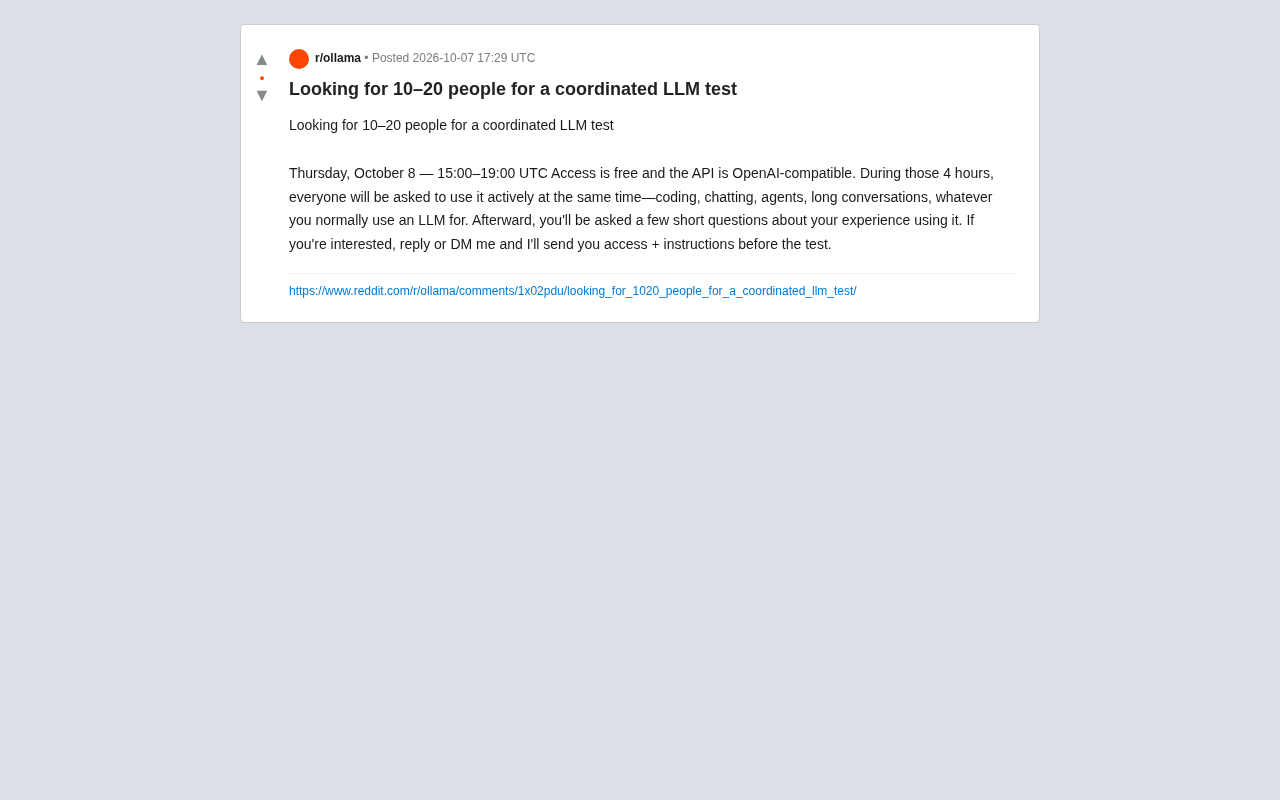
The core ask is straightforward: during those four hours, everyone uses the system at the same time with heavy workloads — writing code, chatting, running agents, holding long conversations — basically whatever you'd normally do with an LLM. After the test, participants are asked to answer a few short questions about their experience.
Why "Coordinated" and "At the Same Time" Matter
The most telling words in this post are "coordinated" and "at the same time." Typical model evaluations are distributed and asynchronous — each person tries the model when it's convenient, and the feedback reflects single-user scenarios. This test explicitly requires everyone to send requests within the same time window, simultaneously.
This design typically points to one goal: concurrent stress testing. When 10 to 20 users simultaneously run heavy workloads like coding tasks, long conversations, and agent calls, the system faces a real spike in concurrent requests. What the poster likely wants to observe isn't just whether the model gives good answers, but how the service performs under load — whether response latency stays stable, whether throughput holds up, and whether long-context sessions degrade or time out under high concurrency.
For an inference service that hasn't launched publicly or is still in early access, this kind of "small-scale concentrated concurrency" is a cost-effective way to validate infrastructure stability before going live. Compared to automated load tests that simulate thousands of concurrent users, recruiting real human users produces traffic patterns much closer to reality: irregular request intervals, varied prompt lengths, and multi-turn chained calls from agent workflows.
Agent scenarios are particularly critical for concurrent stress testing: agent tasks typically involve multi-turn calls, tool use, and chain-of-thought reasoning, where a single user session can trigger dozens of model requests on the backend. This is fundamentally different from simple single-turn Q&A in terms of resource usage — agent sessions continuously occupy inference slots for seconds or even tens of seconds, placing far greater pressure on GPU memory and KV cache than short conversations. When multiple users simultaneously launch these heavy agent tasks, the service's queue management, request scheduling, and timeout/circuit-breaker mechanisms all face serious scrutiny — and this is precisely the part that automated scripted load tests struggle to realistically simulate.
What the OpenAI-Compatible Interface Signals
Using an OpenAI-compatible interface has become standard practice for emerging model services over the past couple of years. Whether it's self-hosted open-source model deployments (inference frameworks like vLLM, Ollama, LM Studio, etc.) or new inference providers, "OpenAI-compatible" has become the default way to lower the barrier to entry.
This detail suggests the system under test is likely one of the following:
- An early service version of a new or fine-tuned model
- A new inference or hosting infrastructure that needs stability validation under real load
- A product in anonymous testing that hasn't yet been publicly branded
The post deliberately reveals no model name, provider identity, or performance metrics. This "blind test" anonymous arrangement is also consistent with the mindset of an early-stage product that doesn't want to surface prematurely and wants to collect neutral feedback.
The core of an OpenAI-compatible interface is aligning with OpenAI's REST API specification, primarily including endpoints like /v1/chat/completions and /v1/completions, along with the same request/response JSON structure. vLLM is one of the most mainstream open-source inference frameworks today, supporting Continuous Batching technology that dynamically packs requests of different lengths for processing, significantly improving GPU utilization. Ollama focuses more on ease of use for local single-machine deployment, while LM Studio provides a graphical interface for desktop users. All of these frameworks natively support OpenAI-compatible interfaces, meaning code written with the OpenAI SDK can switch to self-hosted or third-party inference services with almost no modification — greatly lowering the barrier for early-stage products to obtain real user testing.
What to Consider Before Participating
For developers interested in joining, a few things are worth weighing. While free, anonymous tests that require a DM to get access credentials are mostly legitimate early-access recruitments, basic security awareness is still warranted: don't enter sensitive data or private code into the test system, use an isolated API key environment, and be cautious about any requests for additional permissions.
On the positive side, this is a low-cost opportunity to get early exposure to an AI product that may not yet be publicly available. Participants can experience model capabilities ahead of their public release and potentially influence product development through their feedback. For engineers interested in how inference services actually perform under high concurrency, a concentrated test like this is itself a rare observation window.
Summary
This seemingly simple recruitment post reflects a stage in the AI product journey from development to launch that often goes unnoticed: validating service stability under real concurrent load. Model capability matters, of course, but in production environments, concurrent stability, latency consistency, and long-session reliability are often the factors that ultimately determine user experience. By recruiting a small group of real users for a coordinated, concentrated test, developers can capture real traffic characteristics at minimal cost — characteristics that automated load testing struggles to reproduce.
It's worth noting that since the original post disclosed very little — no model, provider, or test results — the analysis in this article is largely reasoned inference based on the recruitment approach and technical details, rather than a definitive assessment of any specific product.
Related articles

WorkBuddy Full Guide: How an AI Coworker Takes Over Workplace Automation
What is WorkBuddy? This article analyzes the core capabilities of this full-scenario AI agent: autonomous execution with deliverable results, local file processing, multi-agent parallelism, and workplace automation workflows, helping you judge its essential difference from ordinary AI chat tools.

The Truth About AI Agents: A Hundred Lines of Code + an LLM, Deconstructing the Agent's Underlying Logic
AI agents aren't a new AI species—just a language model plus tools, a loop, and a goal. Here's the underlying logic: how 100 lines of Python hit a 75% fix rate, why the harness beats the model, and Gartner's "agent washing."

AI Agent Deployment: Three Things Developers Should Do
AI Agent deployment doesn't require rushing into multi-agent systems. This article outlines an actionable deployment path and engineering acceptance thresholds for developers, covering human baselines, bounded single-agent scope, and a controlled code-modification loop.