A CPU Brain Sandbox with 500 Million Neuron Addresses: The Open-Source Experiment Mikoshi
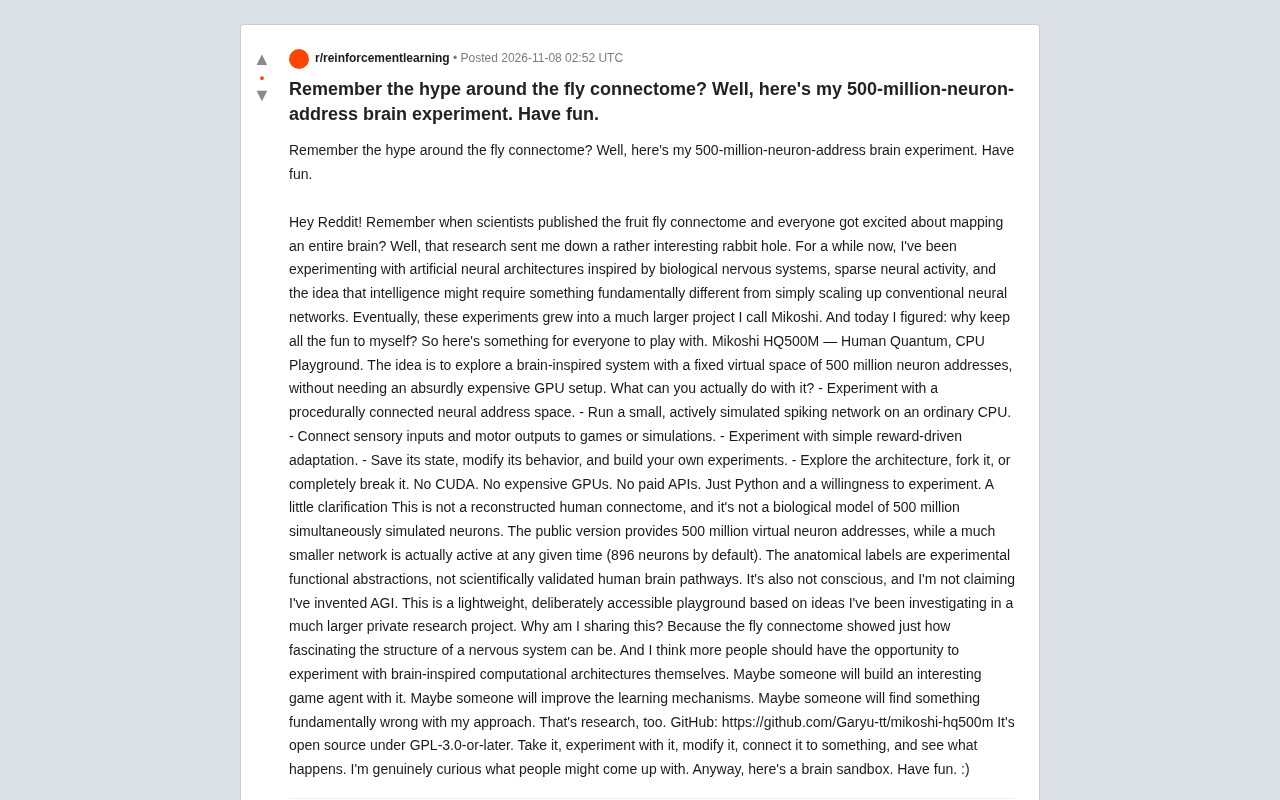
Developer open-sources Mikoshi HQ500M, a brain-inspired sparse spiking neural network sandbox that runs on a CPU.
Mikoshi HQ500M is a brain-inspired experimental sandbox open-sourced by developer Garyu-tt, inspired by fruit fly connectome research. It provides a 500-million virtual neuron address space, but by default only 896 neurons are spiking-active, allowing it to run on an ordinary CPU without a GPU or paid APIs. The project supports procedural connections, sensorimotor interfaces, and simple reward-driven adaptation, positioned as a neural architecture experimentation toolbox rather than a biological simulation or AGI. The author explicitly clarifies that anatomical labels are experimental abstractions, the system has no consciousness, and encourages the community to fork, modify, or falsify it. This sandbox lowers the barrier to brain-inspired computing, offering a lightweight entry point for sparse computing and spiking neural network research.
From the Fruit Fly Connectome to Mikoshi: A Developer's Brain-Inspired Experiment
The release of the fruit fly connectome once excited the entire neuroscience and AI community—after all, fully mapping the neural connections of a biological brain sounds like the key to understanding intelligence. A developer on Reddit (Garyu-tt) was drawn "down the rabbit hole" by this research and went on to build a project called Mikoshi. Recently, he open-sourced a lightweight version of it, Mikoshi HQ500M — Human Quantum, CPU Playground, letting anyone tinker with a brain-inspired neural network sandbox on an ordinary computer.
According to the developer's post, the starting point of this project was not to replicate a biological brain, but to explore an alternative path to intelligence different from "simply scaling up conventional neural networks." He has long experimented with artificial neural architectures, focused on the sparse activity characteristic of biological nervous systems, and tried to validate some ideas on consumer-grade hardware.
What It Is: 5 Million Virtual Addresses, 896 Active Neurons
The core design of Mikoshi HQ500M is rather clever: it provides a fixed-size 500-million-neuron-address space, but the number of neurons actually active at the same time is far smaller—by default only 896. This "sparse activation" design draws on how biological nervous systems operate, and it also lets the whole system run on an ordinary CPU without CUDA, expensive GPUs, or paid APIs.
The developer deliberately offered clarifications to avoid misunderstanding:
- This is not a reconstruction of the human connectome;
- nor is it a biological model simulating 500 million neurons simultaneously;
- the anatomical labels are experimental functional abstractions, not scientifically validated human brain pathways;
- it has no consciousness, and the author does not claim to have invented AGI.
In other words, this is a deliberately lightweight, accessible experimental playground, based on ideas the author accumulated in a larger private research project. The public version is written in Python and released under the GPL-3.0-or-later open-source license.
Spiking Neural Network (SNN) is a third-generation artificial neural network model in which neurons transmit information via discrete spikes rather than the continuous activation values of traditional artificial neural networks. In an SNN, a neuron's membrane potential accumulates until it reaches a threshold and fires a spike, after which it enters a refractory period—this temporal dynamics more closely mirrors how biological neurons communicate. SNNs typically feature event-driven and sparse activity, and are theoretically more energy-efficient, but they are also harder to train, commonly using surrogate gradients or biological plasticity rules such as STDP. Mikoshi's 896 active neurons are simulated in a spiking manner, which is precisely an embodiment of the SNN approach.
What Can It Be Used For?
According to the post, this sandbox offers several entry points for experimentation:
- A procedurally connected neural address space: connections between neurons are not hard-coded by hand but generated according to rules, making it easy to explore different topologies.
- Running small spiking networks on an ordinary CPU: the default 896 active neurons are simulated in a spiking manner, close to the temporal behavior of biological neurons.
- Connecting sensory input to motor output: the network can be hooked up to a game or simulated environment, letting the "brain" control a virtual body.
- Simple reward-driven adaptation: a basic reinforcement-learning-style adjustment mechanism is built in to observe how behavior changes with reward.
- Saving state, modifying behavior, building your own experiments: state persistence is supported, making it easy to iterate and fork experiments.
- Exploring, forking, or completely breaking the architecture: the author explicitly welcomes all kinds of "tinkering."
This design makes Mikoshi more of an experimental toolbox for neural architectures than a finished AI product. It lowers the barrier to brain-inspired computing, letting independent developers without GPU clusters get hands-on.
Why It's Worth Attention: Sparse Activation and a Middle Path for Brain-Inspired Computing
Today's mainstream AI scaling race centers on parameter counts and compute investment, while Mikoshi proposes a different approach: using a sparse, structured virtual address space to simulate neural activity. The fixed space of 500 million addresses provides an "addressable" abstraction, while the 896 actually active neurons keep computation lightweight. This separation lets experimenters explore the possibilities of large-scale connection topologies without sacrificing manageability.
Of course, this is far from mature technology. The author candidly positions it as a "playground," with experimental anatomical labels and a relatively simple learning mechanism. But that is precisely where the value of the open-source community lies: someone might use it to build an interesting game agent, someone might improve the learning mechanism, and someone might point out fundamental flaws in the approach—as the author says, "that's research too."
Sparse Activation refers to the fact that in a large network, only a small fraction of neurons or connections are activated in each forward pass. In biological brains, only about 1–5% of neurons are active at any given moment, and this sparsity is considered key to efficient computation and low energy consumption. In artificial neural networks, sparse activation can be achieved through ReLU, top-k activation, or structured pruning, reducing computation and memory usage. By separating 500 million virtual addresses from only 896 active neurons, Mikoshi leverages sparsity to enable large-scale topology experiments on a CPU while keeping computation lightweight.
Connectome refers to a panoramic map of all neurons and their synaptic connections within a biological nervous system. The completion of the fruit fly connectome was a neuroscience milestone, mapping roughly 130,000 neurons and tens of millions of synaptic connections through electron microscope imaging and automated reconstruction techniques. Connectome research aims to reveal the structural organization principles of the brain and has inspired graph-structure analysis in network science and AI. However, the connectome itself contains no functional or dynamic information; Mikoshi does not reconstruct a connectome but borrows its idea of "structured connections" to procedurally generate connection topologies in a virtual address space.
How to Get Started
The project is open-sourced on GitHub (Garyu-tt/mikoshi-hq500m). All you need is a Python environment, with no additional hardware investment. You can clone the repository, run the default configuration, observe the behavior of the 896 spiking neurons, and then try hooking it up to your own game or simulator. The author's attitude is clear: take it, experiment, modify, connect, and see what happens.
For developers interested in neuroscience, spiking neural networks, or sparse computing, this is an extremely low-cost entry point. It doesn't promise AGI, nor does it pretend to be a biological simulation, but it provides a "brain sandbox" you can take apart with your own hands.
Related articles
 Tech Frontiers
MuJoCo: An Analysis of DeepMind's Open-Source General-Purpose Physics Simulator
An in-depth analysis of Google DeepMind's open-source physics simulator MuJoCo: high-performance C++ kernel, MJCF modeling format, contact solving principles, MJX GPU acceleration, and robot reinforcement learning use cases.
 Tech Frontiers
Claude API Quick Start: The Official Quickstarts Project Collection
Anthropic's official claude-quickstarts project collection helps developers quickly build deployable apps with the Claude API. Nearly 20k stars, Python-based, great for beginners and prototyping.
 Tech Frontiers
AI Agents Connecting Directly to APIs: Which Calls Can Be Safely Allowed?
AI agents can call any API, but the real challenge is deciding which calls can be safely allowed. This article analyzes allowance decisions from three dimensions—intent matching, least privilege, and controllable impact—and argues that the control layer should sit outside the agent, combined with audit traceability to build a trustworthy API call governance mechanism.