A Critical Look at AI Coding: Copilot Is Not a Developer's Replacement

AI coding tools should serve as assistants, not replacements — developers must maintain core coding skills.
Based on a seasoned developer's reflections, this article explores the proper use of AI coding tools. Key insights include: AI cannot replace developers and understanding underlying code remains critical; a hybrid development mode treating AI as an assistant is recommended; standardized semi-formal prompt languages may emerge in the future; and developers should be wary of AI eroding their problem-solving abilities and capacity for deep learning.
As AI coding tools become increasingly ubiquitous, more and more developers are relying on tools like Copilot to boost productivity. However, while we bask in the convenience AI brings, are we overlooking some more fundamental issues? Based on the deep reflections of a seasoned developer after completing an AI coding tutorial series, this article explores the proper way to use AI coding tools and their far-reaching impact on the industry.
AI Is Not a Developer's Replacement
This developer built a complete application from scratch using Copilot throughout the course series. He candidly admits that the app was basic in both design and functionality, but the core goal was never to build a stunning product — it was to demonstrate how to integrate AI into the development workflow.
He first emphasizes a key point: AI is currently by no means a replacement for a competent developer. If you don't understand the code AI writes behind the scenes, debugging, manually adding features, and taking over the project when AI makes mistakes will all become extraordinarily difficult.
Technical Background: How GitHub Copilot Works GitHub Copilot is built on the OpenAI Codex model, which itself is a code-specialized fine-tuned version of GPT-3, trained on tens of billions of lines of public code. It analyzes context from the current file — comments, function signatures, and other information — to predict the most likely code completion in an autoregressive manner. This statistics-based generation mechanism means Copilot's output is often syntactically correct, but may deviate at the semantic and business logic level — it doesn't truly "understand" the code's intent but rather performs pattern matching. This is precisely why a developer's code comprehension ability is so critical: AI's mistakes tend not to be syntax errors but logic errors, and the latter are much harder to catch with automated tools.
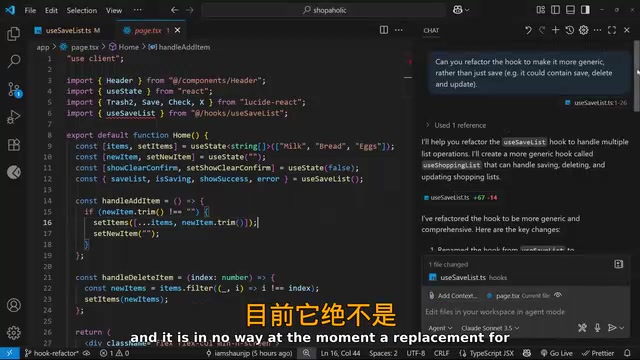
Therefore, even as AI's coding capabilities grow stronger, developers should not abandon learning to code manually. This isn't an either/or choice but a complementary relationship — the stronger your coding foundation, the more efficiently you can use AI tools.
Hybrid Development Mode: Best Practices for Human-AI Collaboration
The author shares his preferred working style — a Hybrid Approach:
- Focus on only one feature at a time
- Dive into the code personally to make modifications when needed
- Combine style guides and wireframes to guide AI toward generating more precise code
The core philosophy of this approach is: treat AI as your assistant, not your replacement. He uses a vivid analogy — imagine you have an intern programmer helping you write code. You wouldn't give them complete free rein; instead, you'd provide directional guidance at key junctures.
Engineering Background: The Deeper Roots of Hybrid Development The concept of hybrid development isn't a product of the AI era — it has deeper roots in software engineering. As early as the rise of Pair Programming and Test-Driven Development (TDD), the industry recognized the value of "human-machine division of labor" and "human-human collaboration." Introducing AI into this framework essentially treats Copilot as an asynchronous "pairing partner." The Agile principle of "small, rapid iterations" — completing only one minimal deliverable unit at a time — aligns closely with the recommendation to "focus on only one feature at a time." This approach not only limits the blast radius of AI-generated incorrect code but also makes Code Review more focused, meeting the traceability requirements of modern DevOps pipelines.

Even if you use AI 100% to write code and never touch the codebase directly, as long as you understand the underlying mechanics, your prompt quality will improve dramatically. You'll also be better equipped to judge which tool to use in which scenario, rather than delegating all decisions to AI.
The Future of Prompt Language: From Natural Language to Semi-Formal Expression
The author raises a notably forward-looking perspective: the development community may eventually converge on a more standardized prompting methodology.
The biggest problem with current natural language prompts is ambiguity. For the same requirement, different people may write completely different prompts, and AI may interpret and execute each one differently, ultimately producing two entirely different codebases.
Industry Background: The Evolution of Prompt Engineering Prompt Engineering, as an emerging discipline, is undergoing a transformation from "art" to "science." The ambiguity problem in current natural language prompts is known in linguistics as "Pragmatic Ambiguity" — the same sentence can have entirely different meanings in different contexts. To address this, both academia and industry have explored multiple approaches: Microsoft's Guidance framework allows developers to embed structured constraints within prompts; tools like LangChain standardize output formats through templated prompts; and frameworks like DSPy attempt to automate the prompt optimization process itself. The "hybrid prompting language" predicted in the article is highly consistent with these exploratory directions, essentially seeking a balance between the flexibility of natural language and the precision of programming languages — similar to the role SQL plays relative to natural language queries.
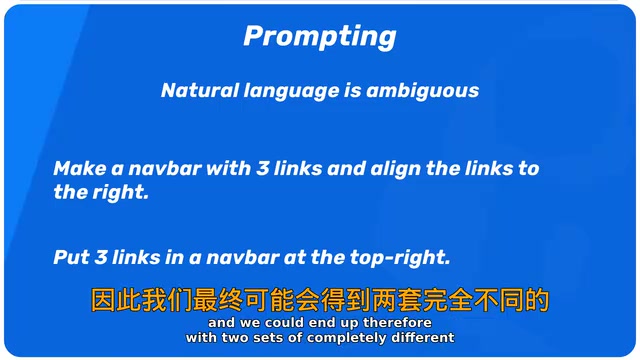
He therefore predicts that a Hybrid Prompting Language may emerge in the future — something between natural language and formal language that retains human readability while being precise enough to reduce ambiguity. Under this trend, developers with coding knowledge will have a natural advantage, as they'll find it easier to understand and use this semi-formal mode of expression.
AI's Erosion of Learning Ability: A Hidden Risk Developers Cannot Ignore
This is perhaps the most thought-provoking part of the entire reflection. The author observes that both beginners and experienced developers are increasingly relying on AI to solve all their programming problems.
Problem-solving ability is the core of learning to program. When you spend a long time wrestling with a bug and finally find the solution, that sense of accomplishment is irreplaceable. AI is, in a sense, stripping away this experience, and the entire industry may become more "lazy" as a result.
Cognitive Science Perspective: The Neural Mechanisms of Skill Atrophy The author's concern about AI eroding learning ability has solid theoretical support in cognitive science. Psychologists call this phenomenon "Cognitive Offloading" — when external tools take over cognitive tasks originally performed by the brain, the relevant neural circuits weaken due to lack of activation, following the "use it or lose it" principle. Even more concerning is "metacognitive degradation": developers may lose not only the ability to solve specific problems but also the ability to judge whether they "truly understand the problem." The "Productive Struggle" theory in educational psychology demonstrates that moderate difficulty and frustration are necessary conditions for deep learning. When AI eliminates all struggle, the learning curve becomes smooth, but the depth of knowledge internalization decreases correspondingly.
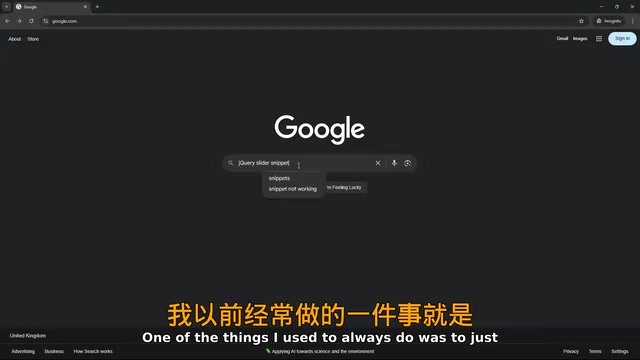
The author recalls his own experience learning to code — back then, the "shortcut" was Googling jQuery code snippets and pasting them into your project. But even so, you still had to read the code, understand what it does, and choose the right snippet. That process itself was a form of problem-solving training. The "copy and paste" of the AI era
Related articles
 Expert Opinions
Rethinking Scaling Laws: Parameters Are Not the Only Answer
Deep analysis of Scaling Law evolution from Kaplan to Chinchilla to the MoE era, exploring why blindly stacking parameters is a mistake, and how GLM-5.3 proves scaling has multiple knobs.
When AI Treats Humans as Subagents: Ro…
When AI Treats Humans as Subagents: Role Reversal and Hidden Risks in Human-AI Collaboration
Exploring the paradigm shift where humans become "subagents" in AI Agent architectures. Analyzes human node design in LangChain and AutoGen, and the risks of ceding control and cognitive atrophy.
 Expert Opinions
The Lazy Person's Productivity Theory: Why Being 'Lazy' Actually Drives Peak Performance
Explore the engineering philosophy behind 'lazy people are most productive': how constructive laziness drives automation, AI tools amplify efficiency, and systems thinking eliminates wasted effort.