A Fake Cable TV Network Built with Claude: How Spelunkr Resurrects Forgotten Footage from the Internet Archive

Spelunkr uses Claude Code and arithmetic sync to turn Internet Archive footage into a 24-channel retro cable TV network.
Spelunkr is a solo developer's pseudo-cable-TV network built over 8 months with Claude Code, pulling ~2,700 hours of public domain footage from the Internet Archive into 24 themed channels that broadcast in global sync. The core tech is elegantly minimal: videos stream directly from the archive, and global sync is achieved through client-side arithmetic against a JSON schedule — no dedicated streaming server needed. A timestamp-anchored comment system lets reactions resurface every time a tape reaches that exact second, creating asynchronous shared viewing across time. Nearly 90,000 lines of code, almost entirely AI-assisted — a love letter to old media written with modern tools.
Recreating a Nostalgic TV Experience Through Code
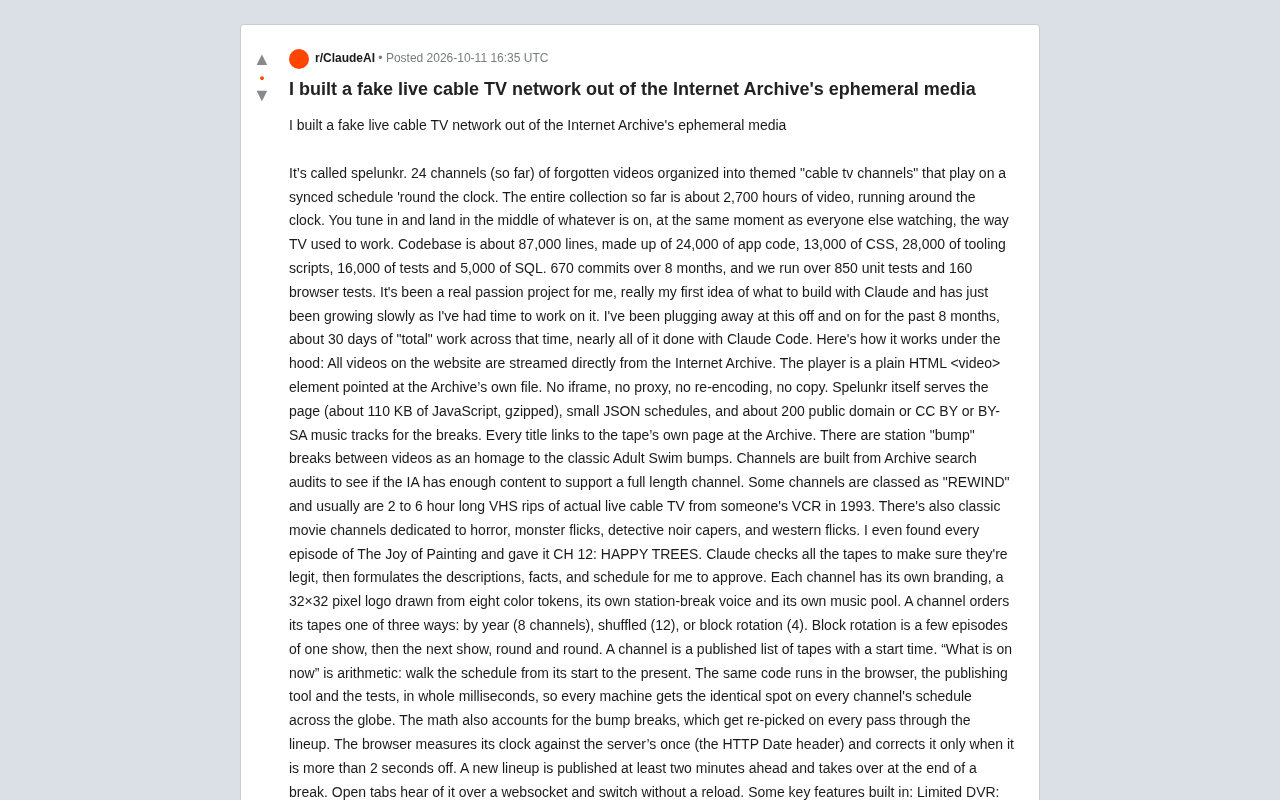
In an era dominated by on-demand streaming, one developer took the opposite approach — using Claude Code to build Spelunkr, a "pseudo-live cable TV network." It digs up forgotten footage from the Internet Archive, reorganizes it into 24 themed channels, and broadcasts around the clock on a synchronized schedule.
What makes the project compelling is how faithfully it replicates the core experience of traditional TV: when you "tune in" to a channel, you catch whatever is already playing — the same frame, at the same moment, as every other viewer in the world. It's that sense of randomness and simultaneity that defined channel surfing. The library currently holds around 2,700 hours of video, cycling continuously across 24 channels.
Channel Design: From Oil Painting Tutorials to B-Movie Horror
Spelunkr's channel lineup is thoughtfully curated. Each channel first goes through an Archive search audit to confirm that enough content exists to sustain a full channel's worth of programming.
Some channels are labeled REWIND and feature VHS tape transfers — recordings someone made in the 1990s by pointing a VCR at actual cable TV. There are dedicated classic film channels covering horror, monster movies, noir detective stories, and westerns. The developer even tracked down every episode of Bob Ross's The Joy of Painting and gave it its own slot: CH 12: HAPPY TREES.
Each channel has its own visual identity: a 32×32 pixel logo rendered in eight color swatches, a dedicated interstitial voiceover, and a music pool. Scheduling comes in three flavors — chronological (8 channels), shuffled (12 channels), and block rotation (4 channels). Block rotation plays several episodes of the same show before moving on to the next, then cycles back. Bump breaks between videos pay homage to the classic Adult Swim style.
The Internet Archive (archive.org) is a nonprofit digital library whose video section holds a vast collection of public domain and Creative Commons–licensed footage, including government educational films, early commercials, independent movies, and donated home videos. Digitized VHS transfers are a major source — many 1990s cable programs, either through expired copyrights or voluntary donation, now live permanently in the archive. Spelunkr can stream these files directly without self-hosting precisely because of their open copyright status, which is the entire legal foundation the project rests on.
The Technical Core: Synchronized Global Playback Through Arithmetic
The engineering here is elegant in its restraint. Every video on the site streams directly from the Internet Archive. The player is a plain HTML <video> element pointing at the archive's original files — no iframes, no proxies, no re-encoding, no copies. Spelunkr itself only serves the page (about 110 KB of gzip-compressed JavaScript), small JSON schedule files, and roughly 200 public domain or CC-licensed tracks for the bump breaks.
"What's playing right now" is fundamentally an arithmetic problem: calculate forward from the schedule's start time to the current moment. The same code runs in the browser, the publishing tool, and tests — computing to the millisecond so that every device worldwide lands at the exact same position in each channel's schedule. Browsers calibrate their clocks against the HTTP Date response header, applying corrections only when drift exceeds 2 seconds. New schedules are published at least two minutes in advance, taking over at a bump break boundary. Open tabs receive the switchover notification via WebSocket without needing a refresh.
The full codebase runs to about 87,000 lines: 24,000 lines of application code, 13,000 lines of CSS, 28,000 lines of utility scripts, 16,000 lines of tests, and 5,000 lines of SQL. Over 8 months: 670 commits, 850+ unit tests, and 160 browser tests.
This sync mechanism reflects a "deterministic scheduling" philosophy: the schedule is essentially a timeline anchored to a fixed epoch. Any client that knows the current time can independently calculate the current playback position — no server needs to continuously push state. This is fundamentally different from traditional live streaming, which requires a dedicated media server (e.g., an HLS/DASH origin) to continuously distribute real-time segments at much higher bandwidth and operational cost. Spelunkr pushes all sync computation to the client; the server only needs to statically host the schedule JSON. The tradeoff is dependence on accurate client clocks, which is why the HTTP
Dateheader calibration exists — a lightweight alternative to NTP that works well in browser environments where direct system clock sync isn't available.
Claude Code as a Development Partner
Notably, the developer describes this as "the first idea I built with Claude" — roughly 30 working days spread across 8 months, almost entirely with Claude Code.
Claude played a genuinely practical role: it checked whether each "tape" was legally available, then generated descriptions, relevant facts, and schedule entries for the developer to review and approve. This human-AI collaboration model — AI handles content auditing and draft generation, human handles final judgment — demonstrates real utility for long-running solo projects. For a complex system maintained by one person with nearly 90,000 lines of code, the output is notable.
Community Features: Timestamp-Anchored "Graffiti"
Spelunkr includes a distinctive interaction layer. It offers limited DVR functionality: you can pause, rewind 15 seconds, or scrub within the current segment. The player shows how far behind live you are, and clicking LIVE snaps you back to real time.
More interesting is the timestamped comment and emoji reaction system. Comments aren't attached to a channel or an air date — they're bound to a specific second within a specific tape (identified by its Archive identifier). Whenever that tape plays, on whatever channel, at whatever time, the comment resurfaces at that exact moment. The developer calls it "pop-up cable TV graffiti." Emoji reactions require no account; text comments require login (which also adds you to a Discord for moderation purposes).
This comment model belongs to the same family as YouTube chapter comments or SoundCloud waveform timestamps, but with a key distinction: the index is "Archive identifier + second," not "a specific playback session." Comments persist across time and across channels. The same tape may air repeatedly on different channels at different times, and each time it reaches that second, the historical comments reappear — creating an asynchronous shared viewing experience that spans time. In spirit, it's close to the danmaku mechanism pioneered by Niconico, but Spelunkr's version emphasizes connection across viewing moments rather than real-time scrolling within a single session.
Ambitious Plans Ahead
The developer's roadmap is equally imaginative: GeoCities-style retro homepages for each channel, complete with guestbooks and webrings; real-time chat with 1990s chatroom skins for each station; machine-translated live English subtitles for foreign-language channels (there's particular interest in a vintage Japanese game show channel); user clip tools and leaderboards; and a "horror host" B-movie channel being rushed for Halloween — a tribute to public access TV hosts like Elvira and the era they belonged to.
He also mentions having enough ideas stockpiled for roughly 50 more channels, including home shopping, game shows, and paranormal programming. Spelunkr is more than a technical experiment — it's a love letter to an older media era, using modern AI tools to breathe new life into footage that might otherwise have slept forever in the archive.
Related articles

@ai-sdk/vue 3.0.306 Patch Release Syncs with [email protected] Update
@ai-sdk/vue 3.0.306 released, synced with [email protected]. A routine patch release for the Vercel AI SDK ecosystem with no public API changes; the Vue adapter layer stays version-aligned with the core package.

Gemini 4 Argon API Launches: The Era of Million-Token Output Begins
Google launches Gemini 4 Argon with sparse MoE architecture, up to 1M output tokens, and a 68.90% Vals Index score, available across API, AI Studio, and the Gemini app.

DukaanAI: Turning Product Photos into Inventory Lists with Open-Source AI
DukaanAI is an AI inventory tool for small retailers that turns product photos into inventory entries using the open-source Gemma 3 model, with local inference, editable fields, and CSV export.