A Fields Medalist's Stunning Confession: When AI Solves a Mathematician's Life Work

A viral statement attributed to a Fields Medalist describes AI solving his life's unsolved problems all at once.
A statement attributed to 2022 Fields Medal laureate Hugo Duminil-Copin spread widely on Reddit, describing his shock after seeing OpenAI's mathematical results: every major open problem he had publicly mentioned throughout his career was reportedly "claimed proved" all at once. The post invokes Jacobi's phrase "for the glory of the human mind" to highlight the crisis of meaning when mathematical exploration is outsourced to algorithms. The article notes the statement's unverified sourcing and the crucial gap between "claimed proofs" and formally verified ones, while affirming that the underlying anxiety is real and forces the research community to rethink what makes mathematicians irreplaceable.
A Statement That Shook the Math World
A statement attributed to Fields Medal laureate Hugo Duminil-Copin has spread rapidly across Reddit, centered on OpenAI's recent mathematical achievements. Duminil-Copin is the 2022 Fields Medal recipient and a professor at both the Institut des Hautes Études Scientifiques (IHES) and the University of Geneva, renowned for his work in probability theory and statistical physics.
What drew attention to this statement wasn't technical detail, but the rare emotion expressed by one of the world's foremost mathematicians — shock, paralysis, and disorientation. It touches on a sharp question the entire research community is grappling with: when machines begin systematically solving problems that humans have spent entire lifetimes pondering, what role remains for mathematicians?
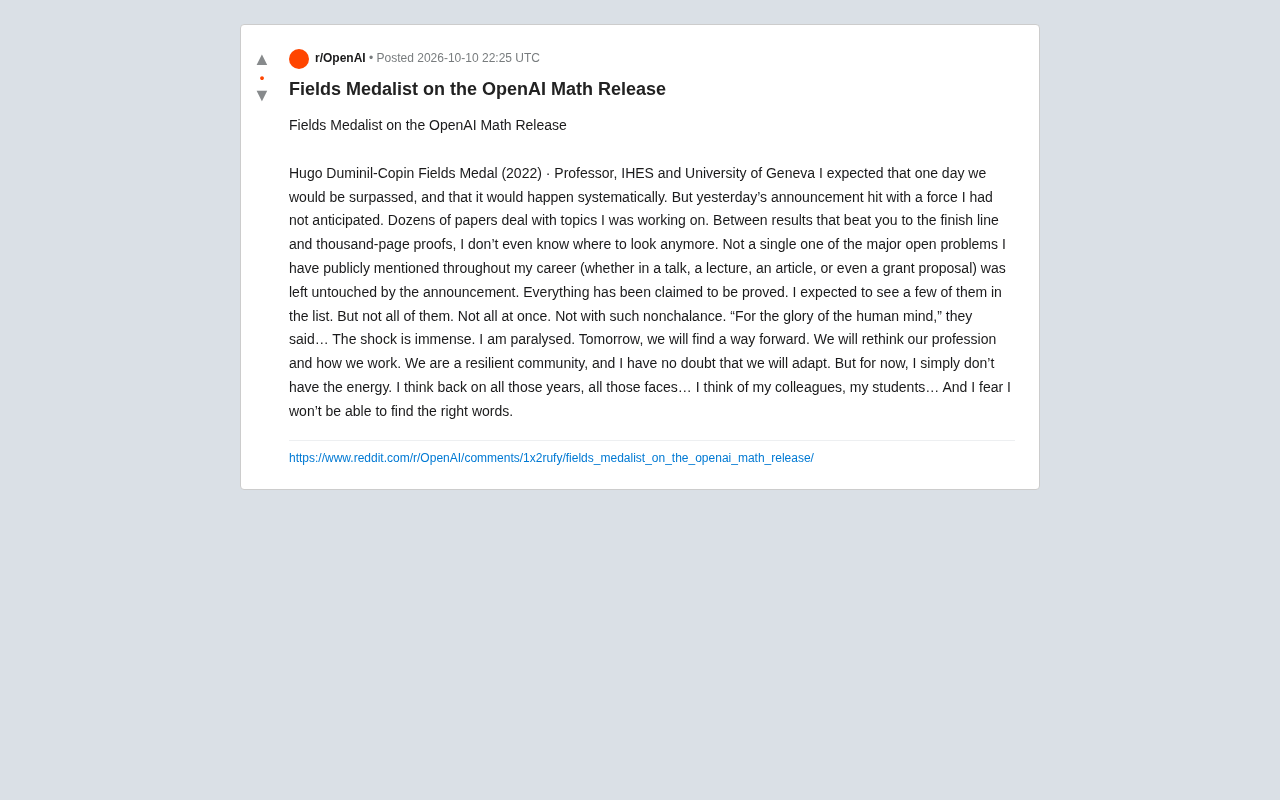
It should be noted that the authenticity and specific context of this statement have yet to be verified. It currently circulates from a single Reddit source and cannot be confirmed as an official statement. But the anxiety it reflects deserves serious consideration.
The Fields Medal is one of mathematics' highest honors, awarded every four years at the International Congress of Mathematicians to researchers under 40 who have made outstanding contributions — often called "the Nobel Prize of mathematics." Duminil-Copin received the award for breakthrough work in percolation theory within statistical physics, proving classical results such as critical exponents for percolation on the two-dimensional square lattice, solving problems that had confounded mathematicians for decades. His research sits at the intersection of probability theory, combinatorics, and mathematical physics — problems that demand both rigor and depth, making his field an important benchmark for evaluating AI's mathematical reasoning capabilities. Understanding this context helps explain why the prospect of "bulk proofs" would hit him so hard: his work is not computational or formulaic mathematics, but structural proof requiring deep conceptual insight.
The Core of the Statement
As described in the text, the speaker expressed emotions that build in layers.
He acknowledged being mentally prepared: "I always expected that one day we would be surpassed, and that this surpassing would be systematic." This reflects a rational anticipation of technological trends. What truly broke him was the manner and scale of that surpassing.
"Dozens of papers on topics I was working on. Some got ahead of me with results, others were thousands of pages of proofs I didn't even know where to begin reading." This paints a picture of being overwhelmed — not that one problem had been solved, but that the entire research landscape had been covered simultaneously.
The line that stung most: "Every major open problem I had publicly mentioned in my career — in talks, lectures, papers, or grant applications — not one was spared. All of them were claimed to be proved."
He had expected to find a few of his problems on the list, not all of them, and certainly not presented in such a "casual" manner all at once.
"For the Glory of the Human Mind"
The statement quotes a phrase — "For the glory of the human mind" — attributed to the mathematician Carl Gustav Jacob Jacobi. It is often invoked to articulate the value of pure mathematics: one studies math not for practical use, but for humanity's understanding of the limits of its own intellect.
When this phrase appears in a context where machines have completed proofs in bulk, the irony is unmistakable. If mathematics derives its glory from the human mind's process of exploration, then when that exploration is outsourced to algorithms, to whom does the glory belong? Much of the speaker's anguish comes from this displacement of meaning — not merely professional competition.
The Real Issues Beneath the Emotion
Setting aside questions of authenticity, the issues this statement raises are real.
Has AI's progress in mathematical proof been overstated? There is a vast gap between "claimed to be proved" and "peer-reviewed proof." Machine-generated proofs require human experts to verify them line by line through formal verification before the mathematics community will accept them. Checking the correctness of a thousand-page proof is itself an enormous undertaking. The word claimed in "claimed to be proved" is precisely what deserves the most scrutiny.
Rethinking the meaning of a research career. The speaker says, "Tomorrow we will find a way forward, we will rethink this profession and how we work." Even if AI could genuinely produce proofs in bulk, mathematicians' roles in posing valuable questions, judging the significance of results, and building conceptual frameworks would remain difficult to replace. Advances in tools tend to reshape disciplines rather than eliminate them.
The resonance of shared anxiety. This statement spread widely on Reddit precisely because it voiced the hidden unease of many researchers. Whoever wrote it, the fear that "everything I've spent my life learning could be matched in an instant" is the shared emotional landscape of knowledge workers in the age of AI.
"Formal verification" is the critical threshold for evaluating AI-generated mathematical proofs. Traditional mathematical proofs are written in natural language and verified through peer review relying on human intuition; formal proofs require each step of reasoning to be translated into a symbolic language mechanically checkable by computer, such as the languages used by proof assistants like Lean, Coq, or Isabelle. Verifying the correctness of a thousand-page machine-generated proof, if not formally verified, can itself require months or even years of human effort. In recent years, systems like DeepMind's AlphaProof have begun combining neural networks with formal proof systems, but what they can independently accomplish remains largely limited to competition-level problems. The significance of the phrase "claimed to be proved" lies precisely in the fact that, before formal verification is complete, any "proof" in mathematics is merely a claim — not an established fact.
How to Approach Such Rumors
When encountering statements attributed to public figures on social media, caution is warranted. This text currently lacks authoritative sourcing, and it cannot be ruled out that it represents personal reflections, creative reworking, or someone else's views expressed under a borrowed name. Until institutions like OpenAI publish specific results and proof details that can be independently verified, claims that "all major open problems have been solved" should be treated with skepticism.
The more constructive attitude may be to treat this text as a mirror: it reflects the genuine anxiety within the research community under technological pressure, and reminds us that the standard for measuring AI's mathematical capabilities should not be "how many proofs are claimed" but "how many proofs hold up to scrutiny and advance understanding."
Duminil-Copin (whether or not these words are truly his) wrote at the end: "We are a resilient community, and I have no doubt we will adapt." Perhaps that is the line most worth remembering — the shock will pass, adaptation will happen, and humanity's curiosity about truth will not disappear just because our tools have changed.
Related articles

Felix Rieseberg Personal Homepage
Felix Rieseberg's personal homepage sparks attention on Hacker News. This article covers the Slack engineer's technical background, the rise and fall of nativefier, and the value of a developer homepage as a tech calling card.

@ai-sdk/vue 3.0.306 Patch Release Syncs with [email protected] Update
@ai-sdk/vue 3.0.306 released, synced with [email protected]. A routine patch release for the Vercel AI SDK ecosystem with no public API changes; the Vue adapter layer stays version-aligned with the core package.

Gemini 4 Argon API Launches: The Era of Million-Token Output Begins
Google launches Gemini 4 Argon with sparse MoE architecture, up to 1M output tokens, and a 68.90% Vals Index score, available across API, AI Studio, and the Gemini app.