A Gaming Newbie Makes an RPG with AI: Full-Pipeline AI Development of 'Still Haven't Ascended'

A gaming newbie uses AI tools to independently develop a 2D ARPG demo, revealing AI's potential and limits in game dev.
A self-described "gaming newbie" used a suite of AI tools to independently build a demo for the xianxia-themed 2D ARPG *Still Haven't Ascended*. The project showcases deep AI integration across scene generation with intelligent layering, frame-by-frame animation, and LLM-driven dynamic expression dialogue — proving that AI can both lower the entry barrier for game development and automate complex workflows, while also exposing real limitations like frame-to-frame inconsistency.
A self-described "gaming newbie" independently developed a demo for a 2D ARPG called Still Haven't Ascended (今天也没飞升) using a variety of AI tools. From scene generation to character expressions and a dynamic dialogue system, this project demonstrates both the enormous potential of AI in indie game development and the real limitations of current technology.
Game Overview: A Xianxia-Themed Survivor-Style ARPG
Still Haven't Ascended is a 2D top-down ARPG, currently at version v0.0.1. The story follows protagonist Lu Xingzhou, a villager who dreams of ascending to immortality while doing his best to exorcise demons and ghosts for his community — until he encounters a nameless beggar who gives him a strange artifact, setting him on a grand journey where the line between good and evil blurs.
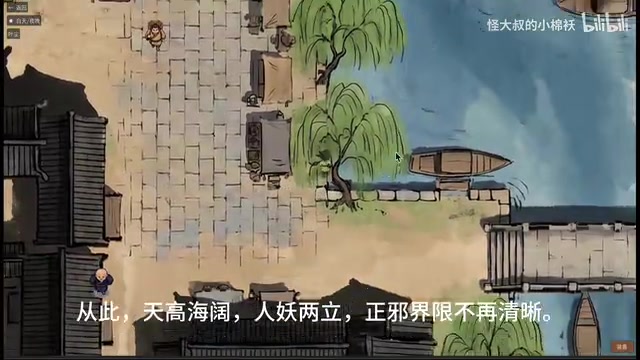
The game combines "survivor-style" mechanics with a formation-based ARPG, driven primarily by narrative progression. The "survivor" subgenre traces its roots to the 2020 indie hit Vampire Survivors — a game built around minimal controls (auto-attacking characters, player only controls movement), randomized skill progression, and intense bullet-hell combat that spawned countless imitators worldwide. Its core design philosophy is the "Build": each run, players choose from random skills and upgrade paths to create a unique character configuration, making every session feel different. Blending this fast-paced, randomized combat with traditional RPG linear storytelling means the developer had to find a balance between two very different pacing sensibilities — a non-trivial design challenge, and all the more impressive coming from a self-described beginner.
Five Elements Skill System: Simple Yet Deep
The game's skill system is built on the five Chinese elements — Metal, Wood, Water, Fire, and Earth — from which six advanced elemental types are derived, creating a layered skill hierarchy. Skills are divided into active and passive categories, each requiring players to equip them in a limited number of skill slots.
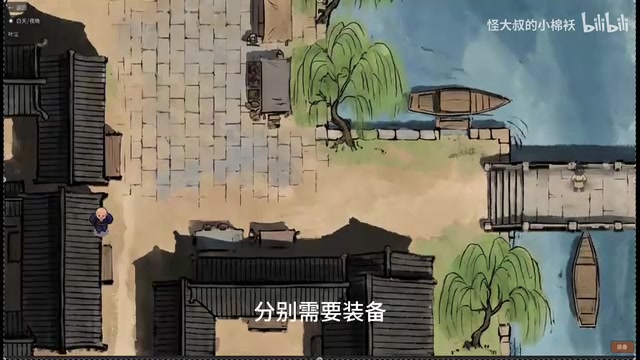
The limited skill slot design is a smart choice — it forces players to make meaningful trade-offs from a rich skill pool, turning pre-battle build construction into a strategic exercise in itself. This "less is more" philosophy complements the survivor genre's random skill acquisition mechanic in an interesting way: randomness brings surprise, while limited slots create tension through trade-offs.
Full AI Pipeline: Scenes, Animation, and Character Expressions
What makes this project most noteworthy is the deep integration of AI technology across every stage of game development.
Scene Generation and Intelligent Layering
The game uses a near-top-down perspective, with all scenes fully AI-generated and processed through automated layer extraction and rendering. The system can automatically define walkable areas, extract water regions, and apply water surface effects.
The core technology behind this is semantic segmentation — AI models that can identify the semantic category of different regions in an image (ground, water, obstacles, buildings, etc.) and automatically generate corresponding mask layers. Modern segmentation models like Meta's SAM (Segment Anything Model) can partition complex scenes with minimal human intervention. Combining this capability with a game engine's layer system creates a "generate-and-deploy" scene asset pipeline — developers no longer need to manually mark collision bodies and effect zones pixel by pixel; AI handles the bulk of that tedious groundwork.
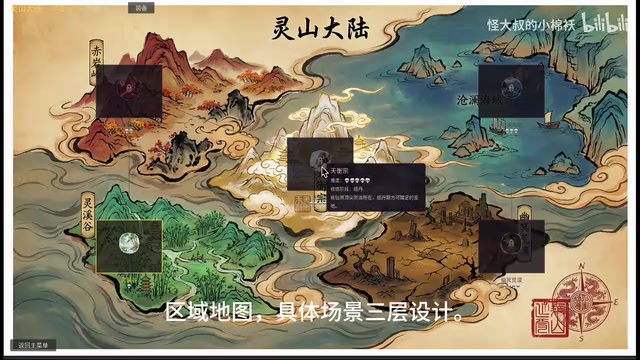
The map is structured across three levels — world map → regional map → local scene — divided into five major areas with difficulty increasing clockwise. This classic open-world zone design, paired with AI-generated scene assets, dramatically lowers the barrier to producing art resources.
An Honest Reflection on Animation Generation
For character animation, the developer used AI to generate frame-by-frame sprite images, but candidly acknowledged that "noticeable flaws remain." He also offered a valuable technical insight: using video generation AI rather than image generation AI for animation would likely yield better results.
There's a deep technical reason behind this observation. Image generation AI models (such as Stable Diffusion or Midjourney) sample each frame independently — even with identical prompts and seeds, subtle variations in facial features, clothing textures, and lighting direction accumulate across frames, producing noticeable flickering and character inconsistency. Video generation models (such as Runway Gen-3 or Kling), on the other hand, enforce temporal coherence constraints: each frame is generated with reference to neighboring frames, ensuring consistent motion trajectories and visual style. For sprite animation — which demands strict frame-to-frame consistency — the architectural advantage of video generation models is fundamental, not something that can be bridged through prompt engineering alone.
LLM-Driven Dynamic Expression Dialogue
The game uses AI to generate a rich set of portrait expressions for all main characters and NPCs, and employs a large language model (LLM) to automatically match each line of dialogue to the appropriate emotional expression.

The elegance of this design lies in the fact that it doesn't just use AI to generate static assets — it brings AI into real-time runtime decision-making. In traditional game development, switching character expressions requires artists and designers to manually annotate every line of dialogue with an emotion tag, an extremely tedious process that becomes unmanageable when dialogue is dynamically generated. The LLM's sentiment analysis capability can understand the context, tone, and emotional nuance of a line of dialogue, then select the best-matching expression from a predefined library in real time. The typical implementation involves sending the dialogue text to the LLM and asking it to return a structured emotion tag (e.g., in JSON format), which the game engine then uses to swap the corresponding expression asset. This pattern of "LLM as a runtime inference engine" makes character dialogue feel genuinely alive. The improvised dialogue stories shown in the demo confirm that this system works in practice.
Lessons and Limitations of AI Game Development
As an early v0.0.1 demo, Still Haven't Ascended already exceeds what one might expect from a "gaming newbie." It demonstrates at least a few important things:
AI lowers the barrier to entry for game development. Tasks that traditionally required a professional art team — scene artwork, character portraits, expression systems — can now be handled by a single person using AI tools to produce a functionally usable result.
AI's value lies not just in generating assets, but in automating workflows. Automatic layer rendering, automatic walkable area annotation, automatic expression matching — these "automation
Related articles
 Product Reviews
The Programmer's Desk Setup Guide: Building a Workspace That Feels Like Home
Discover how programmers build productive, comfortable workspaces. From multi-monitor setups to ergonomic design, explore the desk philosophy that drives focus and flow.
 Product Reviews
Qoder vs Cursor Real-World Comparison: Which $20/Month AI IDE Is Better?
Hands-on comparison of Qoder vs Cursor AI IDEs: Agent autonomy, human interaction count, and architecture decisions. Qoder needed only 2 interactions vs Cursor's 8.
 Product Reviews
Cursor Cloud Agent Demo: Eliminating Bottlenecks Across the Entire Software Development Lifecycle
Deep analysis of Cursor's Cloud Agent demo showing how cloud VMs, automated test artifacts, and a full-chain control plane systematically eliminate human bottlenecks across the software development lifecycle.