A Go Developer's Guide to Gemini: Complete Model Family Breakdown

A comprehensive guide helping Go developers understand and choose the right Gemini model for their projects.
This article provides Go developers with a complete overview of Google's Gemini model family, covering the Pro vs Flash series selection strategy, native multimodal capabilities, official Go SDK integration points, and token management practices. It offers practical model selection guidance based on latency, reasoning complexity, cost, and multimodal needs, including a hybrid routing architecture pattern for production environments.
Introduction: Why Go Developers Should Pay Attention to Gemini
As large language models (LLMs) become core components of modern application development, integrating AI capabilities within specific programming language ecosystems has become a key focus for developers. LLMs have evolved from research tools to production-grade application components through several critical stages—the release of ChatGPT in 2022 marked a turning point for LLMs moving from academia to engineering practice. Today, LLMs are widely embedded in search engines, code editors, customer service systems, and data analysis pipelines. For backend developers, LLMs are no longer as simple as "calling an API"—they involve a series of engineering challenges including prompt engineering, context management, output parsing, cost control, and latency optimization. Go's excellent concurrency model, compilation speed, and deployment simplicity make it particularly well-suited for building high-throughput AI middleware services.
For Go developers, Google's Gemini model family offers a solution worth exploring in depth.
As the first part of the Gemini for Go Developers series, this article focuses on the overall structure of the Gemini model family, helping Go developers build a clear understanding of this AI capability matrix and laying the foundation for subsequent integration and development work.
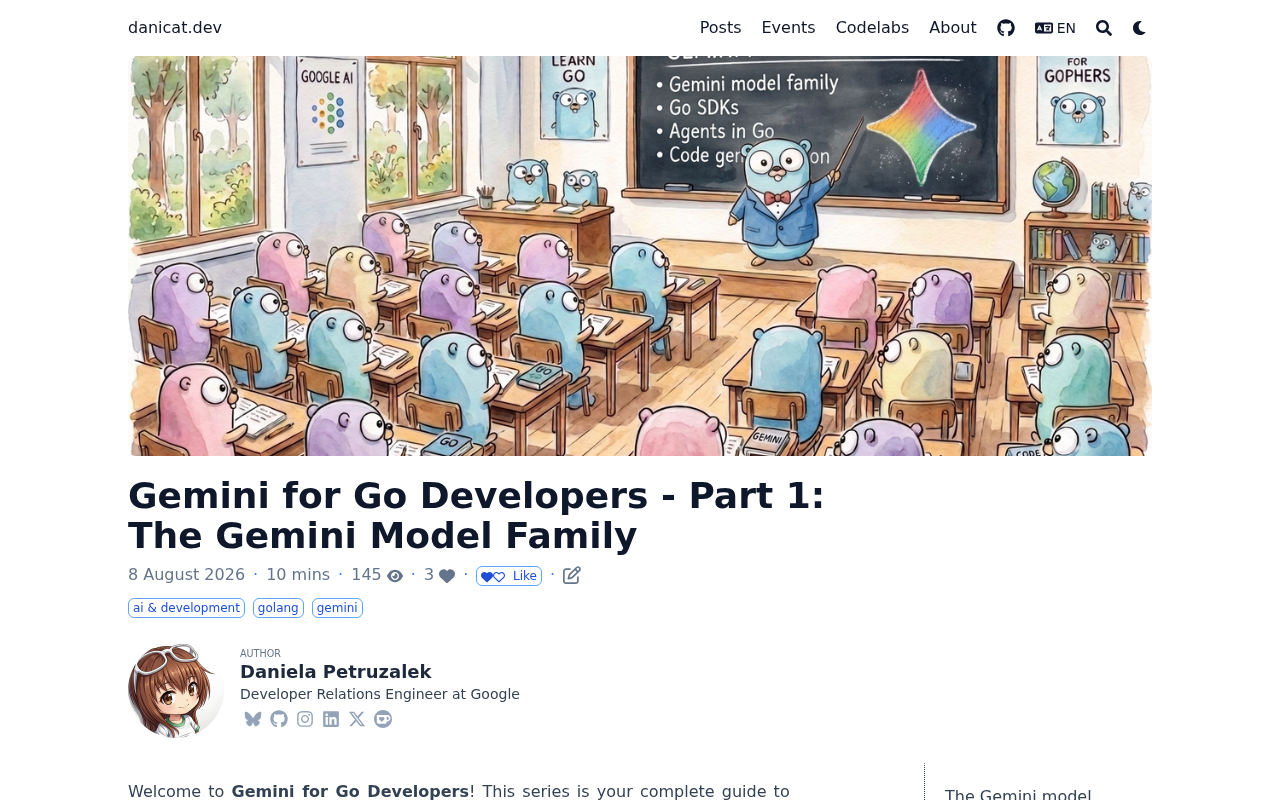
Gemini Model Family Overview
Gemini is not a single model but a series optimized for different use cases. Google designed this family with diverse needs in mind, ranging from edge devices to large-scale cloud inference. Understanding the differences between variants is a prerequisite for using the Gemini API effectively.
From a technical architecture perspective, Gemini is built on research from the Google DeepMind team and employs an improved Transformer architecture. Unlike earlier GPT series models, Gemini was designed from the ground up with multimodality as a core objective, rather than bolting visual capabilities onto a text-only model. Its training data spans text, code, images, audio, and video, enabling the model to establish more natural associations across different modalities. The introduction of Mixture of Experts (MoE) technology allows the model to maintain a large parameter count while activating only a subset of parameters during each inference pass, striking a balance between performance and computational efficiency.
Pro vs. Flash: Balancing Performance and Cost
The Gemini family typically includes flagship versions for high-performance reasoning and lightweight versions optimized for speed and cost.
- Flagship versions (Pro series): Feature stronger reasoning capabilities, longer context windows, and better multimodal understanding. Ideal for complex tasks such as code generation, long document analysis, and complex logical reasoning.
- Lightweight versions (Flash series): Heavily optimized for response speed and call cost. Suitable for high-concurrency, low-latency scenarios such as real-time conversations, content classification, and simple Q&A.
For Go developers, this layered design means you can flexibly choose models based on actual business needs—use Flash for high-frequency lightweight requests and Pro for critical tasks requiring deep understanding—achieving the optimal balance between performance and cost.
Multimodal Capabilities: Beyond Pure Text Processing
A key feature of modern Gemini models is native multimodal support, capable of simultaneously processing text, image, audio, and even video inputs. This opens up space for Go developers to build richer applications, such as intelligent customer service with image recognition or automated processing systems based on document scanning.
It's worth noting that multimodality isn't simply concatenating different data types before feeding them to the model. Gemini's multimodal architecture allows the model to perform Cross-Attention computation across different modalities during the encoding stage. This means the model can understand the semantic relationship between a specific region in an image and a text description, rather than processing them separately and combining results afterward. For Go developers, this means you need to pay attention to the encoding formats for different modalities (such as Base64-encoded images and audio at specific sample rates) as well as the token consumption ratios across modalities when constructing multimodal requests.
Technical Considerations for Integrating Gemini with Go
The Core Value of the Official Go SDK
Google provides an official Gemini client library for Go (github.com/google/generative-ai-go), which significantly lowers the integration barrier. Compared to manually constructing HTTP requests, the official SDK encapsulates tedious details like authentication, request serialization, and streaming response handling, allowing developers to focus more on business logic.
From a technical implementation standpoint, the SDK is built on gRPC and Protocol Buffers, consistent with how Google's internal services communicate. The SDK supports two authentication methods: API Key and OAuth 2.0—the former is suitable for rapid prototyping, while the latter is ideal for production environments integrating with Google Cloud IAM. Streaming responses are implemented through Go's iterator pattern, allowing developers to begin processing partial output before the model finishes generating, which is critical for building real-time chat interfaces or progressive content generation.
For Go developers accustomed to strong typing and explicit error handling, the official SDK follows Go's idiomatic patterns, returning explicit error values that facilitate robust error handling and retry logic design.
Context Windows and Token Management
Different Gemini models have different context window sizes. The context window refers to the maximum number of tokens the model can process in a single inference. Tokens are the smallest units produced when text is split by a tokenizer—an English word typically corresponds to 1-3 tokens, while Chinese characters usually correspond to 1-2 tokens each. Gemini 1.5 Pro supports a context window of up to 1 million tokens, meaning you can input an entire book or large codebase in one go. However, longer contexts mean higher computational costs and latency.
When handling long texts in Go applications, developers need to pay attention to token counting and truncation strategies. Proper context management affects not only output quality but also directly impacts API call costs. Developers need to implement intelligent truncation, summarization, or RAG (Retrieval-Augmented Generation) strategies on the input side—first using vector retrieval to find the most relevant document fragments, then feeding them as context to the model—to find the optimal balance between information completeness and cost.
It's recommended to establish a token budget mechanism in production environments, preprocessing and monitoring inputs to avoid request failures or unnecessary charges from exceeding limits. The Gemini SDK provides a CountTokens method that allows developers to precisely calculate the token count of inputs before sending requests. In Go engineering practice, this can be encapsulated as a middleware layer that uniformly manages token budgets for all outbound requests.
Model Selection Recommendations: Choosing the Right Gemini Model for Your Go Project
In real projects, model selection should be weighed across the following dimensions:
- Latency requirements: For real-time interaction scenarios, prioritize the Flash series. Flash models' Time to First Token (TTFT) is typically 50%+ lower than Pro, which makes a significant difference in user perception.
- Reasoning complexity: Tasks involving multi-step reasoning or code generation should use the Pro series. Pro models perform notably better on tasks requiring Chain-of-Thought reasoning.
- Cost budget: In high-frequency call scenarios, lightweight models can significantly reduce operational costs. Calculated per million tokens, Flash series input pricing is typically only 1/10 to 1/5 of Pro.
- Multimodal needs: If you need to process images, audio, etc., confirm the multimodal support scope of your chosen model.
A pragmatic approach is to adopt a "hybrid model" strategy: dynamically route requests to different models within the same Go application based on request type, ensuring quality for critical tasks while controlling overall costs. This hybrid model routing is a common architectural pattern in production environments, with the core idea being to dynamically select the most suitable model based on request characteristics (such as input length, task type, user tier). In Go, this is typically implemented through a Router layer that makes decisions based on a rules engine or lightweight classifier. For example, you can first use a Flash model to assess the complexity of user intent, and if deep reasoning is detected, forward the request to a Pro model. This cascading approach can reduce overall API costs by 40%-70% while maintaining user experience.
Conclusion
As the opening article of this series, this piece has outlined the overall landscape of the Gemini model family and its significance for Go developers. Understanding model layering, multimodal capabilities, and selection strategies is the first step toward building high-quality AI applications.
In subsequent chapters, the series will dive deeper into practical topics such as specific API calls, streaming response handling, Function Calling, and production environment deployment. Function Calling is a capability particularly worth Go developers' attention—it allows the model to automatically decide to invoke predefined functions based on user requests and return function parameters in a structured format. This naturally aligns with Go's strongly-typed design philosophy, enabling the construction of type-safe AI Agent systems.
For developers looking to integrate AI capabilities into Go services, this is a technical path worth following closely.
Note: This article is based on a technical article shared on Hacker News. Given the rapid iteration of Gemini models, please refer to Google's official documentation for specific model specifications.
Related articles

JobRunner MCP Server: AI Agents Can Now Fix Failed Java Jobs
JobRunner launches an open-source MCP server enabling AI agents to view cluster status, diagnose failures, and recover Java jobs—incident response from any cloud coding environment or existing agent.

MLAI Digital Launches 9 Security Agents: MCP Server Safeguards the Full Lifecycle of Agentic AI
MLAI Digital launches Security MCP Server with nine built-in specialized security agents covering vulnerability discovery, attack simulation, prompt injection detection, API and infrastructure assessment, and accelerated remediation—embedding security validation across the full Agentic AI lifecycle from development to production.

Running Isaac Lab on H100 GPUs: Exploring Better Approaches
Exploring optimization methods for running Isaac Lab on NVIDIA H100 GPUs, including MIG configuration, mixed precision, TensorRT acceleration, and community experience to improve robotics simulation and reinforcement learning efficiency.