A Go Robotics Framework Built on NATS.io: How Distributed Messaging Is Reshaping Robot Architecture

Go + NATS.io offers a lightweight, cloud-native robotics architecture as a compelling alternative to the ROS ecosystem.
This article examines an open-source robotics framework built with Go and NATS.io. Go's goroutine concurrency model aligns well with robotics' parallel processing needs, while its static compilation simplifies deployment on edge devices like Raspberry Pi. NATS.io decouples modules via pub/sub and adds persistence through JetStream. Compared to ROS 2's DDS-based approach, the combination is lighter and easier to deploy — especially for cloud-edge coordination, multi-robot systems, and resource-constrained environments. The project is still early-stage, but its approach of replacing dedicated robotics middleware with cloud-native messaging offers meaningful architectural inspiration.
A Technical Direction Worth Watching
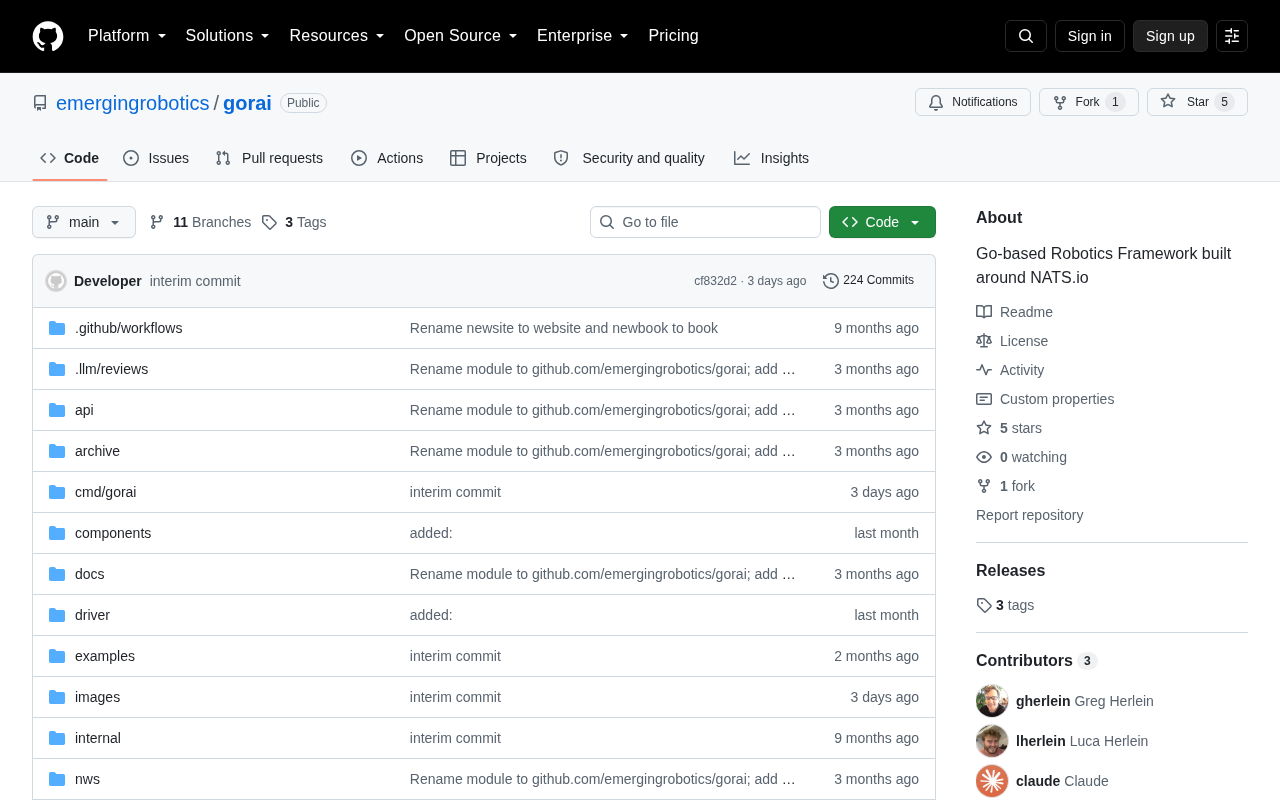
An open-source project that recently appeared on Hacker News has sparked discussion in the technical community: a robotics development framework built with Go and centered around the NATS.io messaging system. Despite modest traction (6 points, no comments at the time), the architectural thinking it represents offers genuine food for thought for developers who care about robotics software design.
It's worth noting upfront that publicly available information about this project is limited. This article is less a detailed review of its implementation and more an exploration of the design philosophy and potential significance of this type of framework.
Why Go + NATS.io?
At its core, a robotics system is a highly distributed software engineering problem with real-time and reliability demands. Modules for sensor acquisition, motion control, decision planning, and status reporting often run in separate processes or even on separate compute nodes — all requiring efficient, low-latency communication.
Go's Natural Advantages
Go's concurrency model is a key reason it's well-suited for building a robotics framework. goroutines and channels let developers manage hundreds or thousands of concurrent tasks with relatively clean code — a natural fit for the many parallel perception and control loops in a robotics system. Go's static compilation also makes cross-platform deployment straightforward: a single binary can run directly on edge devices like a Raspberry Pi or industrial PC without complex runtime dependencies.
NATS.io as the Messaging Backbone
NATS.io is a high-performance, cloud-native messaging system known for being lightweight, low-latency, and easy to deploy. Using it as the communication backbone of a robotics framework means system modules are decoupled via a publish/subscribe (pub/sub) model: a control module doesn't need to know which specific sensor produced the data — it simply subscribes to the relevant subject. This loose coupling dramatically improves scalability and maintainability.
NATS also supports request/reply patterns and JetStream persistent messaging. The former is well-suited for command dispatch scenarios that require acknowledgment; the latter addresses use cases like state logs and task queues where reliability matters.
JetStream is a persistent message streaming feature introduced in NATS 2.2, built on top of core NATS. Unlike the traditional "fire-and-forget" model, JetStream supports persistent message storage, consumer acknowledgments (ACK), message replay, and flow rate limiting — essentially a lightweight Kafka or RabbitMQ. In robotics contexts, this capability is particularly valuable: if a module goes briefly offline due to network instability or a restart, JetStream ensures it won't miss sensor data or control commands produced during that window, improving overall system reliability.
Comparison with Traditional Robotics Middleware
Any discussion of robotics communication frameworks must address ROS (Robot Operating System) and its successor, ROS 2. ROS 2 uses DDS (Data Distribution Service) as its underlying communication standard — powerful, but complex to configure, with a steep learning curve and limited friendliness toward resource-constrained edge devices.
By contrast, a NATS.io-based approach is considerably lighter in deployment and operations. The NATS server is a single, small binary; cluster setup is straightforward; and it's naturally suited to containerized and cloud-edge hybrid environments. For teams looking to rapidly prototype or build distributed systems that coordinate cloud services with physical robots, this stack offers a meaningful alternative to the ROS ecosystem.
That said, this comparison isn't about replacement. The ROS ecosystem has deep reserves of algorithm libraries, simulation tools, and hardware drivers. A Go + NATS framework is, for now, more of a lightweight choice tailored to specific engineering needs.
DDS (Data Distribution Service) is an industrial communication standard from the OMG consortium and serves as the core of ROS 2's communication layer. DDS offers rich Quality of Service (QoS) policies — covering reliability, history, deadlines, and dozens of other parameters — enabling fine-grained control over real-time data streams. It's widely used in aerospace and industrial automation where determinism is critical. The trade-off is significant configuration complexity: developers must understand a large number of QoS parameters and their interactions, and compatibility differences between DDS implementations (e.g., Fast DDS, Cyclone DDS) make ROS 2 noticeably less approachable than lightweight alternatives for rapid prototyping or resource-constrained scenarios.
What Scenarios Fit This Kind of Framework?
Based on its technical characteristics, this type of framework is likely most compelling in the following contexts:
- Cloud-edge robotics systems: NATS's cloud-native DNA makes communication between the robot and cloud services feel natural, well-suited for applications requiring remote monitoring or fleet scheduling.
- Multi-robot coordination: The pub/sub model inherently supports one-to-many and many-to-many message distribution, making coordination logic across a shared message bus relatively clean.
- Resource-constrained edge deployments: Go's compiled output size and NATS's lightweight footprint together lower the barrier to running on low-power devices.
A Realistic Assessment of Maturity
As an open-source project with limited community traction, this framework is still in early stages. Whether it has a robust hardware abstraction layer, an active maintainer community, and sufficient documentation and examples are all critical factors in evaluating its usability — none of which can be determined from currently available information.
For developers, its value may lie more in the architectural inspiration it offers: replacing purpose-built robotics middleware with a mature cloud-native messaging system is an engineering approach worth exploring. Whether it's ready for production depends on validation against specific project requirements.
Summary
Go's concurrency capabilities and developer ergonomics, combined with NATS.io's high-performance messaging, offer a lightweight, modern architectural option for robotics software. It may not be a wholesale replacement for a mature ecosystem like ROS, but in specific domains — cloud-edge coordination, multi-robot collaboration — it shows genuine potential. For engineering teams focused on building production-quality robotics systems, this direction is worth keeping an eye on.
Related articles

Chain of Thought Isn't Just for AI: How Humans Can Use CoT to Improve Thinking Quality
Chain of Thought isn't just a prompt trick for large models. Starting from a Hacker News discussion, this article analyzes why CoT works for human thinking too, breaks down actionable ways to transfer it, and highlights the key differences between human CoT and machine CoT.
Cloudflare Teams Up with OpenAI: Closi…
Cloudflare Teams Up with OpenAI: Closing the Loop from Vulnerability Discovery to Defense with AI
Cloudflare uses OpenAI Daybreak to investigate security vulnerabilities and generate reviewable remediation plans, while developers use Codex to boost coding efficiency and quality.

Orca Multi-Agent Orchestration in Practice: A Guide to Parallel Collaboration with Claude and Codex
Orca is Stable AI's free open-source agent workbench supporting 34 agents like Claude Code and Codex in parallel. Learn its Git worktree isolation, multi-model orchestration, and mobile management.