A Guide to Group Study for Deep Learning: A 60-Day Learning Community in Practice
A practical guide to forming small study groups for a structured 60-day deep learning journey.
Inspired by a Reddit post from a CS student seeking study partners, this article explores why learning deep learning alone is so difficult and how lightweight learning communities of 2-4 people can dramatically improve completion rates. It provides a detailed 60-day roadmap covering neural network basics through Transformers, along with group formation principles, weekly goal-setting strategies, and the psychology behind why accountability partners work.
A Student's Real Dilemma
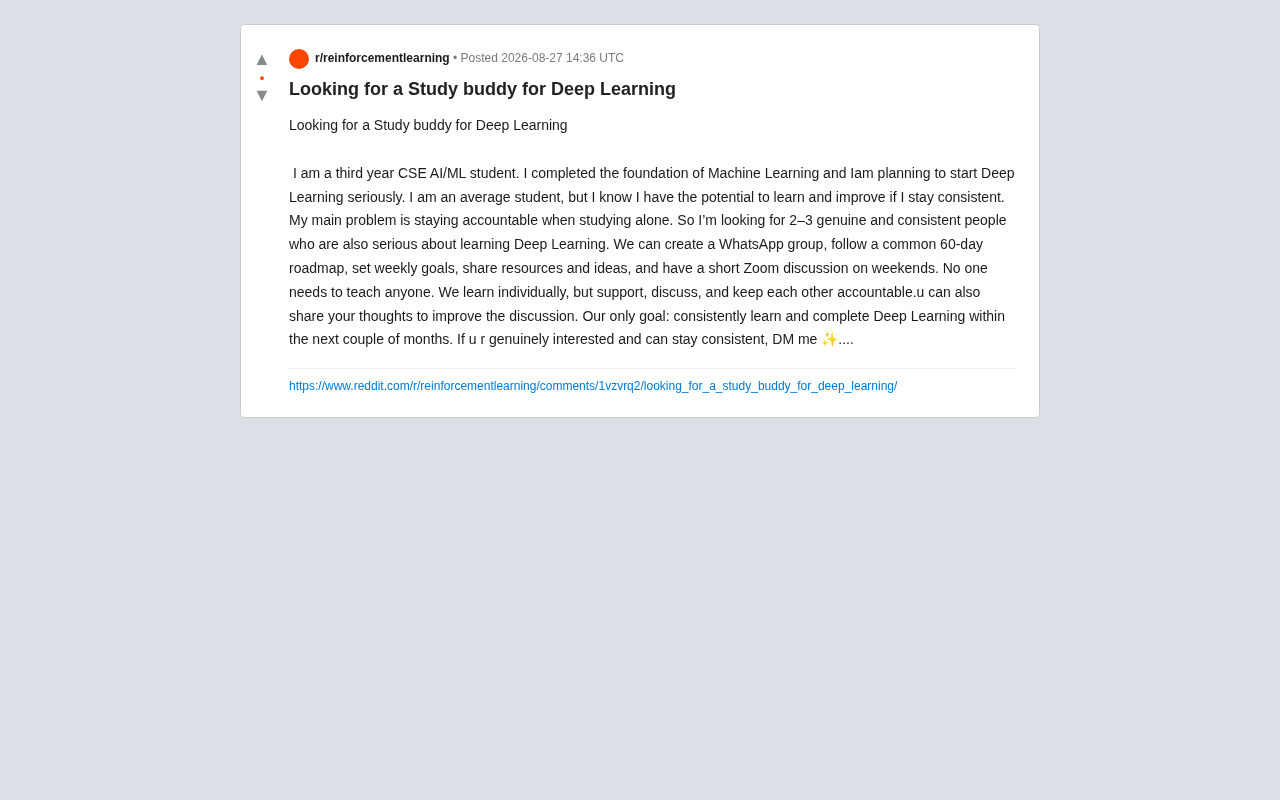
Recently, a junior studying Computer Science with a focus on AI/ML posted on Reddit looking for a "study buddy." He candidly shared that he had already completed the fundamentals of machine learning and was ready to systematically tackle deep learning, but faced a core problem that every self-learner encounters — it's incredibly hard to stay disciplined when studying alone.
His request was simple yet highly relatable: he wanted to find 2-3 partners who were equally serious and committed for the long haul, to follow a unified 60-day study roadmap together, set weekly goals, share resources and ideas, and hold brief Zoom discussions on weekends. He specifically emphasized: "Nobody needs to teach anyone. We each study independently, but we support, discuss, and hold each other accountable."
This seemingly ordinary help-seeking post actually reflects a widely overlooked yet crucial issue in today's AI learning wave: the biggest barrier to technical learning is often not intelligence, but consistency.
Why Learning Deep Learning Alone Is So Difficult
Deep learning is a discipline with a steep learning curve. It demands not only a solid mathematical foundation (linear algebra, calculus, probability theory), but also proficient programming skills, mastery of frameworks (such as PyTorch and TensorFlow), and extensive hands-on experimentation.
The mathematical foundation here is far from abstract. Linear algebra is the cornerstone for understanding neural network weight matrix operations and high-dimensional space transformations — every forward pass is essentially a cascade of matrix multiplications and nonlinear transformations. Calculus (particularly multivariable calculus and the chain rule) is central to understanding the backpropagation algorithm. Probability and statistics underpin loss function design, regularization strategies, and advanced topics like Bayesian methods. These three mathematical pillars are all indispensable, yet most online courses tend to skip rigorous mathematical derivations, leaving learners unable to truly understand what's happening when they later encounter research papers or complex architectures.
As for framework selection, PyTorch and TensorFlow are the two dominant tools in deep learning today. PyTorch, developed by Meta (Facebook), is known for its dynamic computation graphs and Pythonic programming style, and dominates the academic research landscape — over 80% of papers at top conferences currently use PyTorch implementations. TensorFlow, developed by Google, offers a more comprehensive production deployment toolchain (such as TensorFlow Serving and TensorFlow Lite) and remains widely used in industry. While the two have been converging in recent years, the community generally recommends beginners start with PyTorch, as its debugging is more intuitive and its learning curve is gentler.
This learning path is long and often tedious, especially in self-study scenarios that lack immediate feedback, making it all too easy to fall into a pattern of inconsistent effort.
The Three Traps of Studying Alone
The first is the lack of accountability. When nobody knows whether you studied today, the cost of giving up is essentially zero. This student pinpointed his pain point precisely — "not being able to stay accountable when studying alone."
The second is the tendency to give up when hitting a wall. Many concepts in deep learning are bewildering at first encounter. Take backpropagation as an example: it's the core algorithm for training neural networks, essentially a systematic application of the chain rule on a computation graph — starting from the loss value at the output layer, computing the gradient of each parameter layer by layer back toward the input, then using gradient descent to update the weights. The vanishing gradient problem refers to gradients decaying exponentially as they propagate backward through deep networks, causing parameters near the input layer to barely update and training to stagnate. ReLU activation functions, residual connections (ResNet), and batch normalization are all classic solutions to this problem. As for the attention mechanism, it allows models to dynamically "focus" on the most relevant parts of the input when processing sequential data, and is the core component of modern large language models. These concepts require not only mathematical derivation skills but also hands-on training experience to observe loss curves and gradient distributions to build intuition — and the frustration of working through them alone is often amplified infinitely when there's no one to talk to.
The third is the confusion of resource selection. The internet is flooded with deep learning tutorials, from Andrew Ng's courses to various open-source projects. Beginners easily fall into the information anxiety trap of "bookmarking everything but never actually studying."
Learning Communities: A Proven Effective Learning Model
The approach this student proposed is essentially a lightweight learning community (Study Group). This model is known in educational psychology as "social learning," and its effectiveness has been confirmed by extensive research.
The theoretical foundation of social learning traces back to psychologist Lev Vygotsky's "Zone of Proximal Development" theory and Albert Bandura's social learning theory. Vygotsky argued that learners can reach cognitive levels with the assistance of peers or mentors that they could never achieve studying alone. Bandura emphasized the power of observational learning and social modeling — simply witnessing peers' success and effort is itself a powerful motivator. Modern online education research confirms this as well: data from platforms like Coursera and edX show that users who join discussion forums and study groups see course completion rates rise from an average of 5-10% to over 30%, with participants in learning communities completing courses at 3-5 times the rate of pure self-learners.
The Clever Design of This Approach
Credit where it's due — his plan is quite pragmatic and executable:
- Unified roadmap: A shared 60-day plan ensures everyone stays in sync, avoiding fragmented individual efforts.
- Weekly goals: Breaking down an ambitious learning objective into measurable short-term tasks, following the SMART framework. The SMART framework is the most widely used goal management methodology, requiring goals to have five characteristics: Specific — not "learn deep learning" but "complete a CIFAR-10 image classification project"; Measurable — with clear criteria to determine completion; Achievable — attainable within current capabilities; Relevant — directly connected to the ultimate learning objective; Time-bound — with a clear deadline.
- Weekend discussions: Brief Zoom meetings maintain communication without becoming a burden.
- Equal standing: The stipulation that "nobody needs to teach anyone" is crucial — it eliminates utilitarian motives and hierarchical pressure, allowing every member to participate as equals.
The elegance of this design lies in its grasp of the core mechanism of self-discipline — external commitment. Psychological research shows that when we publicly commit to a goal in front of others, the probability of completion increases significantly. And the fixed weekly discussions create a natural "deadline" that compels members to stay engaged.
How to Build Your Own Deep Learning Study Group
Inspired by this approach, anyone looking to systematically learn deep learning can adopt this model. Here's a practical guide for forming your own group.
Group Formation Principles
Keep it small. 2-4 people is the ideal size. Too many people leads to diffusion of responsibility (the social loafing effect), which actually reduces each person's sense of commitment. The social loafing effect was formally identified by social psychologist Bibb Latané in 1979 through the classic "tug-of-war experiment." The experiment found that as team size increases, each member's individual effort actually decreases — in two-person groups, each person exerted about 93% of their maximum individual effort, while in eight-person groups, this dropped to 49%. The root causes are diffusion of responsibility and the inability to identify individual contributions. In study group settings, when the number exceeds 4-5 people, some members tend to develop a "free-rider" mentality, assuming their absence or slack won't be noticed. Therefore, a small group of 2-4 people is the best strategy for combating social loafing, as each person's participation is highly visible.
Match skill levels. Look for partners with similar backgrounds and goals to avoid frustration or disengagement caused by large differences in progress.
Screen for sincerity and persistence. As the original post emphasized, a participant's attitude matters more than their ability. Consider setting up a short "commitment period" early on to filter for truly serious members.
A 60-Day Deep Learning Roadmap Reference
-
Weeks 1-2: Review mathematical foundations and neural network principles; master basic PyTorch/TensorFlow operations. The focus of this phase is building a solid foundation — understanding the complete pipeline of forward propagation, loss functions, and gradient descent, and being able to manually implement a simple multilayer perceptron in code.
-
Weeks 3-4: Dive deep into Convolutional Neural Networks (CNNs) and complete a hands-on image classification project. CNNs are the foundational architecture of deep learning in computer vision. Their core innovation is that convolutional layers use local receptive fields and weight sharing to drastically reduce parameter count while naturally providing translation invariance. The evolution of CNNs is itself a microcosm of deep learning history: from LeCun's LeNet-5 recognizing handwritten digits in 1998, to AlexNet igniting the deep learning revolution in the 2012 ImageNet competition, to VGGNet, GoogLeNet, and ResNet continuously breaking performance records. The recommended practice path is to start with MNIST handwritten digit recognition, progress to CIFAR-10 natural image classification, and then try transfer learning with pre-trained models.
-
Weeks 5-6: Study Recurrent Neural Networks (RNN/LSTM) and sequence modeling. Recurrent neural networks pass hidden states between time steps, giving the network a form of "memory" that enables it to process variable-length sequential data such as text, speech, and time series. However, standard RNNs are severely limited by the vanishing gradient problem when processing long sequences. Long Short-Term Memory networks (LSTMs) introduced three gating mechanisms — the forget gate, input gate, and output gate — allowing the network to selectively remember, forget, and output information, effectively solving the long-range dependency problem. Although Transformers have now surpassed RNN/LSTM on most sequence tasks, understanding the design philosophy behind recurrent architectures is essential for a complete knowledge framework and helps explain why Transformers need positional encoding to compensate for their lack of inherent sequential order information.
-
Weeks 7-8: Conquer Transformers and the attention mechanism; attempt to reproduce a small-scale model. The landmark 2017 Google paper Attention Is All You Need introduced the Transformer architecture, completely abandoning recurrent structures and relying entirely on self-attention mechanisms for sequence modeling. Through Query-Key-Value dot-product attention computation, Transformers achieve O(1) interaction between any positions within a sequence (compared to RNN's O(n)) and naturally support parallel computation. This architecture not only gave rise to large language models like the BERT and GPT series but has been extended to computer vision (Vision Transformer/ViT), speech processing, protein structure prediction (AlphaFold), and virtually every AI subdomain, becoming the unified paradigm of modern deep learning. It's recommended to implement a small Transformer from scratch to deeply understand how multi-head attention, positional encoding, and residual connections work.
-
Throughout the entire period: Complete at least one hands-on project per week; share progress and questions within the group on weekends.
Conclusion: Learning Is a Marathon That Requires Companions
The reason this junior's post deserves attention isn't that it offers groundbreaking technical insights — it's that it honestly reveals the most authentic side of technical learning: persistence is harder than talent, and companions are the best remedy for persistence.
In today's world of rapidly evolving AI technology, more and more people aspire to enter the field of deep learning, but very few actually persist from beginner to advanced level. Rather than struggling alone in a sea of information, it's far better to find a few like-minded partners and use the power of mutual accountability to complete the journey together.
For everyone who's currently self-studying AI, this may be the most straightforward yet most effective piece of advice: Don't study alone — find your study buddies.
Related articles

RAG Getting Started in Practice: From Principles to Building an Enterprise Knowledge Base
Bilibili RAG course highlights: from retrieval-augmented generation principles, document chunking and vectorization, to five accuracy factors and enterprise knowledge base boundaries, with fine-tuning vs RAG selection advice.

AI Model Selection Guide: DeepSeek vs. Qwen3 in Practice
How should AI developers choose models? Based on a Bilibili tutorial, this article breaks down the Function Calling differences between DeepSeek V3 and R1, Qwen3's programmatic thinking mode switching and agent capabilities, and outlines a multi-model learning path and practical selection logic.

Anchoring, Loss Aversion, and Nudges: 5 Psychological Tactics Retailers Use to Make You Spend
Behavioral economics reveals how retailers use anchoring, framing, loss aversion, and nudge theory to manipulate your spending decisions. This article breaks down 5 common psychological tactics and offers counterstrategies like slowing down decisions and setting your own anchors to see through the pricing design behind discounts.