A Human-Curated Agent Skills Marketplace: Building the 'Craigslist' for AI Agents
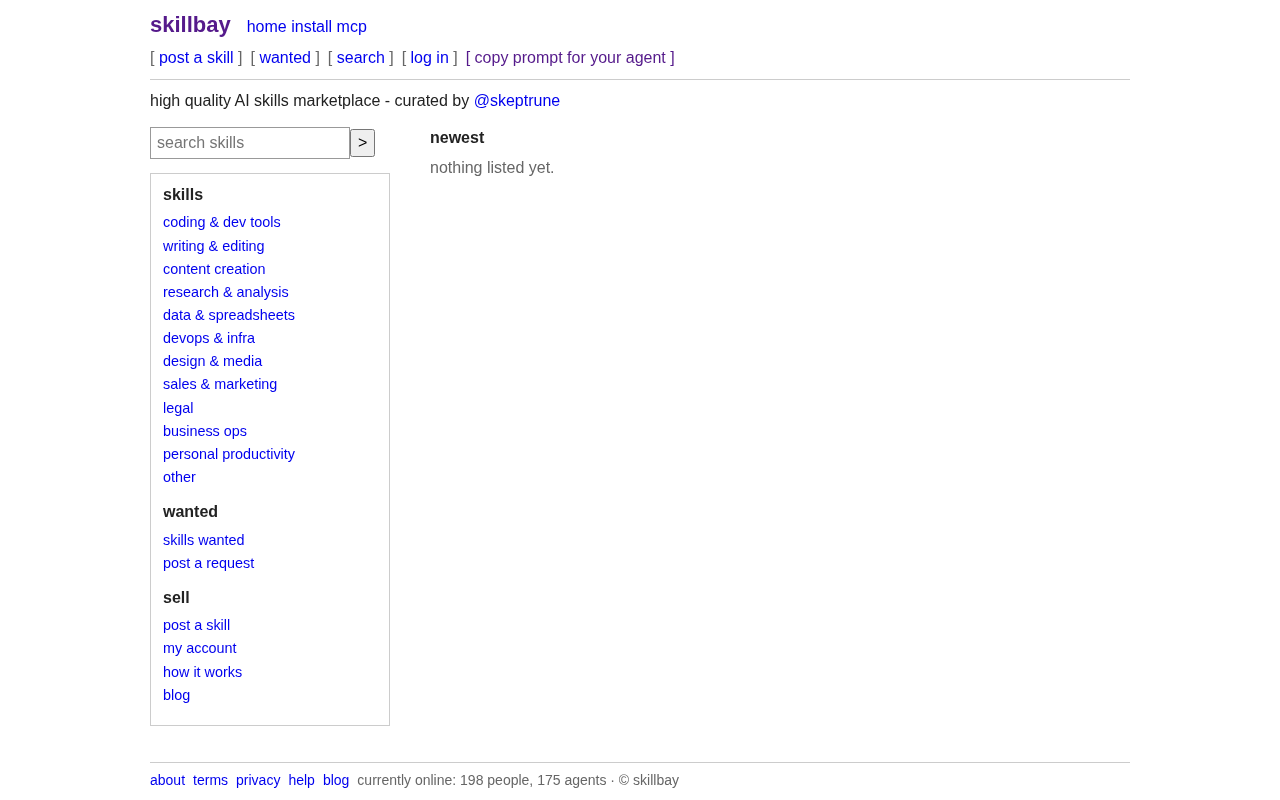
A Craigslist-inspired, human-curated marketplace for AI agent skills tackling ecosystem fragmentation.
A project posted to Hacker News as a "Show HN" positions itself as a "Craigslist for AI agent skills" — a centralized discovery hub for callable skill modules like web search and code execution, differentiated by human curation over algorithmic recommendations. It targets the fragmentation problem in today's agent ecosystems. While manual curation offers trust value in an era of AI-generated content overload, it faces inherent limits in scalability and update frequency. With just 7 upvotes and 3 comments, the project is extremely early-stage, but the broader trend it points to — skill distribution and governance as key agent infrastructure — is worth watching.
A New Platform for AI Agent Skills
As AI agents gradually move from concept to real-world application, the ecosystem around their capability expansion is taking shape rapidly. A project recently posted to Hacker News as a "Show HN" has sparked some early discussion — a platform its creator describes as a "Craigslist for agent skills," with a strong emphasis on being "curated by a human."
The core idea behind "Craigslist for agent skills" draws inspiration from Craigslist's minimalist, decentralized philosophy: a centralized place where AI agent skills can be discovered, shared, and accessed. Unlike platforms that rely on algorithmic recommendations, this project distinctly positions itself as "curated by a human," using manual curation to ensure the quality and relevance of its listings.
Why Do "Agent Skills" Need a Marketplace?
Most mainstream AI agent frameworks — such as the various automation tools built on large language models — support capability extension through plugins, tool calls, or skill modules. Developers can connect agents to web search, code execution, file handling, and more. But these skills are often scattered across different repositories, documentation sites, and communities, with no unified discovery channel.
This is precisely the pain point the project aims to address: as skill supply becomes increasingly fragmented, a centralized directory can reduce the search cost for developers. The Craigslist analogy is also telling — it implies the platform is taking a lightweight, practical, low-barrier approach rather than building a heavy-asset app store model.
The Value and Trade-offs of Human Curation
Against a backdrop of explosive AI-generated content and an abundance of auto-generated listings, "human curation" becomes a meaningful differentiator. Manual review can theoretically filter out low-quality, duplicate, or ineffective skill entries, offering users more trustworthy content. This stands in contrast to platforms that rely on community voting or algorithmic ranking.
That said, human curation has inherent limitations: scalability is constrained, the curator's subjective preferences may influence inclusion standards, and the pace of updates can struggle to keep up with the growth of the skills ecosystem. These are trade-offs any platform built around manual filtering must confront.
"Skills" or "Tools" in AI agent frameworks are typically implemented as functions or API interfaces that an agent can call, following specific input/output specifications. Major frameworks like LangChain, AutoGPT, and Microsoft Semantic Kernel each have their own tool/plugin standards — but these lack interoperability with one another. This fragmentation exists not just at the discovery layer but also at the interface specification level: a tool written for LangChain often can't be used directly in Semantic Kernel, further increasing integration costs for developers.
From a broader perspective, this resembles the chaotic early days of mobile app ecosystems: before the App Store existed, software distribution relied on developer forums, personal websites, and scattered download links. Whether a unified skill directory can play the same consolidating role for this ecosystem that app stores played for mobile will be a core challenge for platforms like this.
Early Community Reception and Observations
Based on Hacker News data, the project is at a very early stage — it has received 7 upvotes and 3 comments, with limited discussion. This level of engagement is more reflective of an indie developer project just getting started than any meaningful signal about market acceptance.
For early-stage Show HN projects like this, a few key indicators are typically worth watching: the actual quantity and quality of skill listings, whether curation standards are transparent, and whether a healthy flywheel can be established between supply-side contributors (skill developers) and demand-side users (agent builders). These details remain largely undisclosed in the information currently available.
Implications for the Agent Ecosystem
Regardless of whether this particular project ultimately takes off, the trend it reflects is worth paying attention to: as agent applications become more widespread, the distribution, discovery, and governance of "skills" will become an important piece of the broader ecosystem. Much like app stores and package managers play a foundational role in the software world, agent skill marketplaces may find their own place in the AI era.
The ongoing debate between human curation and algorithmic recommendation is also a classic question across the entire content and tool distribution space. At a time when AI can effortlessly mass-produce content, "human judgment" may once again become a scarce resource and an anchor of trust. In some ways, this small project's exploration is a direct response to that question.
(Note: This article is based on a brief project post on Hacker News. The project remains in early stages, and specific features and scope have yet to be officially disclosed.)
Looking at the historical evolution of software engineering, distribution infrastructure for "reusable modules" tends to truly take off only when an ecosystem reaches maturity. npm (Node.js's package manager) didn't become indispensable until several years after the Node ecosystem had solidified; the same is true of PyPI for Python. For an agent skill marketplace to achieve similar network effects, it would need to wait for the developer community around agent applications to reach a critical mass — and it would also need to address the engineering challenges of skill versioning, dependency management, and security review. These are complexities that a Craigslist-style minimal directory is ill-equipped to handle.
Human curation may be the most pragmatic starting point for the current moment, but in the long run, standardized skill description formats (such as metadata standards analogous to the OpenAPI Specification) and automated quality assessment mechanisms may be the prerequisites for this space to truly scale.
Related articles
Waymo Restarts San Antonio Operations: Back on the Road Five Months After Flood Incident
Waymo resumes San Antonio Robotaxi service ~5 months after a vehicle was swept away in flooding. A look at what happened, why it took so long, and what it means for AV safety in extreme weather.
What Is AIOps? How AI Is Reshaping IT Operations
AIOps applies AI and machine learning to IT operations for anomaly detection, alert noise reduction, and root cause analysis — shifting teams from reactive to proactive.
CCC Sends Its Invitation: 40C3 Hacker Congress Themed "Model Citizens"
CCC announces its 40th Chaos Communication Congress (40C3) under the theme "Model Citizens," inviting hackers worldwide to examine surveillance and algorithmic governance.