A Humanoid Robot Under $2,500 Just Launched — Here's What Devs Should Know

Faraday Future launches the sub-$2,500 FF Nova humanoid robot, potentially kicking off the affordable home robot era.
Faraday Future and FFR have jointly unveiled the FF Nova, a humanoid robot priced under $2,500, billed as the first embodied AI product at that price point, alongside the Nova Mini for physical AI education and an RL-based developer toolchain. Within the same week, Chery-backed AiMOGA announced Mobo will open global pre-orders October 19–23. The article argues this dramatically lowers the barrier to embodied AI, giving students and small teams real hardware access for the first time. But all info comes from launch announcements — no independent reviews or reliability data exist. Faraday Future's financial instability raises warranty and software support concerns, while AiMOGA is relatively more stable.
A humanoid robot now costs less than a maxed-out MacBook Pro.
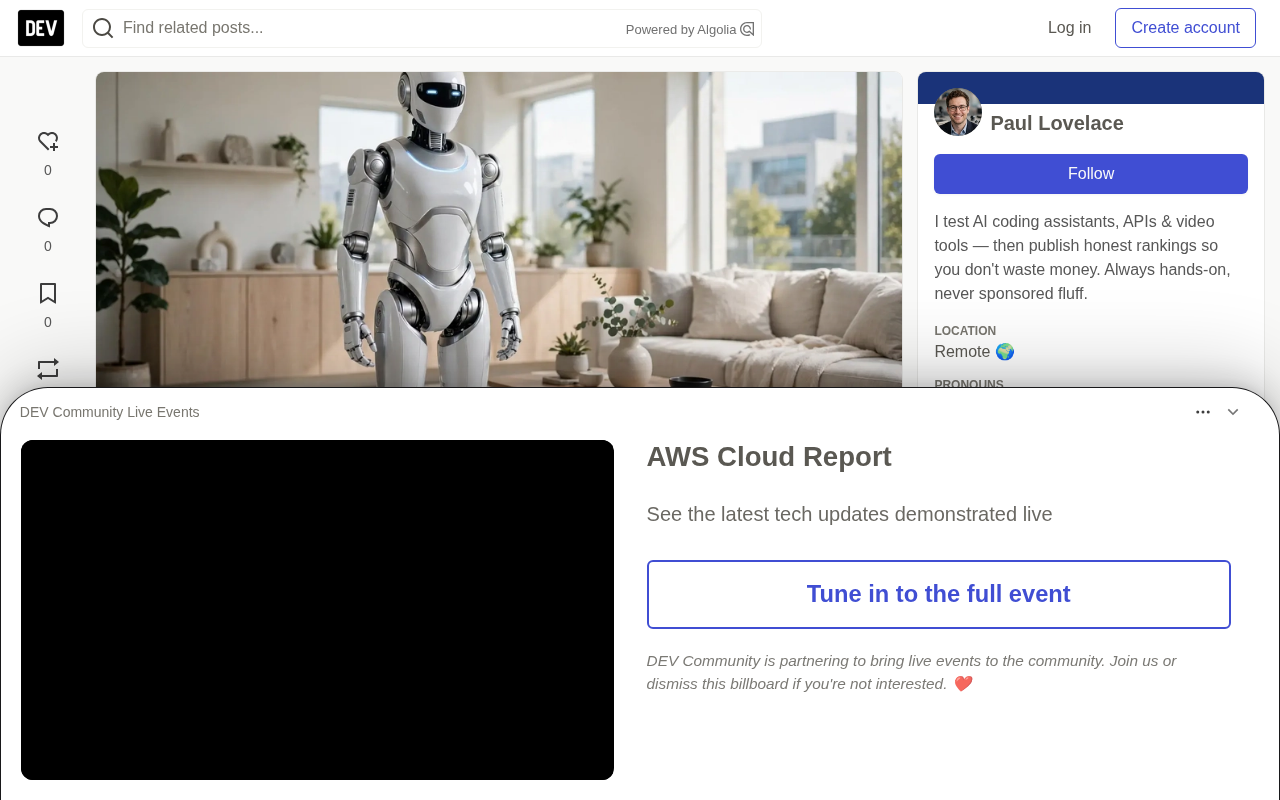
Faraday Future and FFR have jointly unveiled the FF Nova, which they claim is the first embodied-AI humanoid robot priced under $2,500. Alongside it, they introduced the FF Nova Mini for physical AI education, plus a developer program built around Nova reinforcement learning. At the same time, Chery-backed AiMOGA announced that its companion robot Mobo will open global pre-orders from October 19 to 23. Two launches in one week, and affordable home robots have gone from "someday" to "add to cart."
Why Developers Should Care
The barrier to entry for embodied AI just dropped dramatically.
Until now, humanoid robots have largely been the playground of well-funded labs and companies with seven-figure hardware budgets. A humanoid robot under $2,500 with a developer program attached changes the question of who gets to experiment. Students, indie developers, small teams — anyone curious about physical AI can now actually get their hands on hardware.
Even more interesting for developers is the Nova Mini line. Consumer-priced physical AI education hardware means university labs and bootcamps can put real robots in students' hands instead of just running simulators. If you've been watching embodied AI from the sidelines, that sideline just got a lot closer.
Embodied AI is one of the most central concepts at the intersection of robotics and artificial intelligence today. It refers to agents that interact with real environments through a physical body, forming a closed loop between perception, decision-making, and action to accomplish learning and task execution. Unlike traditional software AI trained only on large datasets, embodied AI emphasizes the role of the "body" in shaping cognition — robots must handle sensor noise, motion errors, and the real-time constraints of the physical world.
This field has long been constrained by hardware costs: a humanoid robot with dexterous manipulation capabilities can easily cost tens or even hundreds of thousands of dollars, forcing many researchers to rely on simulation environments (such as Isaac Sim and MuJoCo) to validate algorithms. The gap between simulation and reality — the sim-to-real gap — remains a formidable obstacle. If low-cost hardware becomes widespread, its most direct value is letting more teams cross that gap, collecting data and tuning policies on real platforms.
What We Know and What We Don't
Let's be honest about framing: this product launched today. There are no independent reviews, no teardowns, no real-world reliability data. Everything below comes from the launch announcement.
What we know:
- FF Nova: humanoid form factor, embodied AI, priced under $2,500
- FF Nova Mini: smaller form factor, positioned for physical AI education
- Developer program includes Nova RL (reinforcement learning) toolchain
- AiMOGA Mobo: companion robot, global pre-orders opening October 19–23 during the Chery summit
What we don't know:
- Real battery life, durability, failure rates
- What "embodied AI" can actually do beyond demos
- Software maturity — SDK quality, documentation, community support
- Whether the price is permanent or a launch promotion
Reinforcement Learning (RL) is one of the dominant paradigms for training robot behavior: an agent optimizes its policy through trial and error based on reward signals from the environment. In robotics, RL is commonly used to train continuous control tasks like walking, grasping, and balancing. The nominal value of the Nova RL toolchain lies in potentially packaging simulation environments, reward function templates, and policy deployment pipelines so developers don't have to build a training pipeline from scratch.
That said, RL on real hardware has long suffered from low sample efficiency, training instability, and transfer difficulties. Whether a toolchain is actually useful depends on whether it delivers reliable sim-to-real transfer, clear documentation, and compatibility with mainstream frameworks (like PyTorch and ROS). These details typically aren't disclosed in launch announcements — they can only be judged once developers get hands-on.
The Elephant in the Room
Faraday Future is a financially troubled company. This isn't gossip — it's public record (Nasdaq-listed, with extensive reporting on its operational difficulties). A company in shaky condition launching a cheap robot means real risks: warranty support, software updates, and long-term parts availability are all unknowns.
This doesn't make the Nova uninteresting — it makes it a calculated bet rather than a safe purchase. Early adopters should go in with clear eyes.
AiMOGA is backed by Chery (a major automaker), so its backing is more stable, which probably makes Mobo the safer pre-order of the two — but again, no independent reviews yet.
Faraday Future is a Nasdaq-listed EV company that has long faced cash flow constraints, delivery delays, and executive turnover since its founding, with its financial condition widely disclosed in public filings. For hardware consumers, a manufacturer's financial health directly affects after-sales support: robots involve motors, reducers, sensors, and other wear-prone components. If the company can't sustain operations, warranty commitments and parts supply could both fall through.
By contrast, AiMOGA is backed by Chery, a major Chinese automotive group with a mature supply chain and manufacturing system. When automakers enter the robotics space, they can typically reuse supply chain resources like batteries, motors, and electronic controls, which somewhat reduces the risk of long-term product support. But it's worth emphasizing that a stable corporate backer doesn't equal a mature product — neither robot currently has third-party review data, and marketing claims during the pre-order phase should still be treated with caution.
Things I'll Be Watching
- Mobo pre-order performance (October 19–23) — pricing details and early order volume will tell us whether this is genuine consumer demand or just launch-day hype.
- The developer program's appeal — can the Nova RL toolchain attract real builders, or will it stall after launch?
- First independent reviews — we'll know what's real when someone puts 100 hours on one of these devices.
- The education angle — if Nova Mini makes it into classrooms, that means a long-term pipeline for embodied AI developers. That matters more than any single product.
The Bigger Picture
Regardless of whether the FF Nova itself succeeds, the signal is clear: humanoid robots are entering consumer price territory. The company that wins this category will be the one with the best developer ecosystem — not just the prettiest hardware demo.
If you're a developer curious about robotics, this is the cheapest ticket in we've ever seen. Just don't pre-order with money you can't afford to lose.
This article contains no affiliate links — it's news, not a buying guide. When independent reviews come out, I'll do a proper teardown.
One-line Summary
Faraday Future launches the FF Nova humanoid robot under $2,500, potentially kicking off the era of affordable home robots.
Paragraph Summary
Faraday Future and FFR have jointly unveiled the FF Nova, a humanoid robot priced under $2,500, billed as the first embodied AI product to hit that price point, alongside the Nova Mini for physical AI education and a reinforcement-learning-based developer toolchain. Within the same week, Chery-backed AiMOGA announced that its companion robot Mobo will open global pre-orders from October 19 to 23. The article argues this price dramatically lowers the barrier to entry for embodied AI, giving students and small teams their first real access to hardware. But all information comes from launch announcements, with no independent reviews or reliability data; Faraday Future's financial instability raises questions about warranty and software support, while AiMOGA is relatively more stable. The author suggests treating this as a calculated bet and paying close attention to Mobo's pre-order performance, the developer ecosystem's appeal, and the long-term impact on education.
Related articles

JobRunner MCP Server: AI Agents Can Now Fix Failed Java Jobs
JobRunner launches an open-source MCP server enabling AI agents to view cluster status, diagnose failures, and recover Java jobs—incident response from any cloud coding environment or existing agent.

MLAI Digital Launches 9 Security Agents: MCP Server Safeguards the Full Lifecycle of Agentic AI
MLAI Digital launches Security MCP Server with nine built-in specialized security agents covering vulnerability discovery, attack simulation, prompt injection detection, API and infrastructure assessment, and accelerated remediation—embedding security validation across the full Agentic AI lifecycle from development to production.

Running Isaac Lab on H100 GPUs: Exploring Better Approaches
Exploring optimization methods for running Isaac Lab on NVIDIA H100 GPUs, including MIG configuration, mixed precision, TensorRT acceleration, and community experience to improve robotics simulation and reinforcement learning efficiency.