A Kid Built a Typing Game with DeepSeek: A Complete Record of AI-Assisted Programming from Scratch

A kid independently built a typing game with AI tools, showcasing a new paradigm of human-AI collaboration in education.
A young child leveraged DeepSeek's code generation capabilities to independently build a feature-rich typing practice game in a terminal environment. The game evolved through 5 iterations, from a pure text version to an aerial combat game featuring CIWS, tracking missiles, and multiple power-ups. Throughout the process, AI handled code generation while the kid managed creative design and parameter tuning — embodying the "Vibe Coding" human-AI collaboration model and transforming tedious typing practice into an achievement-filled creative experience.
When a Kid Meets AI Programming: The Birth of a Typing Game
A young child independently built a typing practice game using AI tools — this isn't science fiction, it's happening right now. This young creator worked in a terminal (command-line) environment, leveraging DeepSeekAd's code generation capabilities to iteratively develop a feature-rich, engaging typing game.
Throughout the process, the AI handled core code generation while the kid took charge of creative design, parameter tuning, and feature iteration. This "human-AI collaboration" development model gave a typing beginner the sense of achievement of being a "game developer."
Game Mechanics: It's More Than Just Hitting Keys
This AI-assisted typing game is far more sophisticated than you might expect. Players can adjust game speed at the start, making it suitable for typists of different skill levels. The core mechanic involves correctly typing letters to shoot down targets on screen.
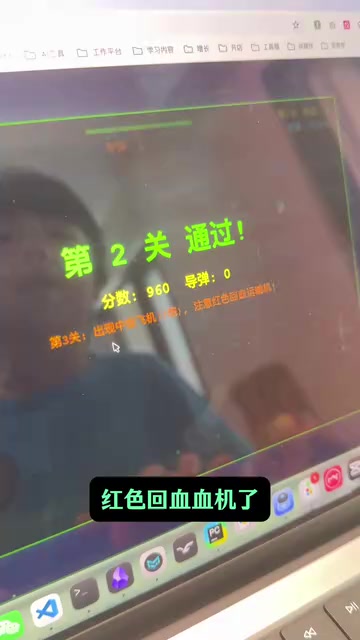
The game includes various power-ups and mechanics:
- Missile Transport Aircraft: Delivers missiles to clear enemy planes from the screen
- Jammer Aircraft: Serves as a support power-up to help players
- Healing Aircraft: Appears from stage 3 onward, granting two extra lives each time
- Different-sized Aircraft: Large, medium, and small planes add visual depth and difficulty variation
After clearing all stages, there's a bonus level offering extra challenge and surprises. These rich design elements transform what would be tedious typing practice into a strategy-filled aerial combat game.
It's worth noting that this approach of embedding game elements into skill practice has solid theoretical backing in educational psychology. Gamification is an educational methodology that introduces game design elements — points, levels, instant feedback, achievement systems — into non-game contexts. Psychological research shows that when learners enter a state of "Flow" — where challenge difficulty precisely matches personal ability — learning efficiency and memory retention reach their peak. This young creator's case represents the ultimate form of gamified learning: he's not just playing a game to learn typing, but gaining a meta-level learning experience by "designing the game himself." A self-designed game naturally matches the creator's own ability level — a personalized advantage that traditional educational software struggles to replicate.
5 Versions of Iteration: The Evolution from Crude to Complete
The most impressive aspect is the game's iteration process. The young creator clearly recounted the entire development journey, revealing a genuine product evolution path:
Version 1 — Pure Text: The most basic version with only letters on screen, no visual elements whatsoever — players just typed letters "raw."
Version 2 — Added Turret: Players could control a turret through typing to shoot down targets, giving the game its first visual dimension.
Version 3 — Aircraft and CIWS: Targets became aircraft, and the turret was upgraded to a Type 1130 CIWS (Close-In Weapon System) — an 11-barrel 30mm close-range defense weapon system developed by the Chinese Navy. It's one of the fastest-firing CIWS in the world, capable of approximately 10,000 rounds per minute, primarily designed to intercept incoming anti-ship missiles and low-flying aircraft. The young creator's decision to incorporate this real military equipment into the game not only dramatically enhanced the visual effect but also demonstrated AI tools' ability to understand and implement specific real-world references — this kind of judgment in blending real-world knowledge into game design is a quintessential example of irreplaceable human creativity.

Version 4 — Tracking Missiles: Introduced homing missiles, adding dynamic energy and fun to the gameplay.
Version 5 — Complete Power-up System: Added jammer aircraft, healing aircraft, different-sized planes, and multiple speed settings, significantly raising the game's completion level.
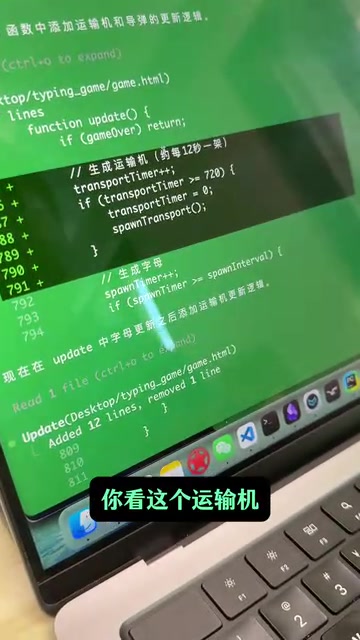
This iteration process is itself a vivid lesson in product development. Every improvement was based on feedback from actual gameplay experience — for instance, the young creator felt "there are too many transport aircraft" and adjusted the parameters himself.
Human-AI Collaboration: AI Writes Code, the Kid Makes Decisions
From a development division-of-labor perspective, this project demonstrates a very typical AI-assisted programming model. The young creator showed the code interface: most code was generated by AI, while he personally handled critical parameter tuning and design decisions.

As revealed in the video, the AI model behind the tool this child used is DeepSeek. DeepSeek is a large language model series developed by the Chinese AI company DeepSeek, renowned for its exceptional performance in code generation, matching top-tier models like GPT-4 across multiple programming benchmarks. For non-professional developers, DeepSeek's greatest value lies in its "conversational programming" capability — users don't need to master programming syntax; they simply describe requirements in everyday language, and the model outputs runnable code.
The development environment used was the Terminal — the text-based interaction interface provided by computer operating systems. For AI-assisted programming, the terminal is the most direct way to run scripting languages like Python — after AI generates code, users simply save it as a file and execute it in the terminal to immediately see results. This instant feedback loop of "write code → run → see results → modify" is the technical prerequisite that enabled this child to complete 5 version iterations in a short time.
This development paradigm has recently been dubbed "Vibe Coding" (coined by OpenAI co-founder Andrej Karpathy in 2025) — describing intent in natural language, letting AI generate code, and having humans handle testing and decision-making. The core shift in this model is that programming's essential skill moves from "memorizing syntax and APIs" to "clearly expressing requirements and judging code quality." Research shows that developers using AI-assisted programming can boost productivity by 30%-50%, and for users with zero programming background, this model compresses the journey from "zero to runnable program" from months of study down to hours of practice.
The core value of this workflow is: AI lowers the technical barrier to programming, but creativity and judgment remain firmly in human hands. The kid doesn't need to master programming language syntax, but he needs to know what kind of game he wants and what constitutes a good experience. The evolution from "turret" to "Type 1130 CIWS" to "tracking missiles" — every step was driven by human creativity.
Educational Insights for the AI Era: Turning Learning into Creation
This case offers profound educational insights. The young creator himself said: "When I first started learning to type, it felt extremely boring, but now I think typing is actually pretty fun."
This precisely reveals an important value of AI tools in education — transforming the learning process into a creative process. This child wasn't just practicing typing; he was also learning:
- Product Thinking: How to design an engaging game
- Iterative Methods: How to improve and refine a product through continuous iteration
- Problem Solving: How to identify issues and find solutions
- Human-AI Collaboration: How to effectively communicate requirements to AI tools
When asked "How does it feel to make your first game?", the kid's answer was "So satisfying!" This sense of achievement is something traditional programming education can rarely deliver in a short timeframe, yet AI tools make it readily accessible.
Final Thoughts: The Barriers to Creation Are Disappearing
"Don't you feel that making games isn't actually that hard anymore?"
Related articles
 Product Reviews
The Programmer's Desk Setup Guide: Building a Workspace That Feels Like Home
Discover how programmers build productive, comfortable workspaces. From multi-monitor setups to ergonomic design, explore the desk philosophy that drives focus and flow.
 Product Reviews
Qoder vs Cursor Real-World Comparison: Which $20/Month AI IDE Is Better?
Hands-on comparison of Qoder vs Cursor AI IDEs: Agent autonomy, human interaction count, and architecture decisions. Qoder needed only 2 interactions vs Cursor's 8.
 Product Reviews
Cursor Cloud Agent Demo: Eliminating Bottlenecks Across the Entire Software Development Lifecycle
Deep analysis of Cursor's Cloud Agent demo showing how cloud VMs, automated test artifacts, and a full-chain control plane systematically eliminate human bottlenecks across the software development lifecycle.