A Killer App for the iPhone Duo Has Arrived: Turning a Foldable into a Virtual Walkman

An indie developer turned the iPhone Duo's foldable form into a virtual Walkman, hinting at the device's creative potential.
Before Apple's foldable iPhone Duo has even built out its ecosystem, a virtual Walkman app by an indie developer has gone viral on social media. The app cleverly uses the foldable's open-and-close motion to simulate a cassette tape player, blending retro-tech aesthetics with a novel hardware form. The article explores what this means for the concept of a "killer app" in new hardware categories, and why indie developers tend to have a structural advantage over large companies in the early stages of a new platform.
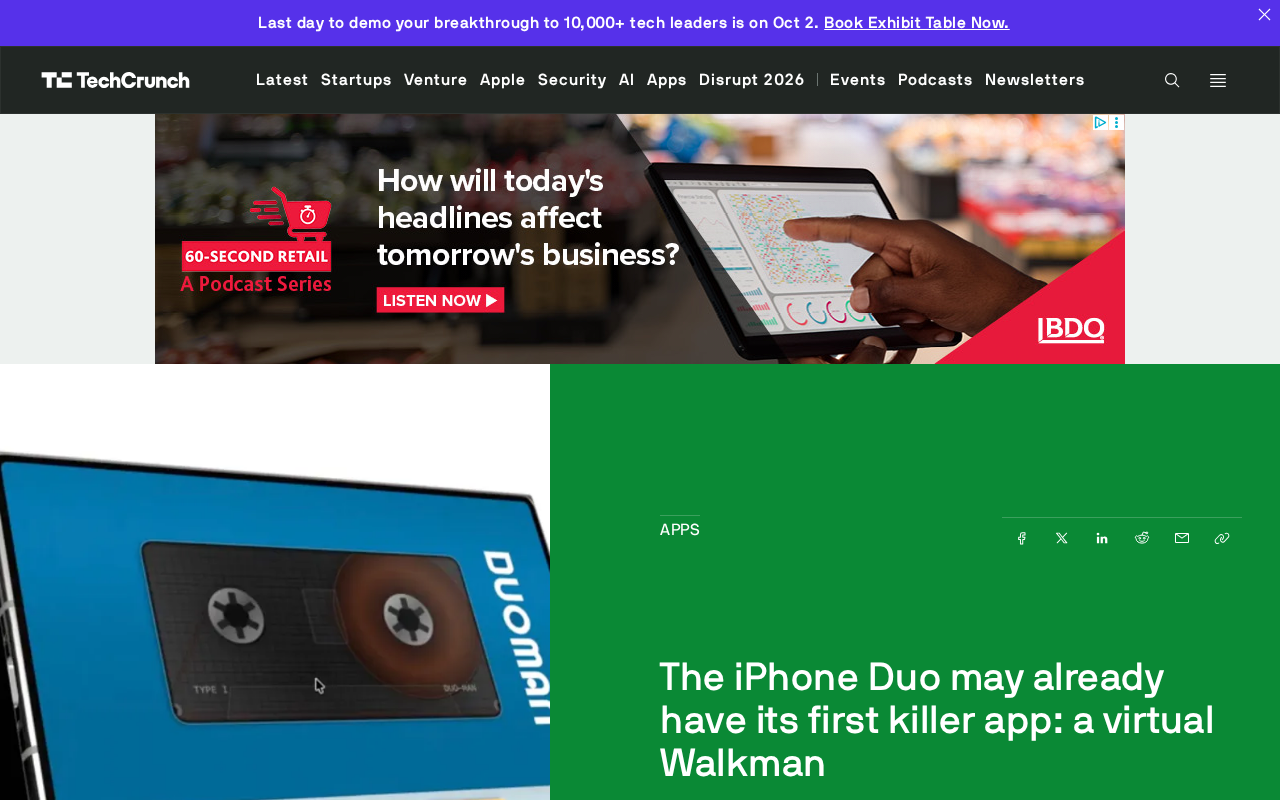
Apple's first foldable iPhone, the Duo, hasn't even had time to build out its ecosystem — yet one indie developer's app is already going viral. The app transforms the folded iPhone Duo into a retro virtual Walkman, spreading rapidly across social media thanks to its nostalgic charm and clever use of the foldable's unique interaction model.
A Creative Take on the Foldable Form Factor
A "killer app" typically refers to software compelling enough on its own to drive hardware purchases. For any new device category, the first true killer app acts as a bellwether — it proves that the hardware form factor can enable experiences that simply weren't possible before.
This viral hit isn't from a major studio; it's the work of an independent developer. The app uses the iPhone Duo's folded dual-screen configuration to simulate a classic cassette Walkman: one screen displays an animated spinning tape, while the other handles controls and information readout. The design taps precisely into the retro-tech nostalgia wave that has been building in recent years.
The concept of a "killer app" has iconic precedents in tech history: VisiCalc once convinced business professionals to buy the Apple II; the Halo franchise drove original Xbox sales; Instagram in its early days was deeply tied to the iPhone 4's camera experience. What these apps share is that they didn't merely use the hardware — they amplified its most distinctive capabilities, creating a near-irreplaceable bond between the software experience and a specific device. For a new hardware category, whether such an app emerges early on often directly shapes the market's perception of whether that category even needs to exist.
Why the Foldable Form Factor Suits a "Virtual Walkman"
The core value of a foldable lies in its adaptable form — fully open for a large screen, closed for a compact one, with various half-open angles in between. A virtual Walkman leverages exactly these physical properties: the original tape player was itself a physical object with depth that could be "flipped open" and "loaded" with a cassette. The foldable's open-and-close motion maps naturally onto the motion of opening a tape deck.
In other words, this isn't about cramming a generic app into a foldable — it's about deeply binding the software experience to the hardware form. An app truly earns the title of a device-exclusive experience only when its core appeal cannot exist without that specific hardware.
Since the Sony Walkman debuted in 1979, it has not only changed how people carry music but become a cultural symbol for an entire generation. Its iconic design elements — the transparent tape window, spinning reels, mechanical buttons — still carry powerful emotional resonance in the age of digital music. In recent years, with the resurgence of vinyl records and cassette tapes, "retro-tech aesthetics" have become a clearly observable cultural trend in consumer electronics. The virtual Walkman app merges this nostalgia with the novelty of a foldable device, letting users experience cutting-edge technology while feeling an emotional sense of familiarity. That tension between old and new is itself a significant driver of its viral spread.
Indie Developers and the Opportunity in New Hardware Ecosystems
The early days of a new hardware category are often the best window of opportunity for independent developers. Large companies tend to wait cautiously for market signals, while small teams and solo developers are more willing to take bold risks and fill ecosystem gaps with creativity. Many landmark apps throughout history were born during the period when a device had just launched and competition was still sparse.
The viral success of this virtual Walkman also shows that the imaginative potential of foldables goes far beyond "a bigger screen" or "more convenient multitasking." When developers step outside the conventional smartphone interaction framework and treat the folding and unfolding motion as part of the design language itself, they can create experiences that genuinely surprise and delight.
Looking at historical precedents, early app ecosystem formation tends to follow similar patterns: in the early days of the iPhone App Store, many indie developers achieved breakout hits through creative interpretations of touch interaction; when the iPad launched, independent developers were the first to explore large-screen-native experiences like split-screen reading and drawing tools. There are structural reasons for this — new devices have small user bases, making it hard for large companies to justify high R&D investment for niche hardware, while indie developers face lower marginal costs and smaller downside risk, making them more willing to bet on uncertainty. For Apple's foldable ecosystem, this means the platform's policies toward indie developers — including developer tools, discovery mechanisms, and revenue sharing — will play an outsized role in shaping the early ecosystem.
Implications for the iPhone Duo Ecosystem
A single nostalgia app certainly won't determine the success or failure of a device, but it sends a positive signal: the iPhone Duo's unique form factor genuinely sparks developers' creative instincts. For Apple, the key question is how to encourage more developers to build natively around the foldable form rather than simply adapting existing apps — and that will be critical to whether this device's ecosystem truly flourishes.
For everyday users, apps like this offer a reason to take the plunge — even if they're not addressing a core need, the emotional value of nostalgia and the novelty of a new interaction model are compelling in their own right. As more developers enter the space, the iPhone Duo may accumulate a collection of exclusive experiences that simply can't be replicated on any other device.
(Note: This article is based on a single media report. Specific features and release dates for the app should be confirmed through official sources.)
Related articles

Chain of Thought Isn't Just for AI: How Humans Can Use CoT to Improve Thinking Quality
Chain of Thought isn't just a prompt trick for large models. Starting from a Hacker News discussion, this article analyzes why CoT works for human thinking too, breaks down actionable ways to transfer it, and highlights the key differences between human CoT and machine CoT.
Cloudflare Teams Up with OpenAI: Closi…
Cloudflare Teams Up with OpenAI: Closing the Loop from Vulnerability Discovery to Defense with AI
Cloudflare uses OpenAI Daybreak to investigate security vulnerabilities and generate reviewable remediation plans, while developers use Codex to boost coding efficiency and quality.

Orca Multi-Agent Orchestration in Practice: A Guide to Parallel Collaboration with Claude and Codex
Orca is Stable AI's free open-source agent workbench supporting 34 agents like Claude Code and Codex in parallel. Learn its Git worktree isolation, multi-model orchestration, and mobile management.