A Little Gadget That Makes a "Dumb House" Smart: Installer Picks

The Verge recommends a bridge gadget that connects traditional infrared appliances to the smart home ecosystem at low cost.
Starting from a gadget recommended in The Verge's Installer column, the article explores the long-standing "dumb house" problem in the smart home industry: many traditional appliances and infrastructure are still not smart, and whole-home upgrades are costly and high-barrier. Such bridge tools use infrared, Wi-Fi, and other methods to give old devices networking and voice control capabilities, addressing three major pain points: compatibility with old devices, lowering the barrier, and a unified control entry point. But they are also limited by one-way infrared communication that cannot obtain device status, uneven protocol compatibility, and inconsistent app experiences. The article frames this as a "patch philosophy" and argues that before Matter becomes widespread, such transitional solutions remain indispensable.
From "Dumb House" to Smart Home: The Lesson of a Little Gadget
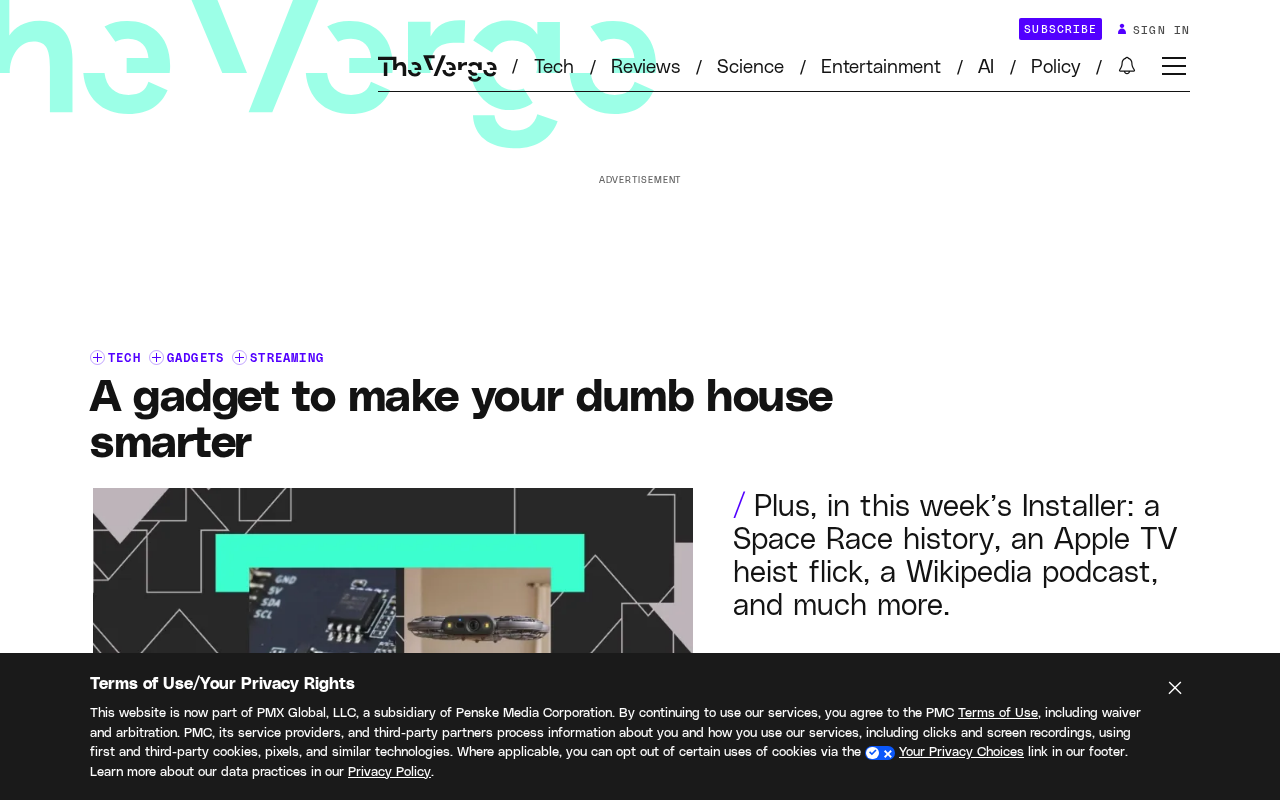
The Verge's Installer column has always been dedicated to uncovering interesting, practical, and even slightly geeky tech finds. The latest issue (No. 152) has a very catchy title: "A gadget to make your dumb house smarter." It sounds like a simple product recommendation, but what it reflects is a persistent pain point in the smart home industry: a large number of traditional appliances and infrastructure are still "not smart," and users don't want to go to great lengths to change that.
Why Are "Dumb Houses" Still So Common?
Although smart speakers and smart bulbs have entered many homes, the "foundation" of most residences is still traditional: wall switches, air conditioners, curtains, door locks, and even garage doors. Whole-home smart upgrades mean wiring, replacing devices, and unifying protocols—the cost and barrier to entry are both high. As a result, a category of "lightweight" retrofit tools has emerged—they don't replace existing devices, but instead use infrared, Wi-Fi, Bluetooth, and other methods to give old devices networking and remote control capabilities.
The gadget mentioned in this issue of Installer is a representative of exactly this approach. It doesn't require you to renovate, nor does it require you to throw away your existing remote controls. Instead, it acts as a "middleman" that connects traditional infrared remote-controlled devices to the smart home ecosystem.
The Protocol Gap Between Infrared Remote Control and Smart Homes
Infrared remote control, widely used in traditional appliances, is a one-way, low-bandwidth local communication method: the remote emits encoded pulses through an infrared LED, the receiver on the device decodes them and executes the command, and there is no return channel throughout the process. This is fundamentally different in design goals from the two-way IP network protocols mainstream in smart homes, such as Wi-Fi, Bluetooth, and Zigbee. The core work of bridge-type tools is to build in an infrared emitter and a learning database, translate network commands from an app or voice platform into infrared codes, and then "aim" them at the device and send them. Because it cannot know the device's actual state, it can only "send commands" rather than "confirm execution"—which is also the reason its automation capabilities are inherently weaker than those of native smart devices.
What Problems Do These Tools Solve?
- Compatibility with old devices: Many air conditioners, TVs, and fans still rely on infrared remote controls. These tools can learn and simulate infrared signals, letting phones or voice assistants control them.
- Lowering the barrier to smart homes: Users don't have to replace an entire device just for one feature—a gadget costing tens of dollars can get an old device "online."
- A unified control entry point: By integrating with platforms such as Apple Home, Google Home, or Alexa, users can manage all devices in one app instead of hunting for remote controls all over the house.
Of course, these tools have limitations. Infrared control is one-way and cannot obtain device status (such as whether the air conditioner is actually on), so the reliability of automation scenarios is compromised. In addition, protocol compatibility across different brands and the quality of the app experience also determine whether it is "truly smart" or a "pseudo-need."
The Ecosystem Roles of Apple Home, Google Home, and Alexa
These three platforms are the "control hubs" of the smart home, but they themselves are not directly compatible with infrared devices; instead, they rely on device manufacturers to connect through certifications such as Works with Apple Home and Works with Google Home. Bridge tools usually first complete infrared learning through the manufacturer's own app, and then expose themselves to these platforms through cloud-to-cloud integration or local Matter bridging. Therefore, whether users can manage everything in one app depends on the depth of integration between the bridge manufacturer and each platform—which is also one of the key reasons why the experiences of similar products differ so greatly.
The "Patch" Philosophy of Smart Homes
From a broader perspective, these small tools reflect a "patch philosophy": before the ultimate vision of an Internet of Everything arrives, use low-cost, low-intrusion methods to gradually bridge the gap between traditional devices and the smart ecosystem. It is not meant to replace whole-home smart solutions, but to provide a pragmatic transitional choice for users who don't want to make major changes.
Installer's recommendations have always emphasized a balance between "practicality" and "fun," and the reason this tool was selected is probably precisely that it solves a real annoyance in an extremely simple way. For renters, residents of old homes, or people who simply want the old air conditioner at home to be a little more obedient, this may be the answer that is "just right."
Trends Worth Watching
With the advancement of the Matter protocol and more manufacturers opening up their ecosystems, such "bridge-type" devices may gradually decrease in the future, but for quite a long time to come, they will remain an indispensable piece of the smart home puzzle. If you are also considering making the "dumb devices" at home smarter, you might start with a small gadget—sometimes, the first step toward smart living is not replacing everything, but finding a smart connection point.
What Is the Matter Protocol
Matter is a unified application-layer standard led by the Connectivity Standards Alliance (CSA) and jointly promoted by Apple, Google, Amazon, and others. Its goal is to enable smart devices from different brands to interconnect across ecosystems without separate adaptation for each platform. It runs on IP networks and supports underlying transports such as Wi-Fi, Ethernet, and Thread, emphasizing local control and device status reporting. For bridge-type devices, the significance of Matter lies in this: new devices with native Matter support can be recognized directly by various platforms, reducing reliance on a "translation layer"; but the huge stock of infrared appliances cannot gain Matter capabilities through firmware upgrades and still need bridge tools to act as gateways.
Related articles

Anthropic's IPO: Is a $1.4 Trillion Valuation AI's Future or the Peak of a Bubble?
Anthropic is about to list on Nasdaq with a valuation of up to $1.4 trillion, potentially raising over $60 billion to become the second-largest IPO in history. This article breaks down its revenue, the truth behind its hundred-billion-dollar book loss, compute costs, control design, and lock-up pressure, and analyzes the IPO's chain effects on the AI sector.

Anthropic Races Toward Nasdaq: Ticker ANT, Can a Trillion-Dollar Valuation Hold?
Anthropic files its S1 for a Nasdaq IPO under ticker ANT, led by Goldman Sachs and Morgan Stanley. We break down revenue, massive compute lease commitments, founder voting control, and the valuation debate.

How Anthropic Uses a Four-Layer Narrative to Prop Up a $2 Trillion Valuation
Anthropic's estimated $2 trillion valuation: a breakdown of its positioning theory and four-layer narrative — civilization-level fear, identity, product, and business — and how founder essays, technical docs, and opinion leaders support the AI safety guardian valuation story.