A Long-Hidden Quirk in ICLR's Official Template: Bengio Listed Twice and a Nonexistent Volume Number

ICLR's official template has listed Bengio twice since 2019 and contradicts itself on page limits.
A Reddit user reviewing ICLR 2027 author guidelines discovered that the official sample `.bib` file has listed Yoshua Bengio's name twice and assigned *Deep Learning* a nonexistent "volume 1" since 2019 — an error quietly inherited through every annual update. More consequentially, the guidelines contradict themselves on the main-text page limit: the formatting section says 9 pages, while the camera-ready section and FAQ point to 10. The irony is sharp given that ICLR has tightened scrutiny over AI-generated hallucinated references, yet its own template has harbored a citation error for years. The takeaway: official documents aren't infallible, and authors should verify citations independently and default to stricter rules when guidelines conflict.
A Template Easter Egg Hidden for Years
A Reddit user who specializes in reference-checking stumbled upon an amusing detail while reviewing the ICLR 2027 author guidelines and style files: in the example .bib file bundled with the official template, the classic textbook Deep Learning is attributed to "Goodfellow, Bengio, Courville, Bengio" — with Yoshua Bengio's name appearing twice. To top it off, the entry also assigns the book a "volume 1" that doesn't actually exist.
According to the poster's investigation, this isn't a recent mistake. It has been present since the 2019 template and has been carried forward unchanged through every annual update, all the way to the ICLR 2027 template. The relevant code can be found in the ICLR Master-Template GitHub repository.
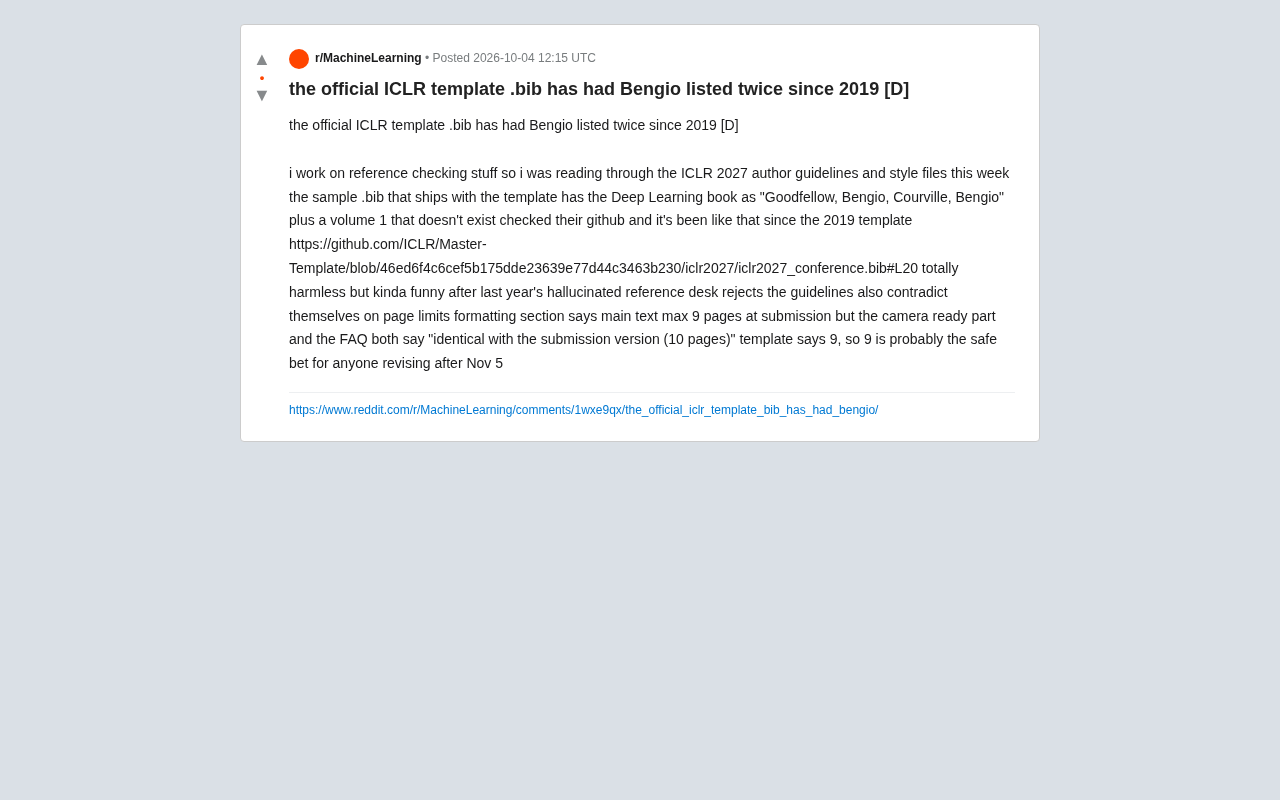
The error itself is, as the poster put it, "totally harmless" — more of an amusing coincidence than anything else. But viewed against the backdrop of academic publishing, it raises some thought-provoking questions.
Why a Small Error Deserves Attention
The purpose of an example .bib file is to give submitting authors a formatting reference. Many authors copy entries directly from it as a template for their own citations, sometimes without any verification. A duplicated author name and a fabricated volume number, if repeatedly copied, could silently spread into the reference lists of a large number of papers.
The poster specifically noted that this situation comes on the heels of "last year's hallucinated reference desk rejects," which makes it particularly ironic. As large language models become widely used in academic writing, AI-generated citations that appear legitimate but don't actually exist — so-called "hallucinated references" — have become a new challenge in academic peer review. The juxtaposition is striking: a conference tightening its scrutiny of citation accuracy while its own official template has quietly harbored an uncorrected citation error for years. That contrast is at the heart of the discussion the post sparked.
It also serves as a reminder to researchers: templates and official documents are not infallible sources of truth. Even style files from top-tier venues need to be verified by authors rather than blindly copied.
A note on "hallucinated references": This term refers to citations generated by large language models during assisted writing that are complete in format and plausible in appearance, but do not actually exist — including fabricated author combinations, invented journal names, and nonexistent page ranges. Because these citations are visually indistinguishable from real ones, they are extremely difficult to catch during manual review. Some conferences and journals have begun requiring authors to submit accessible links to cited sources, or having reviewers specifically audit reference lists. In this context, an official template containing a duplicated author and a fictitious volume number — regardless of whether it has actually been misused — creates an awkward parallel: the same institutions criticizing AI for generating erroneous citations have quietly harbored similar flaws in their own authoritative documents.
Contradictory Page Limits
Beyond the .bib blunder, the poster also flagged a more practically consequential inconsistency in the ICLR guidelines: conflicting statements about the main-text page limit.
Specifically:
- The formatting section states: submissions may have a maximum of 9 pages of main content
- The camera-ready section and the FAQ both state: the final version should be "consistent with the submission (10 pages)"
In other words, the official documentation gives conflicting guidance between "9 pages" and "10 pages." For authors preparing their revised manuscripts, this ambiguity could directly affect whether a submission is compliant.
The poster's recommendation: since the template itself is set up for 9 pages, 9 pages is the safer choice — especially for authors revising their manuscripts after November 5 (Nov 5). When rules are ambiguous, defaulting to the stricter interpretation is a practical way to reduce the risk of rejection on technical grounds.
A note on "camera ready": This is a standard term in the academic conference workflow, referring to the final version of a paper that authors submit after it has passed peer review and been accepted, prepared according to the publisher's formatting requirements. Unlike the submission version, the camera-ready copy must strictly adhere to typesetting specifications and is generally locked after submission, as it will be used directly for printing or digital publication in the proceedings. For this reason, the camera-ready page limit is a hard constraint that authors must get exactly right: exceeding it can result in the submission being rejected by the system or require purchasing additional pages. When different sections of the guidelines give contradictory numbers for the same constraint, the compliance risk is especially real for camera-ready authors.
Key Takeaways for Researchers
This lighthearted discovery actually offers a few practical reminders for academic writers.
Verify the example content in official templates. Sample citations and example text in style files may contain long-standing legacy errors and should not be treated as authoritative references to copy directly.
When rules conflict, follow the stricter interpretation. When page limits, formatting requirements, or other constraints are stated inconsistently, preparing to the strictest standard protects you from rejection on technical grounds.
Take citation accuracy seriously. In an era of increasingly widespread AI-assisted writing, it's worth verifying author names, volume numbers, years, and other details for every citation — regardless of whether it came from a template, a reference manager, or a language model.
The fact that a small error hiding in plain sight for years was finally caught is itself a testament to the irreplaceable role of careful reference-checking in maintaining academic quality. For researchers submitting to ICLR or other top venues, a healthy dose of self-verification beats placing unconditional trust in official documents.
Related articles

Is the Agent Harness Dead? Cursor's Early Engineer Breaks Down the Real Architecture of AI Coding Agents
Cursor early engineer Jediah breaks down the real architecture of the agent harness: why "the harness is dead" is only half right, how the data flywheel lets the harness obsolete itself, and how Grokbot, software factories, and primitive design open new frontiers for agents.
Python Visitor Pattern and Better Alternatives Explained
A deep dive into Python's visitor pattern and four alternatives: method pattern, pattern matching, dictionary mapping, and functools.singledispatch. Choose the best decoupling design by change frequency.

357 Days of Deep Experience: Why Omarchy Made Me Stop Distro-Hopping
A 357-day deep dive into Omarchy: 59-second install, out-of-the-box audio and GPU support, the Quattro QuickShell rewrite migration pains, and why Arch users should try it.