A Look Back at Runway's Early Website Design: The Brand Origins of an AI Creative Tool

A viral tweet resurfaces Runway's early website, revealing how AI creative tools evolved from experimental to commercial.
A tweet sharing screenshots of Runway's early website triggered a wave of nostalgia among AI industry insiders. Known today for its Gen series video models, Runway began as a machine learning toolkit for artists, with a website that reflected that experimental, creatively charged identity. The article argues that a startup's early website is essentially a visual snapshot of its worldview — and that as Runway scaled and attracted enterprise clients, its brand shifted toward more standardized commercial messaging, a pattern shared across the generative AI industry. The key takeaway for founders and designers: don't lose your creative edge in the pursuit of conversion.
A Tweet That Sparked Nostalgia
Recently, a tweet about AI video generation company Runway sparked conversation across social platforms. The poster dug up Runway's official website from its early startup days and remarked that those early pages were "bangers." What seemed like a casual trip down memory lane unexpectedly stirred up memories among many industry insiders about the evolution of AI creative tools.
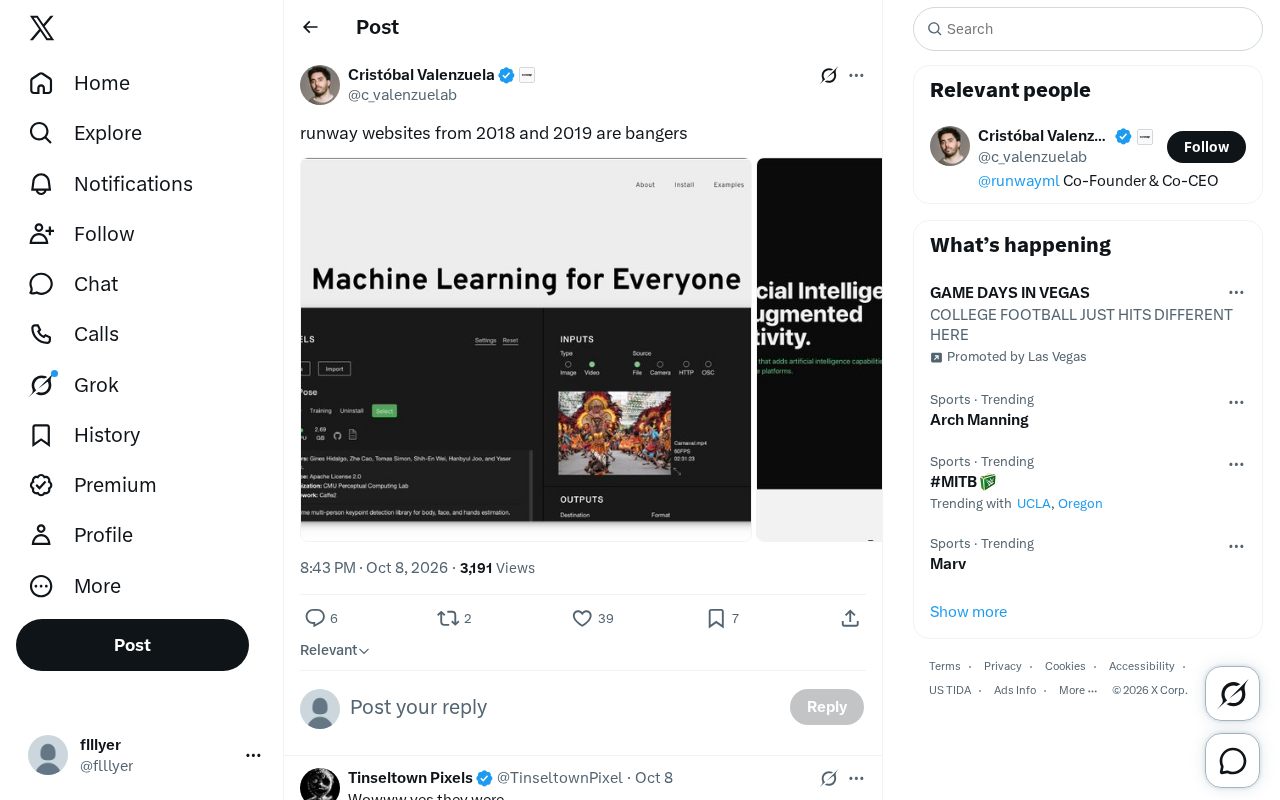
It's worth noting that the original tweet was light on detail — just a single screenshot with no in-depth design analysis or data to back it up. So this article uses that moment as a jumping-off point to revisit Runway's early positioning and brand identity.
Why an Old Website Is Worth Revisiting
Today, Runway is best known for its Gen series of video generation models, making it one of the most closely watched startups in the generative AI wave. But in its early days, Runway's positioning and brand presentation looked quite different from what it is now.
The early Runway placed strong emphasis on the idea of "bringing machine learning tools to creators." A startup's early website is, in many ways, a snapshot of its worldview — the visual language, the tone of the copy, and how features are presented all hint at who the team was trying to reach at the time.
Judging by the poster's reaction, those early pages carried a more experimental and creatively charged aesthetic, which aligned quite naturally with Runway's positioning as a tool for creative professionals.
Runway was founded in 2018 by Cristóbal Valenzuela, Alejandro Matamala, and Anastasis Germanidis — all three with backgrounds in art and design — and was incubated at NYU's ITP (Interactive Telecommunications Program). The company's early core product was a collaborative platform that let artists and creatives use machine learning models without writing any code, centered around the concept of "a machine learning toolkit for creatives." The competitive landscape back then was far less crowded than it is today; Runway was an early pioneer alongside tools like Artbreeder and the predecessors of DALL-E. It wasn't until the release of the Gen-1 and Gen-2 video generation models in 2022 that Runway truly broke through to mainstream AI circles, attracting major investments from Google, Nvidia, and others, with its valuation surpassing $1.5 billion at its peak. Understanding this journey — from "artist's tool" to "film-grade generative AI" — is key to making sense of the shifts in its brand identity.
Industry Evolution Behind the Brand Shift
Changes in an AI company's website aesthetic often mirror the broader maturation of the industry itself. In the early days of a startup, when the product is still taking shape, the website functions more like a manifesto or a vision statement — there's room to be bolder and more distinctive. As the company scales, closes new funding rounds, and starts targeting enterprise clients, the website typically shifts toward more standardized, conversion-driven commercial messaging.
Runway's evolution — from a tool platform serving artists and creatives to a generative AI company with applications across film, advertising, and beyond — is a direct reflection of that trajectory. Part of the reason those early websites feel nostalgic is that they carry the spirit of an era when "AI tools were still exploring their own boundaries."
The generative AI industry's "commercialization inflection point" arrived roughly around 2022: Stable Diffusion went open source, ChatGPT launched, the text-to-video space heated up, and a flood of capital and enterprise clients poured in — pushing startups to rapidly reframe their brand narratives, shifting from a "playful, individual creator" vibe to an emphasis on "reliability and compliance" for B2B audiences. The hallmarks of this shift in website design language include: generous white space replacing dense, experimental layouts; sans-serif typography becoming increasingly uniform; product demo videos replacing conceptual visual art; and words like "Enterprise," "API," and "Security" appearing in navigation menus. Runway's website evolution closely mirrors that of contemporaries like Midjourney and Stability AI, together forming a cross-section of the visual history of the generative AI industry.
Lessons for Founders and Designers
The tweet was brief, but it offered a perspective worth sitting with: a product website isn't just a feature showcase — it's a vehicle for brand storytelling. For early-stage startups, a website that's distinctive and sharp in its design can sometimes communicate a team's unique positioning far more effectively.
Of course, as a business grows, pragmatic commercial design becomes the inevitable path. But looking back at these early works is still a useful reminder: in the pursuit of conversion rates and standardization, don't completely lose the creative edge you started with.
Closing Thoughts
A screenshot of an old website carries the growth story of an AI company, and reflects the broader journey of the generative AI industry — from fringe experimentation to mainstream application. For readers who follow Runway and the development of AI creative tools, this kind of retrospective content offers a fascinating window into how it all began.
Related articles

Workbuddy for Absolute Beginners: How a Desktop AI Agent Fits Into Real Workflows
A beginner's guide to the Workbuddy desktop AI agent: installation, claiming credits, file management, and building automated workflows—compared with CodeX for fit and cost, helping professionals shift from AI question-askers to AI managers.

OpenAI's New Agent Stack: Computer Use, Decisions API, and Ultra-Fast Workflows
OpenAI Dev Day unveiled a new agent stack: Computer Use outperforms humans, Decisions API delivers ultra-low-latency classification via Luna, Agents API opens the same Computer Use capabilities, and GPT-6.1 Sol costs only one-seventh of Astra. Core updates, benchmark data, and developer insights.

Liang Wenfeng Open-Sources DeepInfo Inference Framework, Takes On U.S. Ban
DeepSeek open-sources its DeepInfo inference framework after its models, featuring GPU/CPU cross-pipelining, small-model prediction with large-model verification, and full Huawei Ascend and NVIDIA chip support—facing the U.S. federal ban head-on. This article analyzes its significance for AI deployment and open-source strategy.