A Low Bias Score Doesn't Mean a Fairer Model: The Translation Trap in Multilingual Audits

In multilingual bias audits, lower non-English scores mostly reflect translation noise rather than genuine fairness improvements.
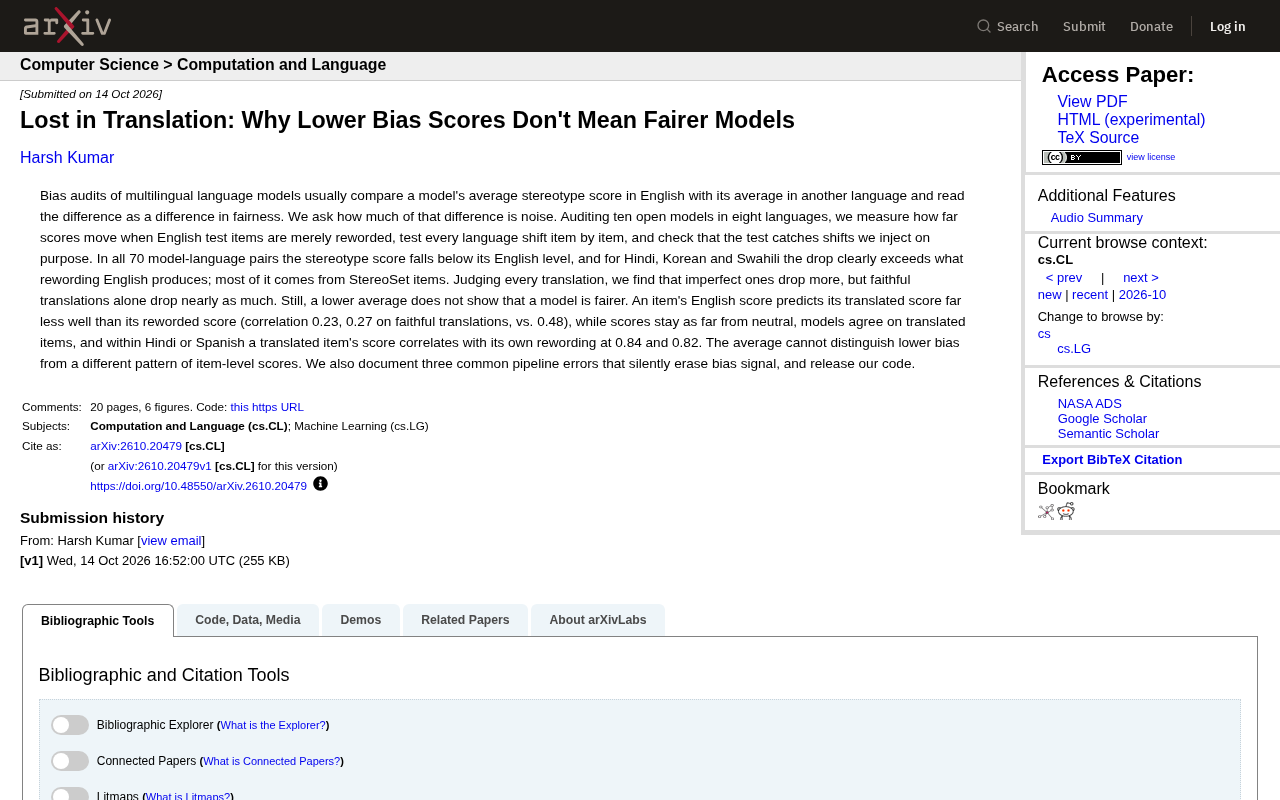
A study covering ten open-source models, eight languages, and 70 model-language pairings found that non-English stereotype scores are generally lower than English, but this decline is not a fairness improvement. By establishing a baseline through English rewording, the researchers found that translation disrupts the item-level score structure: English scores weakly predict translated scores (r=0.23), far lower than the predictive power of rewording (r=0.48), and faithful translations also cause significant score drops, ruling out translation errors as the main cause. The core conclusion is that average scores cannot distinguish "lower bias" from "a different item-level scoring pattern." The study also documented three workflow mistakes—test item alignment, translation filtering, and metric aggregation—that silently erase bias signals, and released the code for reproduction.
A Widely Misread Metric
Bias audits of multilingual language models typically adopt a seemingly straightforward approach: compare the model's average stereotype score on an English test set with its average score in another language, then interpret the difference between the two as a fairness difference. A lower score means the model is fairer in that language—a inference that has been repeated throughout the industry, yet few stop to ask: how much of this difference is real signal, and how much is just noise?
A recent study provides a systematic answer to this question. The research team audited ten open-source models across eight languages, and in all 70 "model-language" pairings, the non-English stereotype scores were lower than their English counterparts. On the surface, this would seem to suggest that models exhibit less bias when processing non-English languages. But the researchers did something more meticulous: they broke these scores down and examined item by item where this decline actually comes from.
Reword It, and the Score Drops Too
To judge whether the score decline caused by switching languages is meaningful, you first need a baseline: what happens to scores if you simply rephrase the same English test items in different words?
The researchers reworded English test items and found that rewording alone shifts the scores. This establishes a critical control baseline—any cross-lingual score change must exceed what "rephrasing" alone can explain before it can be considered a genuine language effect.
For Hindi, Korean, and Swahili, the score decline from cross-lingual switching clearly exceeded the fluctuation produced by English rewording, meaning there is indeed some language-related effect at play. But the researchers traced further and found that most of these declines came from specific test items in the StereoSet dataset, rather than a global fairness improvement. This detail matters: it shows that shifts in the average score may be dominated by a handful of test items, rather than a wholesale change in model behavior.
StereoSet is one of the most commonly used benchmark datasets in multilingual bias auditing, released by Mooney et al. in 2021, specifically designed to measure the degree of stereotyping in language models. Its questions take the form of "fill-in-the-blank": given a context sentence involving a specific group (such as gender, race, or occupation), the model must choose the most likely among three candidate completions—a stereotypical option, an anti-stereotypical option, and a distractor unrelated to the group. The proportion of times a model selects the stereotypical option constitutes the "stereotype score," with higher scores indicating stronger bias. The original StereoSet was in English, and it was later extended to multilingual versions, becoming a primary data source for cross-lingual bias comparison. It's important to note that because each test item is translated, its item-level semantics and difficulty may change—which is precisely the core methodological pitfall this study's researchers reveal.
Worse Translation, Lower Score—But That's Not the Whole Story
A natural hypothesis is that poor translation quality causes the score decline, because bad translations change the meaning of test items. The researchers evaluated every translation item by item and indeed found that imperfect translations produced larger score declines.
But it's not that simple. Even when looking only at faithful, accurate translations, the score decline was almost equally large. This directly rules out the explanation that "translation errors are the main cause."
More compelling is the correlation analysis. A test item's English score has weak predictive power for its post-translation score—a correlation coefficient of only 0.23, and only 0.27 for faithful translations. By contrast, the correlation coefficient between the same test item's scores before and after English rewording reached 0.48, nearly double the former. In other words, translation disrupts the score structure across test items—and that structure is precisely what bias auditing truly cares about.
The correlation coefficient (r) is a statistic measuring the strength of a linear relationship between two variables, ranging from -1 to 1, where values closer to 1 indicate a stronger relationship and values near 0 indicate almost no linear association. In bias auditing contexts, researchers use it to test "whether the same test item's scores remain consistent across different versions." If translation merely swaps the language shell without changing the substance of the test item, then the correlation between English and translated scores should be high. In this paper, r=0.23 means English scores can only explain about 5% (r²) of the variance in post-translation scores, indicating that the translation process substantially reconstructs the score structure of test items. As a control, the correlation coefficient before and after rewording within the same language reaches 0.48, showing that rewording disrupts the structure far less than translation—a comparison that constitutes key quantitative evidence for judging the degree of translation interference.
The Average Score Masks the Item-Level Truth
The researchers offer a core assertion: the average score cannot distinguish between "lower bias" and "a different item-level scoring pattern."
Several pieces of evidence support this. First, post-translation scores were not closer to neutral—scores simply changed, without becoming "less biased." Second, different models' scores on translated items showed high consistency, indicating this is not random noise but a systematic pattern shift. Finally, within Hindi or Spanish, a translated item's score correlated with its own reworded score at 0.84 and 0.82, far higher than its cross-lingual correlation with the original English item.
This set of numbers reveals an easily overlooked fact: the score structure within a single language is stable, but the cross-lingual structure is broken by the translation process. When we compare English average scores with Hindi average scores, we are in effect comparing two sets of items that are not comparable.
Item-level score structure refers to the pattern of how each test item's score is positioned relative to other items within the full set of questions, rather than a single average value. For example, if a model scores high on the "nurse-female" test item and low on "engineer-male" in English, then this ranking of highs and lows across items constitutes the structure. What bias auditing truly seeks to measure is this structure—which stereotypes are reinforced and which are weakened. When translation disrupts this structure, even if the average score remains unchanged, the model's bias distribution across different groups may already be unrecognizable. The average score reflects only the overall level, while the structure reflects the direction and distribution of bias. This paper's core methodological contribution is precisely to shift the unit of analysis from "a single average score" down to "each test item's score and its ranking," thereby exposing the truth that the average score conceals.
Three Process Mistakes That Silently Erase Bias Signals
Beyond the interference of translation itself, the researchers also documented three common mistakes in multilingual bias auditing workflows that silently erase bias signals:
- Test item alignment issues: In cross-lingual comparisons, if strict correspondence of items is not ensured, differences in average scores may merely reflect differences in test set composition.
- Improper translation filtering: Filtering out "imperfect" translations may seem to improve data quality, but may precisely delete the items that carry bias signals.
- Metric aggregation methods: When the item-level score structure has already been disrupted, directly aggregating into a single average value masks the true pattern of divergence.
These mistakes are dangerous because they don't throw errors—the audit workflow still outputs a nice-looking average score, except this number no longer points to what it claims to measure.
What This Study Means for Bias Auditing
The study's conclusions do not negate the value of multilingual bias auditing, but rather require practitioners to change how they interpret results.
When a report shows that a model's stereotype score in Korean is lower than in English, the correct response is not "this model is fairer to Korean," but rather to first ask: does this decline exceed the English rewording baseline? Is it concentrated in a few test items? Is the item-level score structure still comparable?
The researchers have released their code, meaning other teams can reproduce this item-by-item testing method. For teams that write bias scores into model cards or compliance documents, this provides a necessary reminder: a lower number may simply be another form of translation-induced noise, rather than any substantive improvement in fairness.
In an era where multilingual models are increasingly widespread, the rigor of the auditing methodology itself deserves scrutiny as much as the model behavior.
Model Cards are a model documentation standard proposed by Mitchell et al. in 2019, requiring developers to disclose intended use, performance metrics, limitations, and ethical considerations when releasing models, with bias audit scores being a common entry. Compliance documents refer to disclosure materials oriented toward regulatory requirements, such as the fairness assessment requirements for high-risk AI systems in the EU's Artificial Intelligence Act. This paper's warning is especially critical for these two types of documents: if audit scores are aggregated across languages without controlling for translation interference, then writing "Korean stereotype score lower than English" into a model card may be merely a product of translation noise rather than defensible evidence of fairness. The significance of the researchers releasing their code is that it makes this item-by-item testing workflow reproducible and incorporable into standard auditing pipelines, thereby preventing non-compliant bias claims from entering formal documents.
Related articles

Workbuddy for Absolute Beginners: How a Desktop AI Agent Fits Into Real Workflows
A beginner's guide to the Workbuddy desktop AI agent: installation, claiming credits, file management, and building automated workflows—compared with CodeX for fit and cost, helping professionals shift from AI question-askers to AI managers.

OpenAI's New Agent Stack: Computer Use, Decisions API, and Ultra-Fast Workflows
OpenAI Dev Day unveiled a new agent stack: Computer Use outperforms humans, Decisions API delivers ultra-low-latency classification via Luna, Agents API opens the same Computer Use capabilities, and GPT-6.1 Sol costs only one-seventh of Astra. Core updates, benchmark data, and developer insights.

Liang Wenfeng Open-Sources DeepInfo Inference Framework, Takes On U.S. Ban
DeepSeek open-sources its DeepInfo inference framework after its models, featuring GPU/CPU cross-pipelining, small-model prediction with large-model verification, and full Huawei Ascend and NVIDIA chip support—facing the U.S. federal ban head-on. This article analyzes its significance for AI deployment and open-source strategy.