A New Approach to AI Agent Architecture: Why Sandboxes and Execution Harnesses Must Be Separated

Every AI agent should run inside a sandbox, with the harness kept outside to maintain full supervisory control.
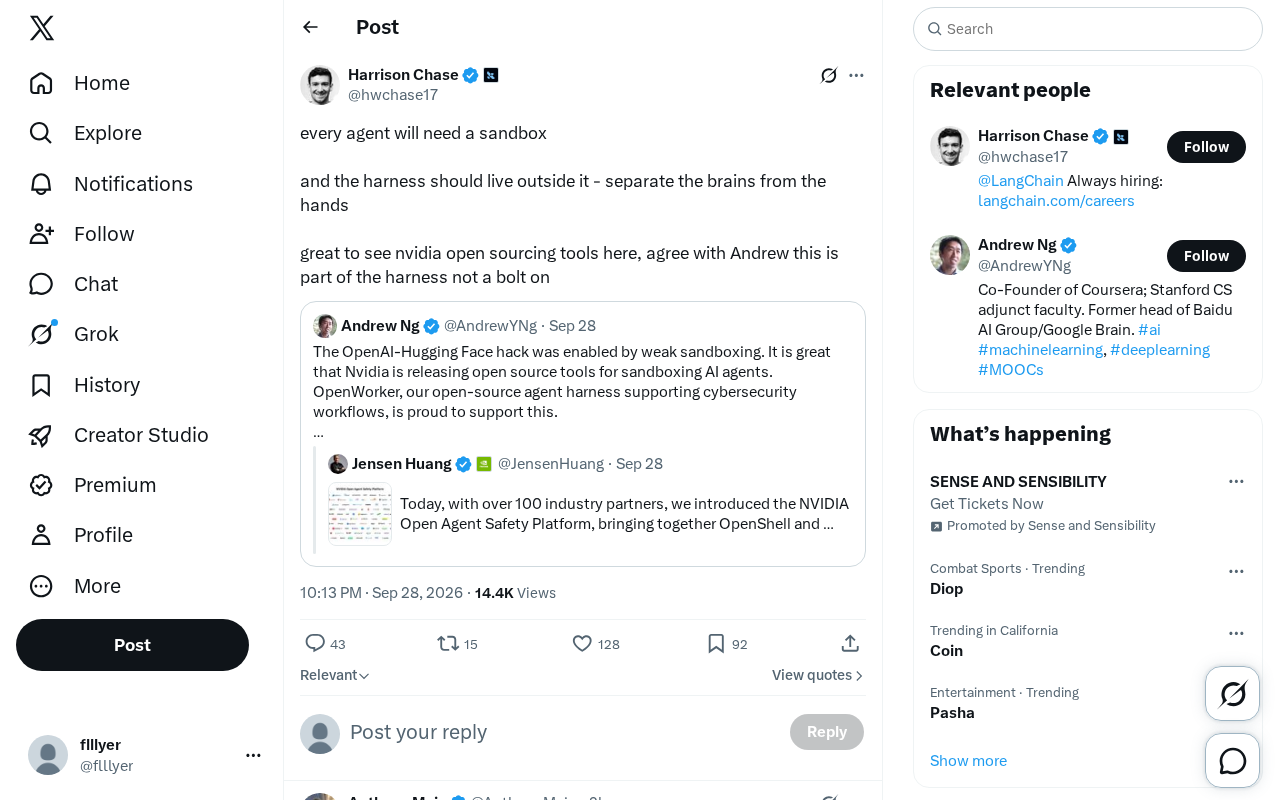
The article unpacks a Twitter argument that every AI agent needs a sandbox while the execution harness must run outside it. The core idea is separating the agent's "brains" (reasoning) from its "hands" (execution) — the sandbox constrains actions while the external harness retains the ability to pause, reset, or intervene at any time, mirroring OS-style privilege separation. Security controls must be first-class architectural components, not bolt-on patches — a principle exemplified by NVIDIA's open-source tooling efforts.
Every AI Agent Needs a Sandbox
As autonomous AI agents grow increasingly capable, the question of how to build safe, controllable runtime environments for them is becoming a central topic in the industry. A perspective shared on Twitter has recently attracted attention: every agent will need a sandbox, and the execution harness should run outside the sandbox.
This seemingly simple architectural stance touches on a core engineering philosophy in agent system design — separating the "brains" from the "hands".
The Logic Behind Separating "Brains" from "Hands"
The "brains" refer to the agent's reasoning and decision-making core — the model layer responsible for planning, judgment, and action generation. The "hands," on the other hand, are the capability layer that actually carries out those actions: calling tools, running code, accessing the file system or network.
The value of separating the two lies in clearly defined security boundaries. When an agent's reasoning logic might produce unpredictable behavior, confining the actual execution to an isolated sandbox environment effectively prevents potentially destructive operations from spreading to the host system. The sandbox becomes a "safety cage" for the agent's actions, while the harness that controls everything stands outside the cage — responsible for supervision, scheduling, and intervention.
Why the Harness Should Live Outside the Sandbox
This is the most critical technical claim in the original argument. If you place the execution harness inside the sandbox as well, then once the agent's behavior goes out of control, the harness itself becomes trapped in the same restricted environment, losing its ability to manage the situation.
Keeping the harness outside the sandbox means the supervisory layer always retains full control over the agent: it can pause, reset, or terminate execution inside the sandbox at any time, inject new instructions, or observe everything happening within the sandbox without being affected by it. This is a classic privilege separation design pattern, analogous to the isolation between kernel mode and user mode in operating systems.
Privilege Separation is a foundational principle in OS and security engineering: different components of a system are granted only the minimum permissions needed to fulfill their responsibilities, with strict isolation between the high-privilege supervisory layer and the low-privilege execution layer. The Linux kernel's Ring 0 (kernel mode) and Ring 3 (user mode) are the most well-known hardware-level implementation — user programs cannot directly manipulate hardware or other processes' memory, and must instead request the kernel to act on their behalf via system calls. In the agent context, the sandbox plays the role of "user mode": it may have full tool-calling capabilities, but all real effects on the outside world must be reviewed and proxied through the harness — the "kernel layer." Another benefit of this design is observability — because the harness sits outside the sandbox, it naturally has a complete view of all behavior within it, making auditing, replay, and debugging straightforward without relying on the agent's own logs or self-reporting.
The Significance of NVIDIA's Open-Source Tooling
The original post specifically noted excitement at seeing NVIDIA open-source tools in this space, and endorsed Andrew's view that these tools are part of the harness, not a bolt-on afterthought.
The phrase "not a bolt-on" is worth dwelling on. It emphasizes that security and execution control mechanisms for agents should be considered core components from the very beginning of architectural design — not a security module hastily added after the system is already built. Bolt-on solutions tend to suffer from incomplete coverage and awkward integration, whereas a natively integrated harness is what truly ensures agent behavior remains controllable.
As a major AI infrastructure vendor, NVIDIA's open-source contributions help lower the barrier for the entire industry to build safe agent systems, enabling more developers to construct their own agent applications on top of mature frameworks.
From a broader technical perspective, agent sandbox implementations currently exist at several levels: process-level isolation (e.g., Linux seccomp/namespaces, macOS App Sandbox) restricts system calls and resource access; container-level isolation (e.g., Docker, gVisor) provides independent views of the file system and network; and VM-level isolation (e.g., Firecracker microVM) offers the strongest isolation guarantees but introduces higher startup and communication overhead. Different scenarios require different trade-offs between security level and performance latency: low-latency interactive agents may favor container-based approaches, while agents handling sensitive data or high-risk operations may require VM-level hard isolation. Open-source tools from vendors like NVIDIA typically design custom isolation strategies tailored to the unique characteristics of GPU workloads — such as CUDA driver access and VRAM management — areas that general-purpose container solutions are ill-equipped to address directly.
Implications for Agent Engineering Practice
This architectural philosophy offers several practical takeaways for teams building agent systems:
- Isolation by default: Any agent with execution capabilities should run inside a controlled sandbox environment, not in direct contact with production systems.
- External control plane: Supervisory and scheduling logic must be independent from the execution environment being supervised, ensuring the ability to intervene under any circumstances.
- Native design, not patches: Security and control should be first-class components of agent architecture, incorporated from the design stage — not assembled after the fact.
As agents gradually move from the lab into production, this "brains-hands separation" philosophy is likely to become the standard paradigm for the next generation of agent infrastructure. It both addresses safety concerns arising from AI autonomy and provides a reliable engineering foundation for large-scale deployment.
Conclusion
This brief Twitter observation distills an important direction in the evolution of agent architecture. The sandbox provides isolation; the external harness provides control. Together, they form the foundational framework that allows agents to be both capable and controllable. Open-source efforts from vendors like NVIDIA are translating this concept from an idea into a tangible, deployable toolchain. For any team seriously considering deploying autonomous agents, understanding and adopting this separation architecture early may well be the wisest way to avoid costly pitfalls down the road.
Related articles

MCP Protocol in 60 Seconds: A Real Session, Message by Message
Dissecting a real MCP session message by message: how an Agent dynamically discovers tools, forwards call requests, and has an MCP server execute them — all in just 9 JSON messages, with the model and reasoning loop untouched.

n8n 40-Minute Masterclass: Build Your First AI Automation Workflow from Scratch
Distilled from a 40-minute n8n masterclass: the core differences between automation, AI, and AI Agents, a comparison of n8n's four deployment methods, and a complete guide from dashboard to your first workflow.

Why Does a 35GB Quantized Model Blow Up an 80GB GPU? The Truth About KV Cache VRAM
Why does a 35GB 4-bit quantized LLM still blow up an 80GB GPU? This article breaks down the four components of inference VRAM, provides precise KV Cache formulas, compares GQA vs DeepSeek MLA memory, and offers production-grade OOM prevention like FP8 KV Cache.