A New Approach to Cross-Model LoRA Reuse: Identifying Backbones via Geometric Signatures

Study reveals LoRA update directions carry backbone signatures; cross-model sharing is feasible but risks need careful evaluation.
The study proposes geometrically that LoRA update directions serve as backbone "training signatures": updates independently trained on the same backbone are intrinsically similar, while those from different backbones differ measurably. The authors derive a cross-backbone correlation upper bound via attention symmetry and explain it with equivariant LoRA and a local gradient flow model. On CLIP backbones, summing updates from different sources yields accuracy nearly matching individual adapters; cosine scores reliably identify the source backbone, and registered adapters remain detectable in mixed sums. This offers two practical tools—cosine-similarity backbone identification and an alignment-free inner-product test. However, when task distributions differ greatly, the correlation bound may tighten, so sharing risks need dynamic evaluation.
Sharing LoRA Updates Across Models: Hidden Concerns Behind the Convenience
In model deployment, sharing the same Low-Rank Adaptation (LoRA) update across multiple pretrained models can significantly simplify the workflow. However, whether updates can be safely shared between different backbones, whether accuracy suffers after sharing, and whether the contribution of an individual adapter can be traced—these questions have long lacked a theoretical explanation. A recent study approaches the problem from a geometric angle, proposing to use backbone-specific update directions as "training signatures," offering a new perspective on these issues.
Core Idea: Update Direction as Backbone Signature
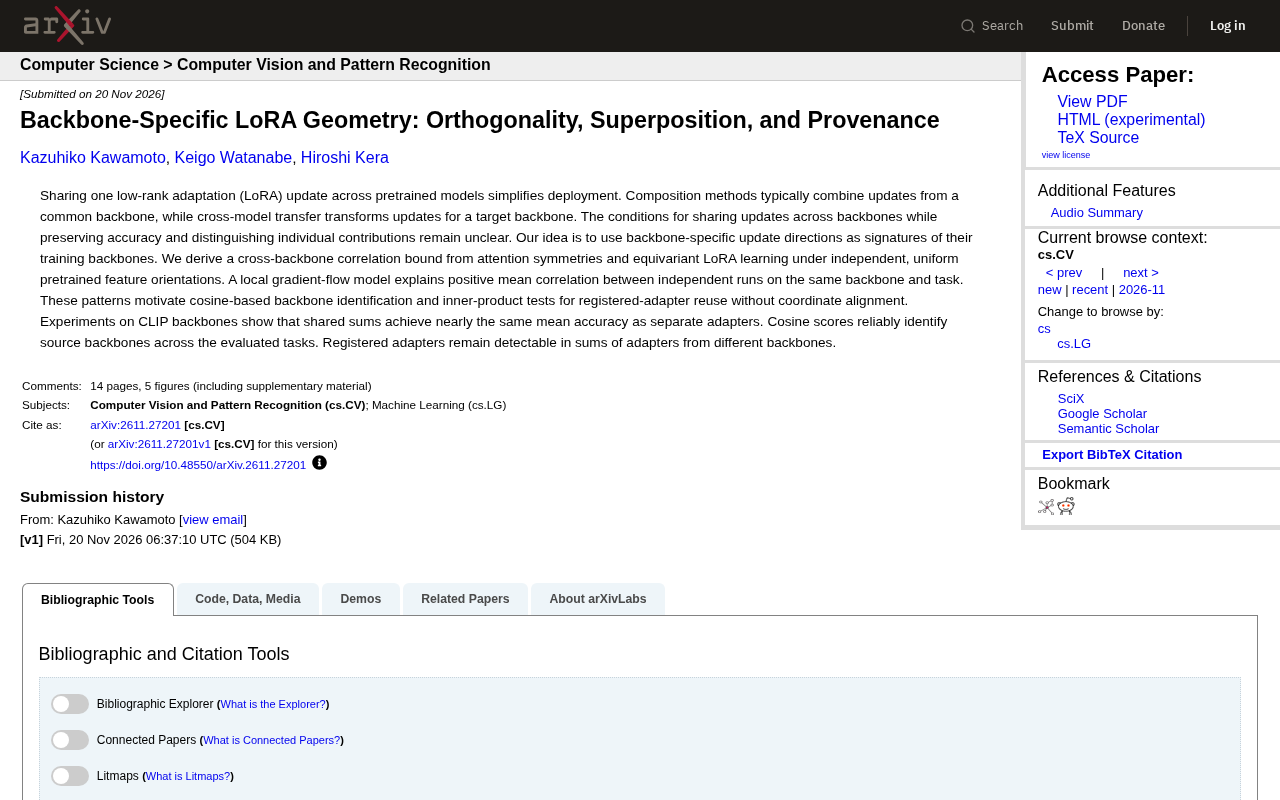
The basic hypothesis of the study is that LoRA updates independently trained on the same backbone have intrinsically similar directions, whereas updates produced by different backbones exhibit measurable differences. Using attention symmetry, the authors derive a cross-backbone correlation upper bound, and analyze it under independent, uniformly distributed pretrained feature directions with equivariant LoRA learning. A local gradient flow model explains the positive mean correlation between independent runs on the same backbone and the same task. These patterns support two practical tools: cosine-similarity-based backbone identification, and a registration-adapter reuse inner-product test that requires no coordinate alignment.
LoRA (Low-Rank Adaptation) is a parameter-efficient fine-tuning technique that freezes the pretrained model weights and injects trainable low-rank decomposition matrices (A and B) alongside the attention matrices in Transformer layers, adapting to downstream tasks by adjusting these two small matrices. Since LoRA updates only change a small number of parameters, different backbones (such as CLIP models of different sizes) can independently train their own adapters. However, when multiple adapters need to be merged or transferred, whether the update directions (i.e., the subspaces spanned by the low-rank matrices) are compatible becomes the key question. The study leverages equivariant LoRA—the property that update directions remain equivariant under symmetric transformations applied to input features—to derive the cross-backbone correlation upper bound, thereby formalizing "direction similarity" as a computable geometric signature.
Experimental Validation: Findings on CLIP Backbones
Experiments on the CLIP family of backbones show that directly summing LoRA updates from different sources yields average accuracy nearly comparable to using each adapter individually. Cosine scores reliably identify the source backbone and perform consistently across the evaluated tasks. Moreover, even when adapters from different backbones are summed, registered adapters can still be detected. This means that sharing updates does not cause severe accuracy loss in most cases, while source information is preserved to some extent.
Cosine similarity is used here to measure the cosine of the angle between two LoRA update matrices (flattened into vectors); values closer to 1 indicate more consistent directions. Since updates independently trained on the same backbone have highly similar directions while those from different backbones exhibit systematic bias, the source of an adapter can be determined by computing the cosine score between the adapter under test and reference updates from known backbones. The registration-adapter reuse inner-product test is a verification method that requires no explicit coordinate alignment: the adapter update is inner-producted with a registration template, and if the result exceeds a threshold, it is judged as a valid registration. Experiments show that even after summing multiple adapters, the registration signal can still be detected by the inner-product test, providing a lightweight means for adapter provenance tracking.
Multi-Source Perspectives: Consensus and Divergence
According to analyses of the study by a Bilibili creator and a YouTube channel, the core consensus is that LoRA update directions do carry characteristic information about the backbone, offering a new dimension for model provenance and adapter management. However, there is disagreement on whether "cross-backbone summation is always safe": one side holds that the accuracy retention in the experiments supports the feasibility of broad sharing; the other points out that the detectability of registered adapters does not equate to lossless performance in all scenarios, especially when task distributions differ greatly, where the correlation upper bound may tighten and sharing risks still require careful evaluation. These divergences suggest that in actual deployment, decisions should be made dynamically based on task similarity and backbone differences.
Practical Implications: From Identification to Reuse
The study provides an actionable path for LoRA adapter management. Developers can quickly determine whether an adapter comes from the target backbone via cosine similarity, avoiding blind reuse. When multiple adapters need to be merged, the inner-product test can help confirm whether a registered adapter is still valid, reducing the cumbersome steps of coordinate alignment. Although the experiments focus on CLIP backbones, the geometric analysis framework is general and is expected to extend to more model families in the future.
Limitations and Future Directions
The current conclusions are mainly based on the assumption of independent, uniformly distributed feature directions; real pretrained models may have more complex characteristics. The tightness of the cross-backbone correlation upper bound when tasks differ greatly still needs further verification. In addition, the study does not address long-term stability in large-scale multi-task scenarios. Future work could explore adaptive thresholds and richer backbone signature methods to improve the robustness of cross-model reuse.
Related articles

Nothing CMF Buds 2A Drops to $17.89 on Black Friday: A New Low for ANC Earbuds
Nothing CMF Buds 2A wireless earbuds Black Friday deal: just $17.89 on Amazon, about $11 off retail and a record low. ANC earbuds at an entry-level price.

When AI Creation Gets Accused of "Spitting": Hacker News Heats Up Over the Glaude Controversy
A Hacker News post, "Spitting in the Face of Glaude," sparks debate on AI creation transparency and attribution ethics. This analysis examines the blurred creator identity behind the controversy and offers practical advice for AI content production.

Akai Embraces Custom Firmware: MPC Sample 1.4 Lets Users AI-Program Their Sampler
Akai embraces the modding community with MPC Sample 1.4 firmware, supporting vibe-coded custom firmware and effects. We analyze the impact of this open strategy on music hardware and AI-assisted programming.