A New Approach to Document Review: Unsiloed and TypeSafe Jev Explained

Unsiloed and TypeSafe Jev combine to offer a 'broad ingestion + precise validation' layered architecture for document review.
This article explores the Hacker News topic 'Document Review with Unsiloed and TypeSafe Jev,' analyzing the combination of two tools in document review. Unsiloed breaks down enterprise document data silos, unifying multi-format documents into structurally accessible information; TypeSafe Jev introduces type safety via predefined schemas, ensuring AI-extracted information conforms to expected formats. Together they form a 'broad ingestion + precise validation' layered architecture. The article notes that structured output is becoming AI infrastructure, and in document-intensive industries, output determinism has more commercial value than model scale.
A New Approach to Document Review: What Are Unsiloed and TypeSafe Jev?
In a recent Hacker News discussion, a topic titled "Document Review with Unsiloed and TypeSafe Jev" caught the attention of the technical community. From the title, it involves a combination of two tools or concepts: Unsiloed and TypeSafe Jev, applied to Document Review scenarios.
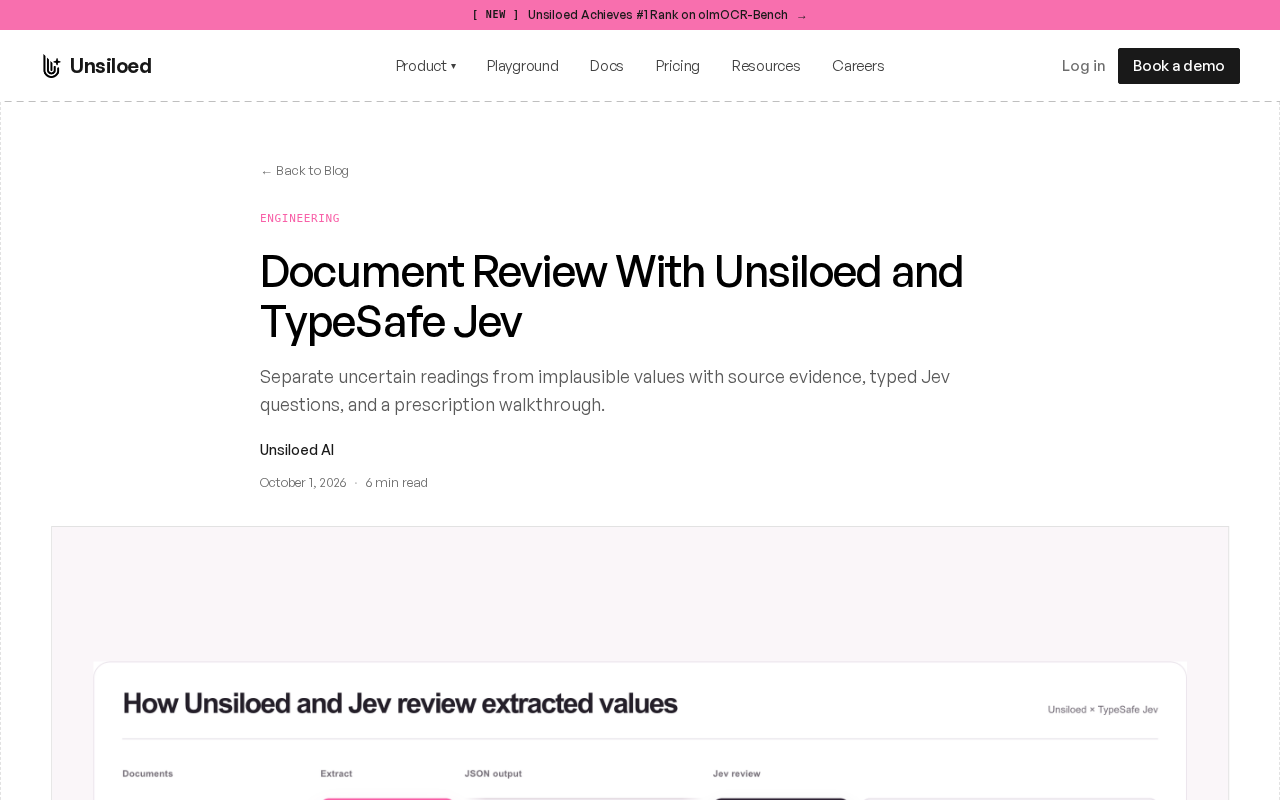
Document review has long been a pain point in legal, compliance, and financial industries — massive amounts of unstructured text require manual line-by-line comparison, extraction of key clauses, and identification of risk points. Traditional OCR tools can only recognize text but cannot understand the semantic structure of documents; general-purpose large models can process text but have clear shortcomings in formatted output and type safety. The combination of Unsiloed and TypeSafe Jev is an attempt to find breakthroughs in these two dimensions.
Unsiloed: Breaking Down Data Silos
The name "Unsiloed" itself conveys the core design philosophy — breaking down data silos. In enterprise environments, documents are often scattered across different systems, formats, and storage locations. PDFs, scanned files, email attachments, and contract templates each operate independently.
Unsiloed's value lies in unifying these "siloed" document data and transforming it into structurally accessible information. For document review tasks, this means reviewers no longer need to manually switch between multiple systems to copy and paste — they can perform retrieval, comparison, and analysis on a unified data layer.
At the technical implementation level, breaking down data silos typically requires document parsing and layout understanding capabilities. Modern document processing pipelines generally include layout analysis (identifying regions such as headings, tables, paragraphs, headers, and footers), OCR text recognition, table structure reconstruction, and reading order reconstruction. For scanned files and complex PDF layouts, plain text extraction often loses critical structural information, leading to errors in subsequent extraction stages. Therefore, tools like Unsiloed typically need to integrate multiple parsing engines and adapt templates for specific document types such as contracts, invoices, and reports. Additionally, the data unification layer must handle multi-source ingestion, including connecting to enterprise cloud drives, email systems, CMS, and other data sources, while providing a unified metadata index so that retrieval and comparison operations can be performed across document collections from different sources.
TypeSafe Jev: Type-Safe Document Output
TypeSafe Jev approaches the problem from a different angle. In document review workflows, if AI-extracted information lacks type constraints, it easily produces output that "looks reasonable but is actually unusable" — such as inconsistent date formats, monetary fields mixed with text, or incorrectly identified clause numbers.
TypeSafe Jev's approach is to introduce a type safety mechanism for document review output. Through predefined data schemas, it ensures that every piece of information extracted from documents conforms to expected type and format requirements. This is crucial for downstream applications that require strict data quality, such as compliance checking engines and risk scoring systems.
Type Safety originates from the field of programming languages, referring to the ability of a program to guarantee at compile time or runtime that a variable's value always conforms to its declared type, thereby catching type mismatch errors early. Applied to AI document review scenarios, type safety means using schema definition tools like JSON Schema, Pydantic, or Zod to constrain the output structure of large models — for example, enforcing that a "contract amount" field must be numeric and that an "effective date" must conform to ISO 8601 format. The value of this approach lies in the fact that large models are essentially probabilistic text generators — no matter how precise the prompt, format drift cannot be fundamentally eliminated. With a type validation layer in place, downstream systems receive not free text that "looks like structured data" but reliable data objects verified against schemas, avoiding cascading failures caused by dirty data.
Practical Significance of the Combined Approach
Looking at Unsiloed and TypeSafe Jev together, this combined approach attempts to solve two core tensions in document review:
The breadth of data ingestion and the quality of output results. Unsiloed handles "casting a wide net" — unifying documents from various sources and formats; TypeSafe Jev handles "precise filtering" — ensuring every piece of structured information output has undergone type validation.
This layered architecture is reasonable from an engineering perspective. What document review systems fear most is not "not being able to review everything" but "reviewing incorrectly without knowing it." The introduction of type safety is equivalent to adding a quality control checkpoint between AI output and business decisions.
From an engineering architecture perspective, this "ingestion layer + validation layer" design is similar to a traditional ETL (Extract-Transform-Load) pipeline, but with an AI inference component added. The difference is that traditional ETL processes relatively well-structured data, while document review faces highly heterogeneous unstructured content, requiring higher fault tolerance and explainability. In actual deployment, teams typically also need to consider a human review step — when type validation fails or confidence falls below a threshold, results are routed to human handlers, forming a hybrid workflow of "AI initial screening + human fallback." This human-in-the-loop model is particularly common in legal and compliance scenarios, because the cost of incorrect extraction can far exceed the cost of human review.
Implications for Developers and Enterprises
Judging from the traction of the Hacker News discussion, tool innovation in the document review space is accelerating. Several trends worth watching:
Structured output is becoming infrastructure for AI applications. Whether it's Unsiloed's data unification layer or TypeSafe Jev's type safety layer, both are essentially adding determinism to large model outputs. In document-intensive industries, this determinism has more commercial value than the model's parameter scale itself.
Composable toolchains outperform monolithic solutions. Document review involves multiple stages including parsing, extraction, validation, and comparison — it's difficult for a single tool to do it all. The Unsiloed + TypeSafe Jev combination reflects developers' preference for assembling toolchains on demand rather than committing to an all-in-one platform.
For teams building document processing pipelines, this case provides an architectural pattern worth referencing: unify at the data ingestion layer, constrain at the output layer, and keep processing stages in between flexible and replaceable.
One-line Summary
Unsiloed and TypeSafe Jev combine to provide a "broad ingestion + precise validation" layered architecture for document review.
Paragraph Summary
This article explores the Hacker News topic "Document Review with Unsiloed and TypeSafe Jev," analyzing the combination approach of two tools in the document review space. Unsiloed is dedicated to breaking down enterprise document data silos, unifying multi-format documents such as PDFs, scanned files, and email attachments into structurally accessible information; TypeSafe Jev introduces type safety mechanisms through predefined data schemas, ensuring that every piece of information AI extracts from documents conforms to expected formats. Together they form a "broad ingestion + precise validation" layered architecture. The article points out that this pattern reflects the trend of structured output becoming infrastructure for AI applications — in document-intensive industries, output determinism has more commercial value than model scale, and composable toolchains outperform monolithic solutions.
Related articles

Chain of Thought Isn't Just for AI: How Humans Can Use CoT to Improve Thinking Quality
Chain of Thought isn't just a prompt trick for large models. Starting from a Hacker News discussion, this article analyzes why CoT works for human thinking too, breaks down actionable ways to transfer it, and highlights the key differences between human CoT and machine CoT.
Cloudflare Teams Up with OpenAI: Closi…
Cloudflare Teams Up with OpenAI: Closing the Loop from Vulnerability Discovery to Defense with AI
Cloudflare uses OpenAI Daybreak to investigate security vulnerabilities and generate reviewable remediation plans, while developers use Codex to boost coding efficiency and quality.

Orca Multi-Agent Orchestration in Practice: A Guide to Parallel Collaboration with Claude and Codex
Orca is Stable AI's free open-source agent workbench supporting 34 agents like Claude Code and Codex in parallel. Learn its Git worktree isolation, multi-model orchestration, and mobile management.