A New Approach to Pose Control in MiniMax H3: Using Video Outpainting Instead of OpenPose

Developer ports image outpainting technique to MiniMax H3 to bypass OpenPose skeleton extraction for robust pose control.
A Reddit developer has proposed an outpainting-based alternative to traditional pose control methods in MiniMax H3 video generation. Rather than relying on unstable reference video control or the ControlNet/OpenPose pipeline — which is slow and sensitive to body proportion mismatches — the new approach stitches the reference video alongside the target canvas and lets the model transfer motion directly. Validated via the ComfyUI-MMH3-UltimateExtend node, it maintains good motion consistency even with significant character body differences, at the cost of wider video frames and higher VRAM usage.
Precisely controlling character motion and pose in AI video generation has long been one of the most frustrating challenges for creators. Recently, a Reddit developer shared a brand-new method for controlling character poses in MiniMax H3 — one that sidesteps many of the limitations of traditional ControlNet and offers a simpler path to video motion transfer.
The Pain Points of Traditional Pose Control
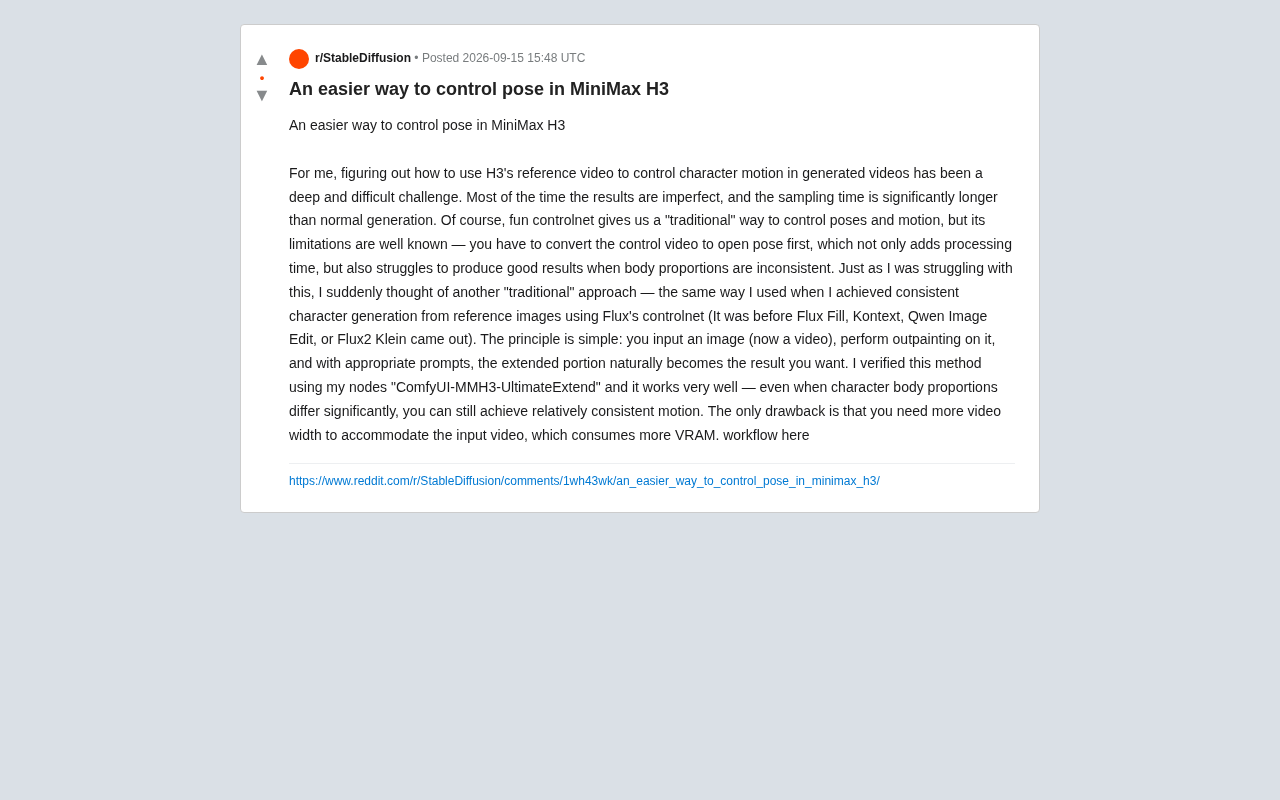
MiniMax H3 natively supports using a reference video to control character motion in generated videos, but the real-world experience leaves a lot to be desired. According to the developer, controlling character movement via reference video is a "deep and difficult" challenge — results are rarely perfect in most cases, and sampling time is noticeably longer than standard generation.
The alternative is ControlNet (referred to as "fun controlnet" in the post), a more "traditional" approach to pose and motion control. But its limitations are well known: you must first convert the control video into an OpenPose skeleton, which adds extra processing time and makes it difficult to get good results when character body proportions don't match.
In short, no matter which path you take, creators are forced to compromise between generation quality, processing time, and the difficulty of adaptation. That's the problem this new method sets out to solve.
ControlNet is a conditional control network designed for diffusion models. It injects spatial structural information — such as skeletons, depth maps, and edge lines — into the generation process via an additional encoder, constraining the pose or composition of the output. OpenPose is the most commonly used skeleton extraction method within this framework, detecting human keypoints (head, shoulders, elbows, wrists, hips, knees, ankles, etc.) and representing them as a colored line diagram, which is then fed into ControlNet to guide character pose generation. This pipeline is well-established for static image generation, but extending it to video requires per-frame skeleton extraction and temporal consistency, dramatically raising the technical bar and computational cost. Even more problematic: OpenPose keypoint coordinates are absolute pixel positions. When the reference and target characters differ in height, body type, or aspect ratio, directly reusing skeleton maps often results in distorted limbs or mismatched proportions — requiring additional normalization to address.
Borrowing an "Old Trick" from the Flux Era
Interestingly, this new approach isn't an entirely new invention — it's an experience transplanted from the image generation era. The author mentions that before editing tools like Flux Fill, Kontext, Qwen Image Edit, and Flux2 Klein came along, he had used Flux's ControlNet to achieve character consistency from reference images using an outpainting-based technique.
The core principle of this method is actually quite straightforward:
- Start with an image (now replaced by a video);
- Apply outpainting to it;
- With the right prompt, the expanded region naturally becomes what you want.
Transferring this logic from static images to video yields a new method for pose control in MiniMax H3. Compared to the pipeline of converting to OpenPose first and then generating, it eliminates the skeleton conversion step entirely.
Outpainting refers to generating new content beyond the edges of an original image or video, extending the frame while maintaining internal consistency. In image generation, this technique is widely used to expand compositions, complete cropped limbs, or place multiple reference elements within the same frame so the model can perceive their relationship. The core mechanism is: treating the original content as a known region, marking the area to be extended with a mask, and having the model generate content that maintains stylistic and semantic coherence with both sides. In video scenarios, outpainting works at the frame level — by stitching the reference video and target canvas together in a wide-aspect frame, the model can perceive the motion information from the reference side during generation and "translate" it onto the target character. This is the underlying logic that lets the method bypass skeleton extraction: spatial juxtaposition replaces explicit structural encoding.
Validation and Results
The author validated this approach using their own ComfyUI node, ComfyUI-MMH3-UltimateExtend, with promising results.
The most notable finding: even when character body proportions differ significantly, this outpainting approach can still achieve relatively consistent motion transfer. This directly addresses the long-standing weakness of ControlNet when dealing with mismatched body proportions.
The Only Trade-off: Higher VRAM Usage
Of course, this method isn't without its costs. The author is upfront about the one downside: you need a wider video frame to accommodate the input video, which consumes more VRAM.
For users with limited VRAM, this may require some consideration — trading higher hardware overhead for a simpler workflow and better proportion-adaptation capability.
What This Approach Reveals
The insight this case offers to AI video creators may be more valuable than the method itself.
Many times, solving problems with new tools doesn't require waiting for official features to arrive. Instead, you can recombine and port "traditional" techniques that have already been validated in other models and contexts. The image outpainting technique that matured during the Flux era has been cleverly grafted onto video pose control — a prime example of cross-domain experience reuse.
For users working with MiniMax H3 who are struggling with pose control, this outpainting-based workflow is worth trying — especially in scenarios where the reference video and target character differ significantly in body type. Note that this content comes from a single Reddit developer's personal practice, so actual results should be verified within your own workflow.
Related articles

LynnReal-Omni: 32B Unified Video Diffusion Model Goes Open Source with Multi-Task Coverage in Four Steps
LynnReal-Omni is a 32B unified video diffusion model on MiniMax H3, covering text-to-video, pose guidance, style transfer, restoration in 4 steps. Flash version generates 540p video in 377ms on one H100.

Anthropic Co-Founder: AI 'Kill Switch' May Need to Be Mandatory by Law
Anthropic's co-founder tells the BBC that AI 'kill switches' may need to be legally mandated. We analyze the industry logic, technical challenges, and the tension between regulation and innovation.

The AI Data Center Boom Is Colliding With Cities Scarred by Heavy Industry
The AI data center boom is clashing with post-industrial communities. Philadelphia's case reveals structural conflicts between AI growth, energy use, water, and environmental justice.