CUDA-Accelerated Rocket League Simulator: A Player-Made Hardcore Experiment

A hot Reddit post shows a CUDA-accelerated Rocket League physics simulator with a bold claim but little detail, sparking debate on GPU physics and AI training environments.
A post in r/rocketleague showcases a Rocket League physics simulator labeled "100% Accurate," built on NVIDIA CUDA for GPU acceleration. The article notes that Rocket League's collision and rigid-body physics are natural fits for parallel computing, and CUDA could speed up batch collision detection and state updates, with potential value for RL training. But the post has only a title and one screenshot—no performance data, accuracy metrics, or code—so "100% Accurate" is more community joke than technical claim, and reproducibility remains unverified.
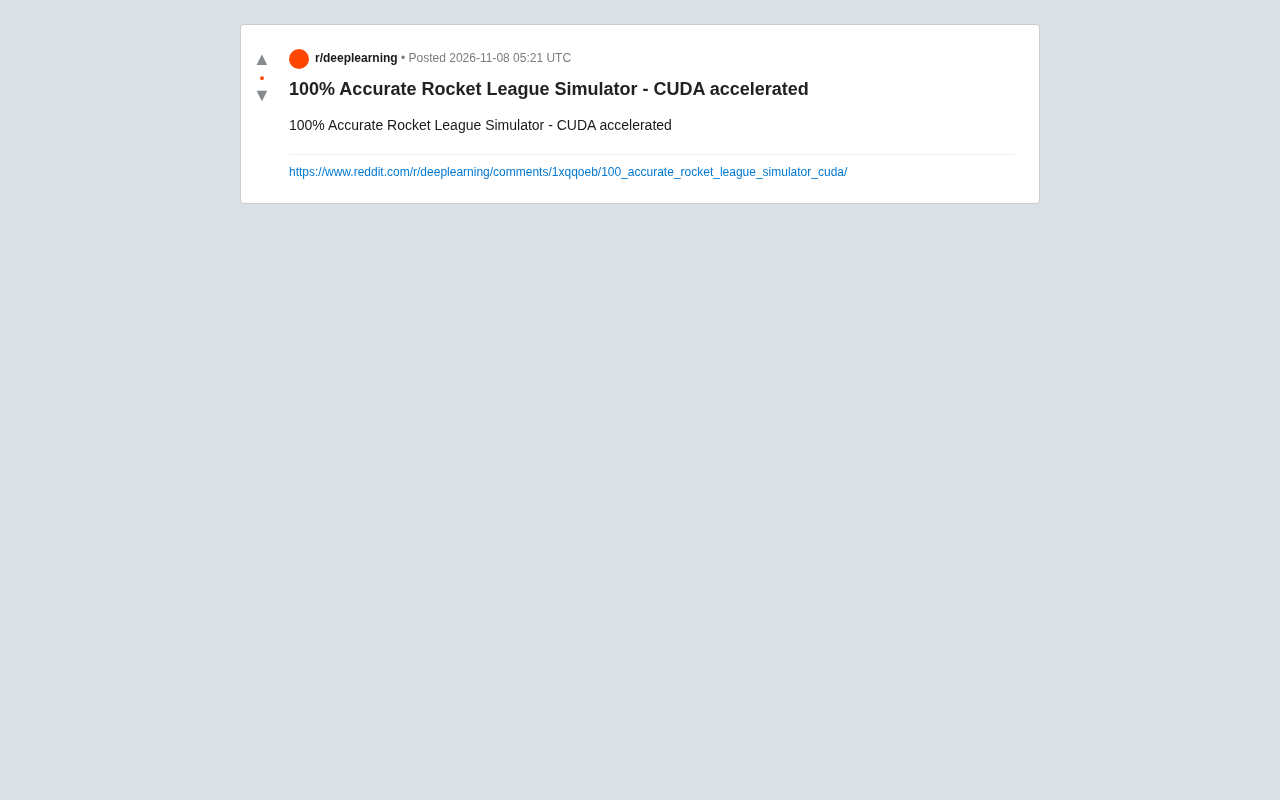
In the r/rocketleague subreddit, a post titled "100% Accurate Rocket League Simulator - CUDA accelerated" drew attention. The author showcased a Rocket League physics simulator accelerated with CUDA, accompanied by the "100% Accurate" phrasing that carries an obvious community-joke tone.
What This Project Actually Is
Judging from the title and screenshot, this is a physics simulation program modeled on Rocket League, with its core selling point being the use of NVIDIA CUDA for parallel acceleration. Rocket League itself is known for vehicle collisions, aerial flips, ball physics, and high-speed motion — scenarios naturally suited to GPU parallel computing.
"100% Accurate" is clearly not a literal, precise replica; it reads more like a community-style joke — wrapping a technical demo in an exaggerated claim. The original post provides no specific technical details, accuracy metrics, or performance data, so it's impossible to judge how closely its simulation results approach the real game's physics.
Why CUDA Is Used Here
Rocket League's core physics involves collision detection and response among multiple rigid bodies, ball rotation and aerodynamics, and vehicle attitude changes in the air. If all of these were computed serially on the CPU, they would easily become a bottleneck with large numbers of objects or high-precision stepping.
The value of CUDA lies in offloading the parallelizable parts — such as batch collision detection, particles, or state updates — to the GPU. For developers doing reinforcement learning training, physics engine experiments, or game AI research, a GPU-accelerated simulation environment means running more episodes in the same amount of time. However, the original post discloses no speedup ratios, frame rates, or training throughput, so any claim about the magnitude of performance gains can only remain speculation.
CUDA (Compute Unified Device Architecture) is a parallel computing platform and programming model introduced by NVIDIA, allowing developers to directly call thousands of compute cores on the GPU using languages such as C/C++. GPUs were originally designed for graphics rendering, and their architecture excels at executing large numbers of simple computations simultaneously — a strong fit for the needs of physics simulation, where tasks like batch collision detection and state updates must be processed. CUDA organizes data into grids and thread blocks, giving developers fine-grained control over parallelism, but it also requires explicit management of memory transfers between host and device. Since its release in 2007, CUDA has become one of the de facto standards in scientific computing, deep learning, and physics simulation, with an ecosystem including acceleration libraries such as cuBLAS and cuDNN that greatly lower the barrier to GPU programming.
The Significance and Limitations of Community Projects
Posts like this on Reddit typically have two kinds of readers: developers who come to see the technical implementation, and ordinary players who come for the memes. The "100% Accurate" in the title happens to satisfy both needs at once — a technical hook and community humor.
The limitations are equally obvious. A single screenshot and one title line carry very limited information, and there's no way to verify whether the simulator is actually runnable, whether it's open source, or what input methods it supports. Only if the author later releases code or a demo video would the project have a basis for reproduction and evaluation. Until then, it's better treated as an interesting signal of GPU physics experimentation rather than a directly usable tool.
Implications for the Intersection of AI and Games
Game simulators have always been the invisible infrastructure of AI research. From Atari to Dota to various physics-intensive games, the speed of the training environment often directly determines the pace of experiment iteration. A CUDA-accelerated Rocket League-style simulator, if it could truly maintain physical plausibility while gaining parallel benefits, would be practically appealing to researchers working on reinforcement learning, imitation learning, or game agents.
But this path is not easy. GPU-parallel physics must handle issues such as data synchronization, precision consistency, and kernel scheduling, and the many branches in game logic also undermine parallel efficiency. The gap between a CUDA simulator that "runs" and one that's "usable for training" is often far larger than the title suggests.
At present, the only confirmable information is the title, the platform, and one screenshot. The project's true quality still requires more evidence from the author.
Reinforcement Learning (RL) involves an agent learning a policy through trial and error by interacting with an environment, and the training process typically requires millions or even billions of simulation steps. The speed of the simulation environment directly determines the number of samples that can be collected per unit time, which in turn affects training efficiency. Traditionally, many RL experiments rely on game simulators running on the CPU (such as the Atari 2600 emulator), but the complex computations of physics-intensive games (such as Rocket League) easily become a bottleneck. GPU-accelerated simulators can parallelize physics stepping, making them especially suitable for distributed RL training that requires large numbers of parallel environment instances. However, GPU simulation also brings new challenges: environment states must be maintained in GPU memory, data exchange with the learning algorithm may introduce additional overhead, and not all game logic is easy to parallelize.
One-line Summary
A hot Reddit post showcases a CUDA-accelerated Rocket League physics simulator with an exaggerated title and limited information, sparking discussion about the value of GPU physics simulation and AI training environments.
Paragraph Summary
A post in the r/rocketleague subreddit showcases a Rocket League physics simulator labeled "100% Accurate," with its core selling point being GPU acceleration via NVIDIA CUDA. The article argues that Rocket League's collision and rigid-body physics are naturally suited to parallel computing, and that CUDA can accelerate batch collision detection and state updates, offering potential value for reinforcement learning training environments. However, the original post contains only a title and one screenshot, disclosing no performance data, accuracy metrics, or code, so "100% Accurate" is more of a community joke than a technical claim. The project's reproducibility is questionable, and its true quality awaits more evidence from the author.
Related articles
 Tech Frontiers
Coldframe: A Honeypot Disguised as a Supermarket Freezer Controller
Coldframe is a honeypot disguised as Danfoss AK-SM 800A and Dixell XWEB freezer controllers, built as a single Python file that detects CVE-2025-41450 attempts and is identified as real devices on Shodan.
 Tech Frontiers
GRFNet: A Lightweight PyTorch Model Designed for Multichannel Time-Series Classification
GRFNet is a lightweight PyTorch model for multichannel time-series classification, originating from EEG decoding research. With only 3,847 parameters, it is based on the ROCKET architecture, combining random convolution kernels with learnable spatial filters, supports arbitrary input lengths, and will soon be evaluated on the PhysioNet dataset.
 Tech Frontiers
Stylome Bot Slammed as Useless Junk: Why Do AI Detection Tools Keep Failing?
Reddit users test the Stylome AI detection bot: Gemini-rewritten text judged human-written, consistently low confidence. An analysis of AI text detection's technical dilemmas, privacy concerns, and credibility crisis in community governance.