A New Breakthrough in Differential Privacy: How to Achieve Instance-Optimal Moment Estimation?
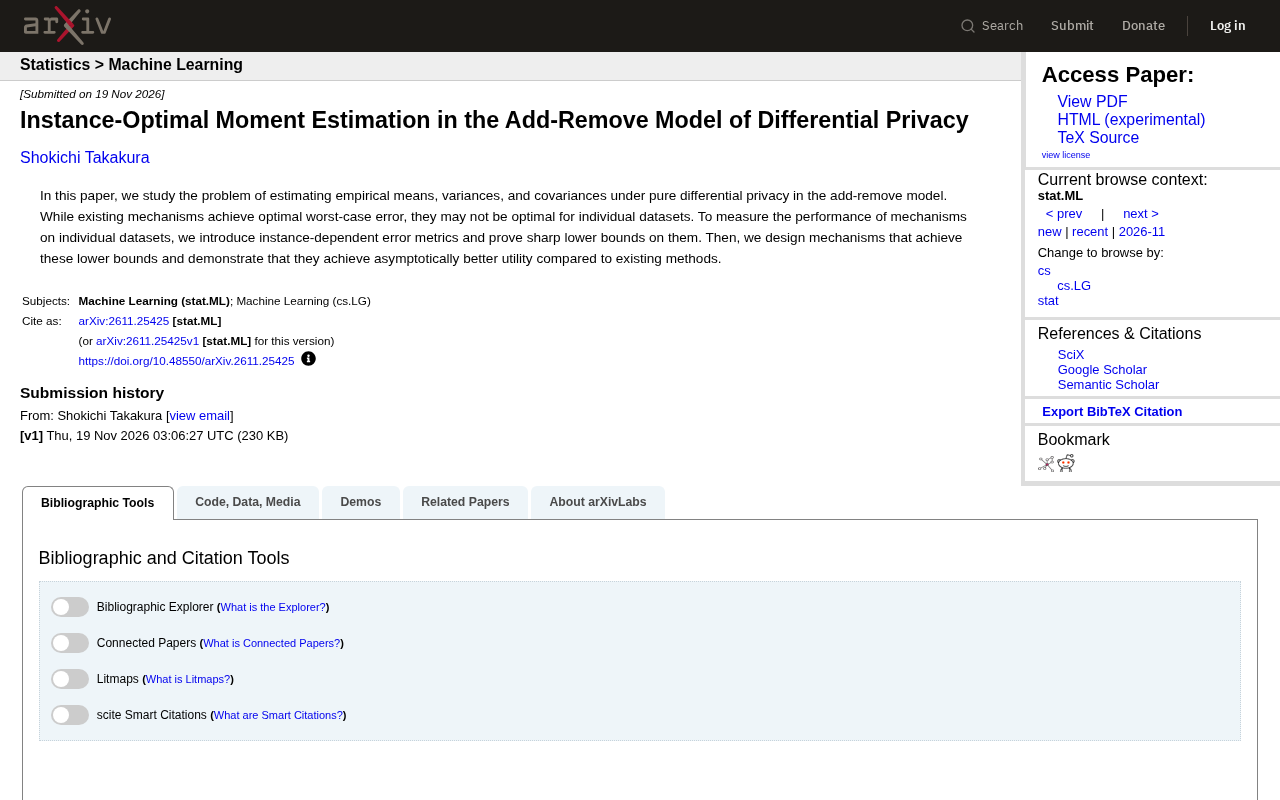
The paper proposes instance-dependent lower bounds and adaptive mechanisms for differential privacy moment estimation under the add-remove model, achieving optimal utility on individual datasets.
This article introduces research on instance optimality for moment estimation in differential privacy. Traditional mechanisms are worst-case optimal but may introduce excessive noise for specific datasets. Under the add-remove model, the paper defines instance-dependent error metrics, proves tight lower bounds using information-theoretic tools, and designs adaptive noise calibration mechanisms whose error asymptotically attains the lower bounds. Theory and experiments show the new mechanisms significantly outperform existing methods on many datasets while maintaining pure differential privacy, advancing differential privacy from worst-case optimality toward instance optimality and providing a more efficient solution for precise privacy-preserving data analysis in fields such as healthcare and finance.
The Challenge of Moment Estimation in Differential Privacy
In the field of differential privacy, estimating the mean, variance, and covariance of a dataset are fundamental and critical tasks. Traditional methods such as the Laplace mechanism or the Gaussian mechanism guarantee worst-case optimal error, but they may not achieve optimal performance for every specific dataset. A recent paper, Instance-Optimal Moment Estimation in the Add-Remove Model of Differential Privacy, proposes instance-dependent error measures for pure differential privacy under the add-remove model and designs mechanisms that attain the lower bounds, significantly improving practical utility.
Why Is Worst-Case Optimality Not Enough?
Existing mechanisms are typically designed with the worst case in mind, ensuring that the error on any dataset does not exceed a certain bound. However, real data distributions vary widely, and for some datasets, worst-case mechanisms may introduce excessive noise, leading to poor utility. The paper points out that to measure a mechanism's performance on an individual dataset, one needs to introduce instance-dependent error measures and prove tight lower bounds for these measures.
The classical definition of differential privacy requires that a mechanism's output distributions on any two neighboring datasets be sufficiently close, thereby ensuring that the addition or removal of a single individual's data has limited impact on the result. The add-remove model is a way of defining adjacency in differential privacy: two datasets are adjacent if and only if one can be obtained from the other by adding or removing a single record. Compared with the replace-one model, the add-remove model imposes stricter constraints on neighboring datasets, so both lower bound proofs and mechanism design need to be specially tailored to this structure. The pure differential privacy discussed in this paper refers to mechanisms satisfying ε-differential privacy (without δ relaxation); its privacy guarantee is stronger, but it also places higher demands on noise calibration. Understanding these model differences is the basis for grasping the tightness of the lower bounds and the effectiveness of the mechanisms in the paper.
Instance-Dependent Error and Tight Lower Bounds
One of the core contributions of the paper is defining instance-dependent error metrics and proving tight lower bounds under these metrics. This means that for any dataset, the error rate of any differential privacy mechanism cannot be lower than a threshold determined by the data itself. Through theoretical analysis, the authors show that while existing mechanisms are worst-case optimal, there is room for improvement on many instances.
Construction and Proof of the Lower Bounds
The authors use tools from information theory and statistical decision theory to derive instance-dependent lower bounds for mean, variance, and covariance estimation. These lower bounds depend not only on the privacy parameter but also on the characteristics of the dataset (such as the value range and distribution shape). The proof accounts for the special structure of neighboring datasets in the add-remove model, making the lower bounds tighter.
An instance-dependent lower bound is a lower bound whose value depends not only on the privacy parameter and sample size but also on certain features of the true dataset (such as the mean, variance, and value range). In statistical decision theory, lower bounds are usually derived through the minimax risk or local minimax framework, but instance-dependent lower bounds require more refined tools, such as information inequalities (e.g., Hellinger distance and KL divergence) and variants of Le Cam's method. For the add-remove model, the special structure of neighboring datasets allows for more precise sensitivity analysis, thereby yielding tighter lower bounds. These lower bounds reveal that for some "easy" datasets (e.g., those with small variance and a narrow value range), the minimum error of any differential privacy mechanism can be far below the worst-case error, thus providing a theoretical target for the design of instance-optimal mechanisms.
Design of Instance-Optimal Mechanisms
Based on the lower bounds, the researchers designed new mechanisms whose error asymptotically attains the lower bounds, thereby achieving optimal utility on individual datasets. Compared with existing methods, the new mechanisms exhibit significantly better accuracy on many datasets while maintaining pure differential privacy.
Core Idea of the Mechanism
The new mechanism adaptively adjusts the noise scale according to the sensitivity or local characteristics of the data instance to optimize error. Specifically, for mean estimation, the mechanism may calibrate noise based on the range or variance of the data; for covariance estimation, it considers correlations among variables. This adaptive strategy ensures that the mechanism approaches the theoretical limit at the instance level.
Adaptive noise calibration is a key technique of instance-optimal mechanisms. Traditional differential privacy mechanisms usually add noise at a fixed scale based on global sensitivity, whereas adaptive mechanisms adjust the noise according to the local sensitivity of the data instance or data-dependent statistics. However, directly using local sensitivity may leak privacy, so the smooth sensitivity framework or instance-dependent privacy budget allocation strategies are needed. In moment estimation problems, the adaptive noise scale for mean estimation may depend on the range of the data or the variance of a preliminary estimate; covariance estimation needs to account for the correlation structure among variables. This adaptive strategy ensures that the mechanism, while satisfying pure differential privacy, achieves error close to the theoretical lower bound for each specific dataset, thereby achieving instance optimality.
Comparison with Existing Methods
Through theoretical analysis and experimental validation, the paper shows that the new mechanisms are asymptotically superior to existing methods. For example, on certain datasets, the error of the new mechanism is an order of magnitude lower than that of traditional mechanisms, and the advantage becomes more pronounced as the data size grows. This provides a more efficient solution for the practical deployment of differential privacy.
Significance for Differential Privacy Practice
This research advances differential privacy from worst-case optimality toward instance optimality, enabling privacy-preserving mechanisms to better adapt to specific data and reduce unnecessary utility loss. For fields that require high-precision statistical analysis (such as healthcare and finance), instance-optimal mechanisms are expected to provide more reliable results while meeting privacy requirements.
Future work may further explore instance-optimal estimation of other statistics (such as quantiles and regression coefficients), as well as extending the methods to other differential privacy models (such as local differential privacy).
One-line Summary
The paper proposes instance-dependent lower bounds and adaptive mechanisms for differential privacy moment estimation under the add-remove model, achieving optimal utility on individual datasets.
Paragraph Summary
This article introduces research on instance optimality for moment estimation in differential privacy. Although traditional mechanisms are worst-case optimal, they may introduce excessive noise for specific datasets. Under the add-remove model, the paper defines instance-dependent error metrics, uses information-theoretic tools to prove tight lower bounds, and designs adaptive noise calibration mechanisms whose error asymptotically attains the lower bounds. Theoretical analysis and experiments show that the new mechanisms, while maintaining pure differential privacy, significantly outperform existing methods on many datasets, advancing differential privacy from worst-case optimality toward instance optimality and providing a more efficient solution for precise privacy-preserving data analysis in fields such as healthcare and finance.
Related articles

Anthropic's IPO: Is a $1.4 Trillion Valuation AI's Future or the Peak of a Bubble?
Anthropic is about to list on Nasdaq with a valuation of up to $1.4 trillion, potentially raising over $60 billion to become the second-largest IPO in history. This article breaks down its revenue, the truth behind its hundred-billion-dollar book loss, compute costs, control design, and lock-up pressure, and analyzes the IPO's chain effects on the AI sector.

Anthropic Races Toward Nasdaq: Ticker ANT, Can a Trillion-Dollar Valuation Hold?
Anthropic files its S1 for a Nasdaq IPO under ticker ANT, led by Goldman Sachs and Morgan Stanley. We break down revenue, massive compute lease commitments, founder voting control, and the valuation debate.

How Anthropic Uses a Four-Layer Narrative to Prop Up a $2 Trillion Valuation
Anthropic's estimated $2 trillion valuation: a breakdown of its positioning theory and four-layer narrative — civilization-level fear, identity, product, and business — and how founder essays, technical docs, and opinion leaders support the AI safety guardian valuation story.