A New Efficient RSA Cracking Method Has Emerged: Are Your SSL Certificates Still Safe?

Community buzz around a new RSA cracking method — here's how ops teams should rationally respond and migrate to ECC.
A reportedly faster RSA cracking method is circulating in the cryptography community, sparking debate on Reddit, though technical details remain unverified. The article helps ops teams assess the risk rationally: RSA-only environments like Proxmox, legacy IoT devices, and internal PKI are priority audit targets. Practical mitigations include migrating to ECC certificates (ECDSA/Ed25519), centralizing via reverse proxies, upgrading RSA key lengths to 3072+ bits where migration isn't possible, and building crypto-agility for the post-quantum era.
A New Threat to RSA
The cryptography community has been buzzing about a new method for cracking RSA — one that's reportedly faster than any previously known technique. The news has sparked widespread discussion on Reddit and other technical forums, particularly around the real-world implications for SSL/TLS certificate security.
To be clear: based on what's publicly available, the information is still circulating at the community level and has yet to be fully verified with complete technical details. This article therefore focuses on how operations teams should rationally assess this risk and what practical steps can be taken in real deployments.
Why Ops Teams Are Starting to Worry
RSA is the backbone of public-key cryptography, widely used in HTTPS, SSH, code signing, and more. If cracking efficiency were to improve significantly, it would theoretically weaken the entire trust chain that depends on RSA.
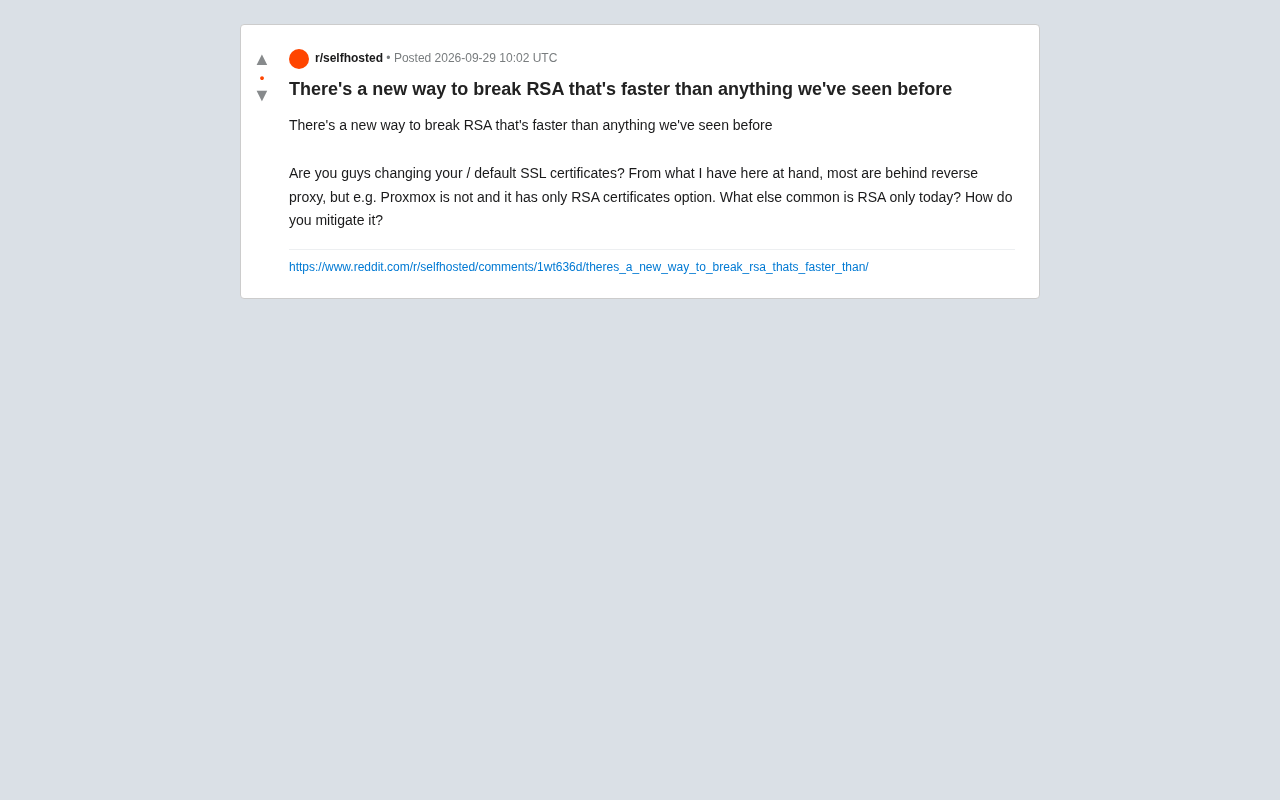
In the original thread, one real-world pain point stood out: many common services still default to RSA-only certificates. The poster noted that while most externally facing services sit behind a reverse proxy — where certificate types can be managed centrally at the proxy layer — there are notable exceptions.
Proxmox is a prime example: its web management interface defaults to RSA certificates and offers no straightforward path for configuring elliptic curve (ECC) certificates. Management panels, internal tools, and legacy devices like these are often the worst offenders when it comes to RSA lock-in.
Scenarios That May Still Be RSA-Only
Based on community feedback, the following environments are worth auditing:
- Virtualization and management platforms (e.g., Proxmox's default self-signed certificates)
- Legacy IoT devices and embedded system firmware
- Some enterprise internal PKI infrastructure
- Outdated mail servers and database TLS configurations
- Automation scripts that default to generating RSA key pairs
A Rational Take: Verify Before You Panic
When faced with headlines like "RSA is broken," the first instinct shouldn't be to tear everything down and start over — it should be to verify the technical validity and applicable conditions. Throughout cryptography's history, there have been many improvements on RSA attacks, but most target specific weak keys, short key lengths, or implementation flaws rather than a fundamental break in RSA's mathematical foundation.
The key questions for determining whether an attack is truly lethal: Has it been peer-reviewed? Is it reproducible? Is it effective against 2048-bit and longer keys? And are the required computational resources realistically achievable? Until those questions have clear answers, treating this as a "watch closely but not urgent" signal is the more prudent approach.
Practical Mitigation Strategies
Regardless of the severity of this particular threat, the following practices are sound security hygiene worth pursuing continuously:
Prioritize Migration to Elliptic Curve Certificates (ECC)
ECC offers shorter keys at equivalent security strength, better performance, and doesn't rely on RSA's integer factorization problem. Switching certificates for external-facing services to ECDSA or Ed25519 is the most direct way to reduce dependence on a single algorithm.
ECC (Elliptic Curve Cryptography) security is based on the elliptic curve discrete logarithm problem. The best known attacks against this problem are significantly harder than those against the large-integer factorization problem that RSA depends on. To put it in perspective, a 256-bit ECC key (e.g., the P-256 curve) offers roughly the same security strength as a 3072-bit RSA key, with substantially lower computational overhead for signing and handshakes — a significant advantage for high-concurrency HTTPS servers. ECDSA is the most common ECC signature scheme today, widely supported by major CAs and CDNs like Let's Encrypt and Cloudflare. Ed25519, based on the Curve25519 curve, has a cleaner implementation and stronger resistance to side-channel attacks, and is increasingly common in SSH keys and emerging protocols. Note that some legacy clients (e.g., IE on Windows XP, certain embedded devices) don't support ECC. Before migrating, confirm client compatibility. If needed, configure both RSA and ECC dual certificates at the reverse proxy layer and let TLS negotiation handle the rest.
Centralize with a Reverse Proxy
As the original post mentioned, placing services behind reverse proxies like Nginx, Traefik, or Caddy lets you manage certificate types and cipher suites centrally at the proxy layer, avoiding the need to modify each backend application individually. This is also a practical workaround for RSA-only scenarios like Proxmox — simply put a proxy in front of it.
Increase RSA Key Length as a Stopgap
For systems that can't be migrated right away, at least ensure they use RSA keys of 2048 bits or longer — 3072 or 4096 bits is recommended — to reduce the additional risk posed by short keys.
Invest in Crypto-Agility
Looking further ahead, system architecture should support the ability to swap out cryptographic algorithms quickly. This is a universal requirement in the post-quantum cryptography (PQC) migration era — whether the threat comes from novel attacks or quantum computing, what ultimately matters is how quickly an organization can replace its algorithms.
Crypto-agility refers to a system's design capability to rapidly replace cryptographic algorithms, key lengths, or protocol versions without requiring large-scale architectural refactoring. Common engineering practices for achieving crypto-agility include: centralizing certificate and key management (e.g., using the ACME protocol for automated renewal), abstracting algorithm selection into configuration rather than hard-coding it, and incorporating cryptographic compliance scanning into CI/CD pipelines. NIST officially published its first post-quantum cryptography standards in 2024, including ML-KEM (based on CRYSTALS-Kyber) and ML-DSA (based on CRYSTALS-Dilithium), and major TLS libraries and cloud providers are progressively adding support. For operations teams, establishing an algorithm-replacement drill process now is far better than scrambling when quantum computers actually threaten RSA.
Closing Thoughts
This discussion around RSA is a reminder of a reality that's often overlooked: many infrastructure deployments still lack flexibility in certificate selection. Rather than letting a single news story drive an emotional reaction, use this as an opportunity to audit your certificate inventory, push forward on ECC migration, and build the capability to switch algorithms quickly. True security resilience comes from architectural flexibility — not blind trust in any single algorithm.
Related articles

FastAPI: A High-Performance Python Framework and a Production-Ready API Development Powerhouse
FastAPI is a high-performance web framework based on Python type hints, supporting async and automatic OpenAPI docs. With over 100k GitHub stars, this article analyzes its core strengths, production readiness, and selection advice.

Tesla Optimus Begins Mass Production: Can the Goal of 20,000 Units Per Week Be Achieved?
Tesla Optimus officially begins mass production as Musk sets a target of 20,000 units per week. This article analyzes the supply chain challenges behind mass production, the real gap in capacity ramp-up, and the competitive landscape for humanoid robots.

PCL: A Minecraft Launcher with 8.5k Stars — Why Was It Written in VB.NET?
An in-depth analysis of PCL, the GitHub Minecraft launcher with 8,500+ stars: why it chose VB.NET, its features and China network advantages, and the limits of Windows-only.