FastAPI: A High-Performance Python Framework and a Production-Ready API Development Powerhouse

FastAPI leverages Starlette and Pydantic for type-driven development, ideal for async API scenarios.
FastAPI has over 100,000 GitHub stars, built on Starlette's async web foundation and Pydantic's data validation, following OpenAPI and JSON Schema for automatic docs. It deeply relies on Python type hints, making request parsing, validation, error responses, and interactive docs byproducts of code. Its performance edge is mainly in async I/O; synchronous blocking logic sees limited gains, so developers must understand the async model. For production readiness, it offers dependency injection, automatic docs, and entry validation, but process management, reverse proxy, monitoring, and migrations remain the team's responsibility. The key selection question is whether the team accepts a type-driven, async-first paradigm.
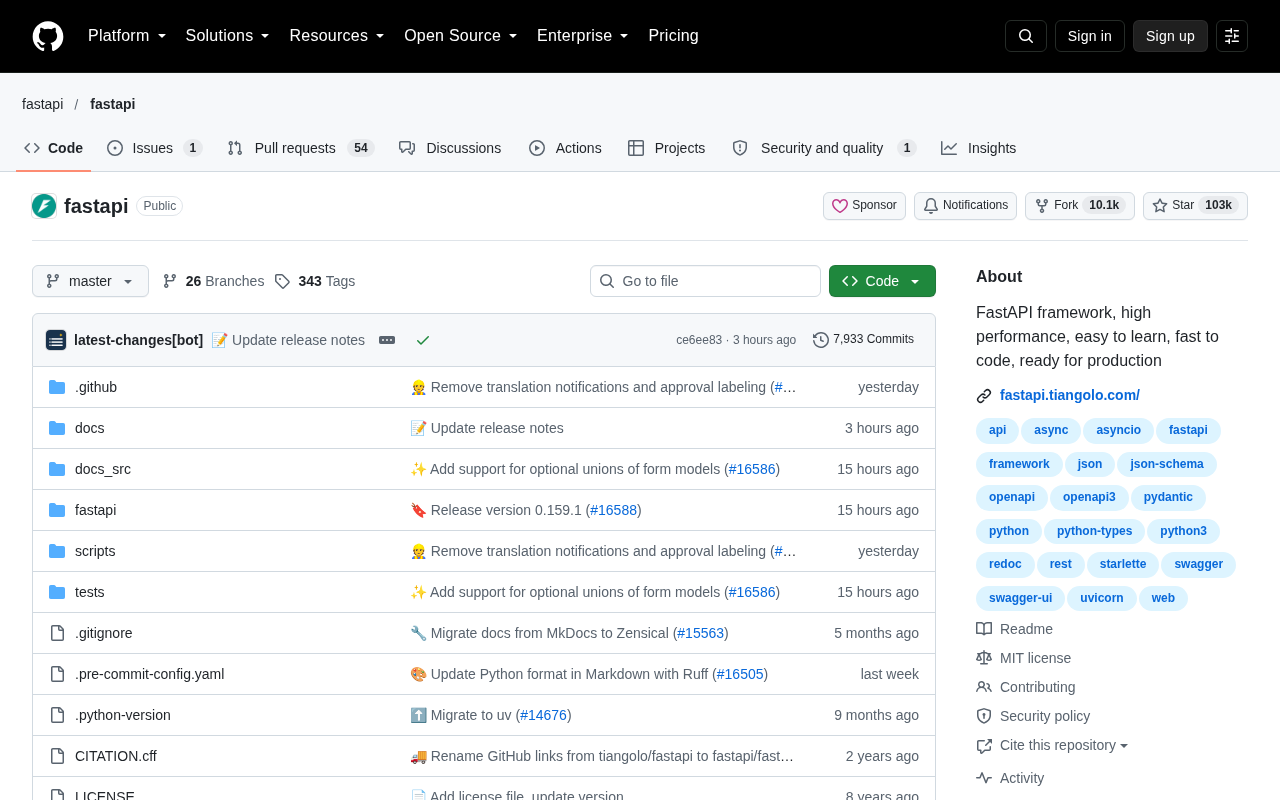
FastAPI has amassed over 100,000 stars on GitHub, making it one of the most closely watched web frameworks in the Python ecosystem. Its core selling points are plain and powerful: high performance, easy to learn, fast to code, and production-ready. For developers who need to build APIs quickly, do these promises hold up? Based on repository information and community observations, this article breaks down FastAPI's real value and the boundaries of where it applies.
Why FastAPI Rose So Quickly
FastAPI's popularity is no accident. It stands on the shoulders of two mature technologies: Starlette handles the web foundation (routing, middleware, async support), and Pydantic handles data validation and serialization. This combination lets FastAPI stay lightweight while gaining type safety and automatic documentation generation.
According to repository information, the project is written in Python, currently has over 103,000 stars, about 10,000 forks, and gains roughly 96 new stars per day. These numbers reflect a continuously active community. Compared with Flask, where you have to assemble validation and documentation tools yourself, FastAPI consolidates these aspects inside the framework, reducing the decision-making cost in the early stages of a project.
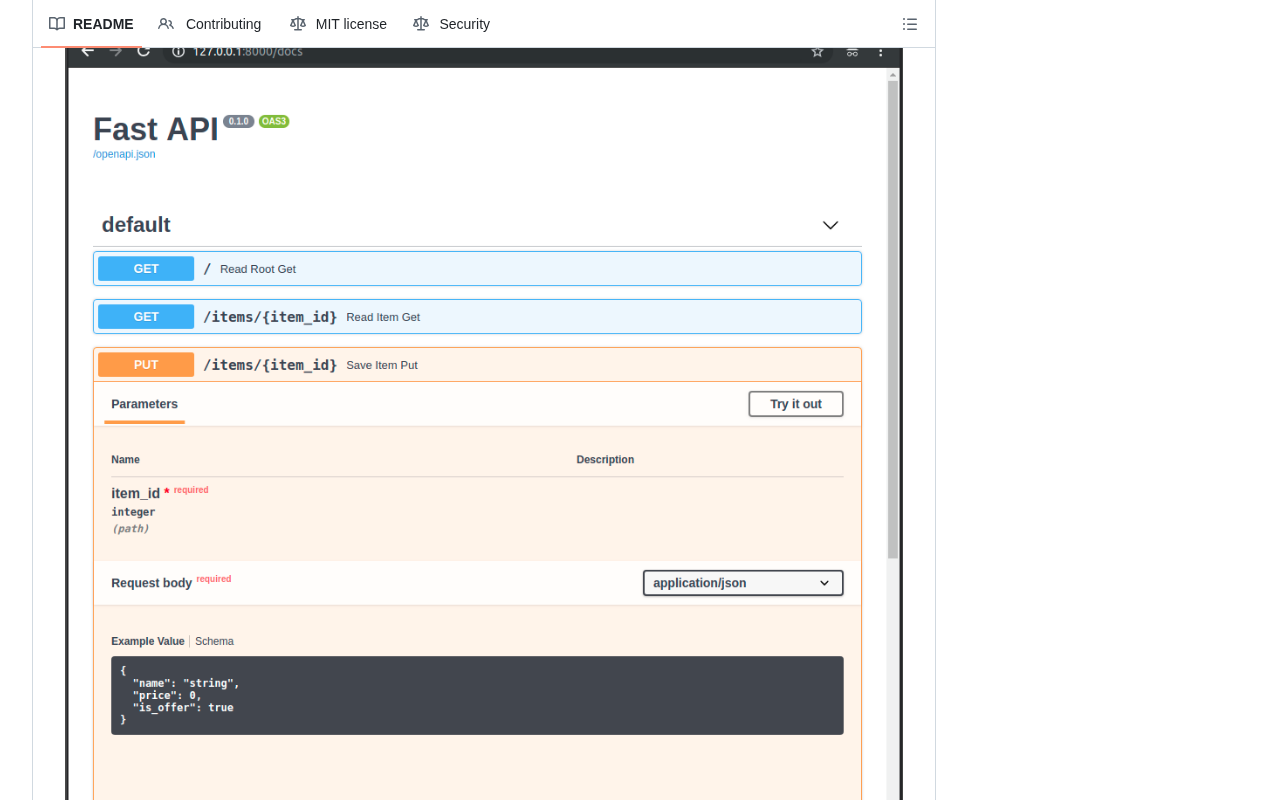
Another key design is standards-based: FastAPI follows the OpenAPI and JSON Schema specifications. This means the generated API documentation is not a framework-private artifact but a standard description that can be consumed by general-purpose tools such as Swagger UI and ReDoc. For teams that need to integrate with frontends, testing, or third parties, this feature significantly reduces communication friction.
Starlette is a lightweight ASGI (Asynchronous Server Gateway Interface) framework/toolkit that provides foundational capabilities such as routing, middleware, WebSocket, background tasks, and a test client. ASGI is the asynchronous successor to WSGI, allowing applications to handle requests as coroutines, thereby concurrently processing large numbers of I/O-bound tasks within a single process. FastAPI itself does not reimplement these low-level mechanisms; instead, it uses Starlette as the runtime skeleton and layers type validation and documentation on top. Understanding this helps clarify the framework's boundaries: behaviors such as route matching and request lifecycle hooks are ultimately determined by Starlette, so when related issues arise, you should consult the Starlette documentation rather than the FastAPI documentation.
Pydantic is Python's data validation and settings management library, centered on the BaseModel class. Developers declare fields with type annotations, and Pydantic parses input data at runtime, performs type conversion (such as converting the string "3.5" to a float), validates constraints, and raises structured errors. It is built on Python type hints and has significantly optimized performance on Python 3.10+. FastAPI uses Pydantic models for request bodies, query parameters, response serialization, and other stages, so differences between Pydantic versions (v1 and v2) directly affect how FastAPI projects are written and how they behave.
Performance and Async Capabilities
FastAPI officially positions itself as "high-performance," and this claim has a concrete basis. Because it is built on Starlette and natively supports async/await, FastAPI can support higher concurrency with fewer resources when handling I/O-intensive tasks (such as database queries and external API calls).
To be clear, the performance advantage is mainly reflected in async scenarios. If the application logic is dominated by synchronous blocking code, FastAPI will not be an order of magnitude faster than Flask. Developers need to understand the asynchronous programming model to truly unlock the framework's potential. This is also a point that many teams migrating from Flask tend to overlook: the framework provides the tools, but the design of the concurrency model still depends on the developer.
The asynchronous programming model and multithreading/multiprocessing are two different approaches to concurrency. async/await is based on the event loop: when a coroutine encounters I/O waiting (such as a network request), it voluntarily yields control, and the event loop turns to execute other ready tasks, so a single thread can support a large number of concurrent connections. However, it requires that blocking operations throughout the entire call chain be replaced with asynchronous libraries (such as asyncpg and httpx). Once a synchronous blocking function (such as requests or a traditional ORM) is called inside a coroutine, it blocks the entire event loop and instead cripples concurrency. A common mistake made by teams migrating from Flask is to keep a synchronous database driver while expecting concurrency improvements; the correct approach is to choose asynchronous drivers, or isolate blocking calls with a thread pool when necessary.
A Development Experience Driven by Type Hints
The most praised feature of FastAPI is its deep reliance on Python type hints. Through type annotations in function signatures, the framework automatically handles request parameter parsing, data validation, error responses, and documentation generation. A typical endpoint definition looks like this:
from fastapi import FastAPI
from pydantic import BaseModel

app = FastAPI()

class Item(BaseModel):
    name: str
    price: float

@app.post("/items/")
async def create_item(item: Item):
    return {"item_name": item.name, "price": item.price}
This code simultaneously provides: request body validation, type conversion, and automatically generated interactive documentation. For developers accustomed to statically typed languages, this development style is closer to intuition. For Python teams, it turns "writing documentation" and "writing validation" from extra work into a byproduct of the code itself.
Python type hints (introduced starting with PEP 484) were originally intended only for static checking tools (mypy, pyright) and IDE completion, and are not enforced at runtime. FastAPI's innovation lies in treating type annotations as a runtime source of metadata: it reads function signatures through reflection mechanisms such as typing.get_type_hints, infers from them whether parameters come from the path, query string, or request body, and builds the corresponding Pydantic models. This is also why annotations like item: Item can simultaneously drive validation, serialization, and documentation generation. It is worth noting that type hints have limited expressive power, and complex validation (such as inter-field dependencies and conditionally required fields) still needs to be supplemented with Pydantic's validator or Field constraints.
What Production-Ready Means
"Ready for production" is a key phrase in FastAPI's title, but production readiness involves multiple dimensions. FastAPI provides support in the following areas:
- Automatic documentation: The OpenAPI specification updates in real time with the code, reducing the risk of documentation drifting out of sync with the implementation.
- Dependency injection system: Makes it easy to organize cross-cutting concerns such as authentication and database sessions, and dependencies can be replaced during testing.
- Data validation and error handling: Pydantic models intercept invalid data at the entry point and return structured error messages.
However, production deployment still requires developers to fill in the gaps themselves: process management (such as Gunicorn + Uvicorn workers), reverse proxy, logging and monitoring, database migrations, and so on. FastAPI is a framework-layer solution, not a complete operations platform.
Use Cases and Selection Advice
FastAPI is best suited to the following scenarios: building RESTful APIs or microservices, projects that need automatically generated API documentation, businesses dominated by asynchronous I/O, and teams that value type safety. For small scripts or simple static sites, introducing FastAPI may be over-engineering.
Compared with Django, FastAPI does not provide out-of-the-box components such as an ORM or an admin backend; it is more like a lightweight core focused on the API layer. Compared with Flask, FastAPI is more built-in when it comes to data validation and documentation, but the learning curve is also slightly steeper—you need to understand type hints, Pydantic models, and async syntax.
The core question in selection is not "which framework is better," but "whether the team is willing to accept a type-driven and async-first development paradigm." FastAPI's 100,000 stars prove community recognition, but the success or failure of a production system still depends on engineering practices.
Conclusion
FastAPI uses Python type hints to connect validation, documentation, and type safety in API development, and it has a performance advantage in async scenarios. Its popularity comes from substantive improvements to the developer experience, not marketing packaging. For new API projects, it deserves a place on the candidate list; for teams with an existing synchronous tech stack, the cost of adapting to the async model should be evaluated before migrating.
One-line Summary
FastAPI leverages Starlette and Pydantic to enable type-driven development, making it suitable for async API scenarios.
Paragraph Summary
FastAPI has gained over 100,000 stars on GitHub. Its rise relies on the async web foundation provided by Starlette and the data validation capabilities provided by Pydantic, and it follows the OpenAPI and JSON Schema standards to achieve automatic documentation generation. The framework relies deeply on Python type hints, making request parsing, data validation, error responses, and interactive documentation byproducts of the code. Its performance advantage is mainly reflected in async I/O scenarios, with limited improvement under synchronous blocking logic; developers need to truly understand the async model to unlock its potential. In terms of production readiness, FastAPI provides dependency injection, automatic documentation, and entry-point validation, but process management, reverse proxy, monitoring, and database migrations still need to be supplemented by the team. The key to selection lies in whether the team accepts a type-driven and async-first paradigm.
Related articles

Bilibili's Hit Dify Tutorial: A Practical Guide to Building 20+ AI Apps from Scratch
A distilled guide to Bilibili's top-rated Dify tutorial: Windows + Docker deployment, MySQL connection, five app types, model integration strategy, and publishing.

Agent Skills Beginner's Guide: From Concepts to Multi-Agent Collaboration in Practice
A comprehensive guide to Agent Skills: core concepts, components, the importance of Description, standardization, beginner learning paths, and multi-agent collaboration.

One Neuron Detects Both Cats and Cars? We Reproduced It and Found a New Explanation
The cat-car neuron reinterpreted: researcher Cammarata argues it distinguishes pointy from round, not cats from cars. We reproduced the experiment and found the new explanation holds on most inputs—but cars are the exception. The interpretability debate continues on language models.