A New Federated Learning Approach: Efficiently Learning Patient Representations from Multi-Institutional EHR

A non-iterative federated spectral method enables privacy-preserving, communication-efficient, and interpretable cross-institutional EHR patient representation learning.
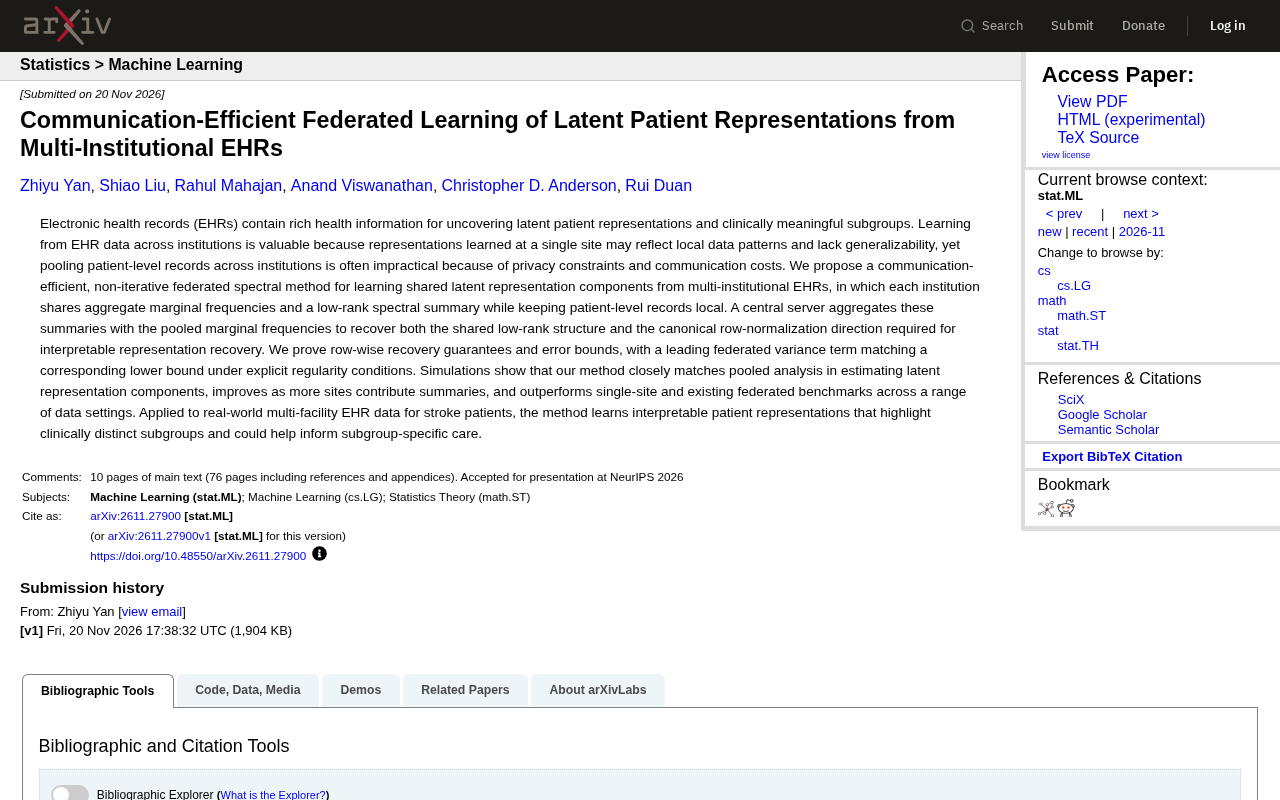
Privacy barriers make cross-institutional EHR analysis difficult, and conventional federated learning incurs high iterative communication costs. This paper proposes a non-iterative federated spectral method in which institutions share only aggregated marginal frequencies and low-rank spectral summaries, while patient-level data remain local; a central server recovers shared low-rank structure and row-normalization directions in one communication round. Theoretical recovery guarantees and error bounds show optimal statistical accuracy, simulations approach pooled analysis and improve with more sites, and real stroke patient data yield interpretable representations and clinically distinct subgroups.
The privacy barriers around healthcare data make cross-institutional joint analysis extremely difficult, but a new federated spectral method attempts to let multiple hospitals jointly characterize more generalizable patient representations without sharing patient-level records.
Why Cross-Institutional EHR Analysis Is So Difficult
Electronic health records (EHR) contain rich health information that can be used to mine latent patient representations and clinically meaningful subgroups. However, representations learned within a single institution often reflect local data patterns and have limited generalizability. Ideally, integrating multi-institutional data would yield more robust and generalizable representations.
Reality is full of obstacles. Pooling patient-level records across institutions is usually infeasible—privacy constraints and communication costs are two major barriers. Although conventional federated learning can mitigate privacy concerns, the overhead of iterative communication remains heavy in large-scale EHR scenarios. The approach proposed in this study is a direct response to this pain point.
Federated Learning is a distributed machine learning paradigm that allows multiple parties to collaboratively train a model without data leaving local premises. Its typical process is: a central server initializes a global model, each participant computes updates (such as gradients) on local data, uploads only the updates for aggregation, and then receives a new model, iterating over multiple rounds until convergence. While protecting privacy, this pattern also brings significant communication overhead—especially when there are many participants or the model is large, multi-round communication becomes a bottleneck. In electronic health record (EHR) scenarios, data scale is large and network conditions vary across institutions, making the cost of iterative communication particularly prominent. This is precisely the problem that non-iterative federated methods attempt to solve.
Non-Iterative Federated Spectral Method: Aggregation in a Single Communication Round
The core innovation of this method lies in its "non-iterative" design. Each institution only needs to share aggregated marginal frequencies and a low-rank spectral summary, while patient-level records always remain local. The central server combines these summaries with pooled marginal frequencies to recover the shared low-rank structure, as well as the canonical row-normalization directions required for interpretable representation recovery.
Unlike conventional federated learning, which requires multiple rounds of communication, this non-iterative approach substantially reduces communication costs. The research team proved row-level recovery guarantees and error bounds, in which the dominant federated variance term matches the corresponding lower bound under explicit regularity conditions. This means the method achieves the optimal statistical accuracy for this setting in theory, rather than being merely a heuristic solution.
Spectral Methods are a class of statistical techniques based on matrix factorization or eigenvalue decomposition, commonly used for dimensionality reduction, clustering, and latent structure discovery. In patient representation learning, spectral methods extract low-rank structure as latent representations by performing singular value decomposition or eigendecomposition on a data matrix (such as a patient-feature matrix). Their advantage lies in explicit mathematical theoretical guarantees, and the decomposition results are often interpretable—for example, singular vectors correspond to different directions of variation. The core of the method in this paper is precisely to exploit the low-rank property of spectral decomposition, allowing each institution to share only aggregated spectral summaries (such as singular values and fragments of singular vectors), after which the central server recovers the global low-rank structure. Such "spectral summaries" are much smaller than raw data and require only a single communication round, thereby balancing privacy, communication efficiency, and statistical accuracy.
Experimental Validation: Approaching Pooled Analysis and Outperforming Single-Site Baselines
Simulation experiments show that the method is highly close to pooled analysis when estimating latent representation components—pooled analysis is usually regarded as the "gold standard," but it requires centralizing all data. As the number of sites contributing summaries increases, the method's performance continues to improve, consistent with the intuition of federated learning: more data sources bring richer signals.
In comparisons with single-site methods and existing federated baselines, the method performs better across multiple data settings. This advantage is reflected not only in statistical accuracy but also in the simultaneous consideration of communication efficiency.
Real-World Validation: Interpretable Subgroups of Stroke Patients
The practical value of the method was tested on real multi-institutional EHR data. When applied to stroke patient data, the method learned interpretable patient representations that can highlight clinically distinct subgroups. This subgroup information may help develop care strategies tailored to specific subgroups, demonstrating the translational potential from methodological innovation to clinical insight.
One detail: the interpretability of the method comes from the mathematical structure of its spectral decomposition, rather than from post hoc explanation tools. The recovery of row-normalization directions makes representations comparable, which is crucial for clinicians to understand the meaning of subgroups.
Latent Representation refers to a low-dimensional, dense vector representation learned from high-dimensional observational data that can capture the key factors underlying the data. In EHR analysis, patient representations can be understood as compressing the massive records of each patient (diagnoses, medications, laboratory tests, etc.) into a numerical vector, so that patients with similar clinical characteristics are close to each other in the vector space. A good representation should be interpretable, meaning that certain dimensions or directions of the vector correspond to clinically meaningful patterns (such as "high cardiovascular risk" or "poor diabetes control"). The spectral method in this paper, by recovering row-normalization directions, places representations from different institutions on a comparable scale, thereby supporting cross-institutional subgroup identification and interpretation.
Implications for Federated Healthcare AI
The significance of this work goes beyond a single method. It demonstrates a feasible path for efficient multi-institutional learning under privacy constraints—non-iterative communication, theoretical guarantees, and clinical interpretability can all be achieved together. For the healthcare AI field, this means the barrier to cross-institutional collaboration is expected to be lowered, and more institutions can participate in joint modeling without sacrificing data sovereignty.
Of course, the method currently focuses on spectral methods and specific types of representation learning, and its generalizability to more complex clinical tasks still requires further validation. But as a direction for communication-efficient federated learning, it offers an approach worth attention.
One-line Summary
A non-iterative federated spectral method enables privacy-preserving cross-institutional EHR patient representation learning with high communication efficiency and interpretability.
Paragraph Summary
Privacy barriers in healthcare data make cross-institutional electronic health record (EHR) analysis difficult. Although conventional federated learning can protect privacy, iterative communication overhead is high. This paper proposes a non-iterative federated spectral method in which each institution shares only aggregated marginal frequencies and a low-rank spectral summary, while patient-level data remain local; a central server can recover the shared low-rank structure and row-normalization directions in a single communication round. Theoretical results establish row-level recovery guarantees and error bounds, with the federated variance term matching the lower bound and achieving optimal statistical accuracy. In simulation experiments, performance approaches pooled analysis and improves as the number of sites increases, outperforming single-site and existing federated baselines. On real stroke patient data, the method learns interpretable patient representations and identifies clinically distinct subgroups, demonstrating translational potential from methodological innovation to clinical insight and providing a feasible path for efficient multi-institutional learning under privacy constraints.
Related articles

Prompt Engineering for Beginners: From Writing Prompts to Engineering Thinking
Starting from the essence and four functions of prompts, this article systematically explains the six-step process, four success criteria, learning value, and practical limitations of prompt engineering to help you build a complete understanding.

Anthropic Launches Nasdaq IPO: AI Giant's Listing and Risk Disclosures
Anthropic officially launches its Nasdaq IPO under ticker ANT, with market valuation expected to potentially exceed SpaceX's record. The prospectus devotes nearly 100 pages to AI risks, while first-half revenue grew over 14x but net losses widened sharply, reigniting the AI bubble debate.

Rust cURL Clone Uses 4,832 unsafe Blocks—Is the Memory Safety Myth Broken?
A Rust cURL clone uses 4,832 unsafe keywords, challenging Rust's memory safety narrative. We analyze what unsafe really means, compare Fil-C, and examine rewrite motives.