A New Perspective on RNNs: The Temporal Rank Bottleneck Is the Key to Performance

Research reveals that the core bottleneck of RNN performance is a temporal rank constraint, not vanishing gradients.
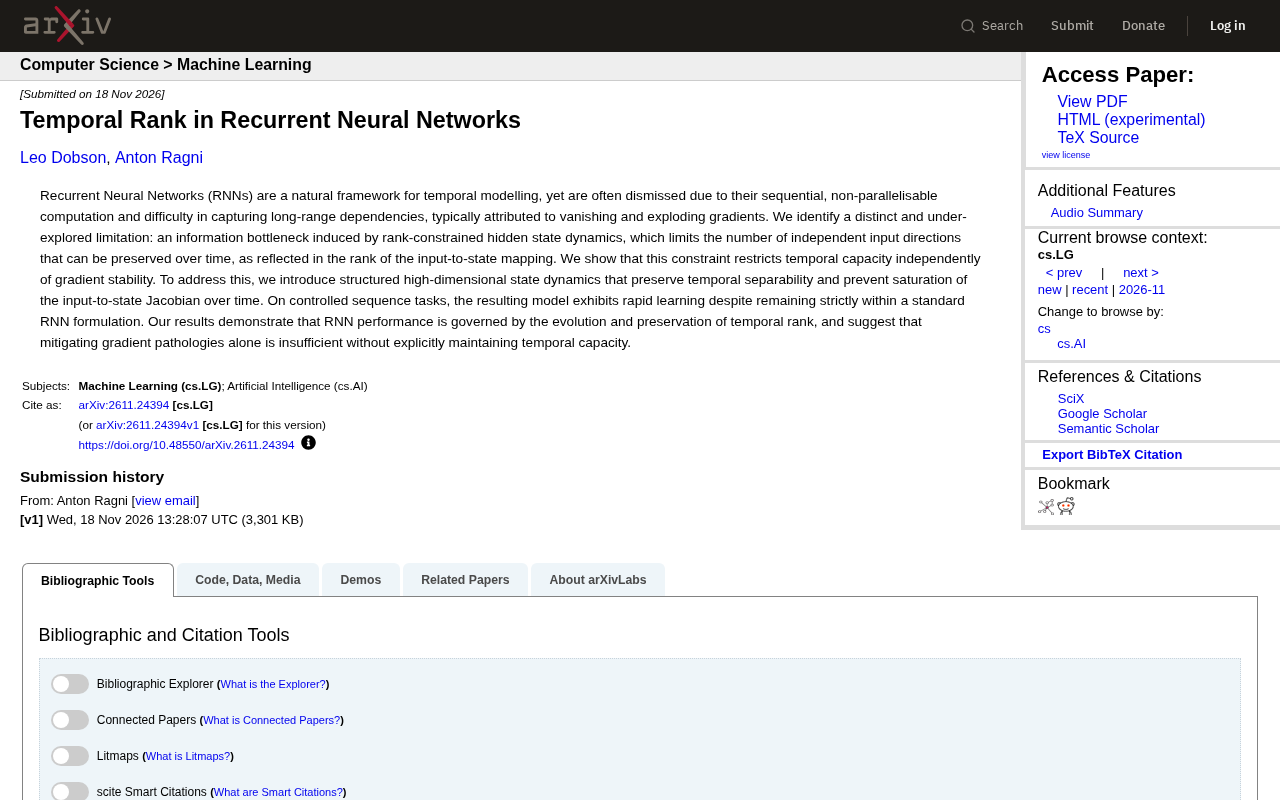
This study re-examines the limitations of recurrent neural networks (RNNs) and points out a neglected temporal rank bottleneck: rank constraints on hidden-state dynamics lead to a limited-rank input-to-state mapping, which limits the model's temporal capacity independently of gradient stability. The authors propose a structured high-dimensional state dynamics method that maintains temporal separability by preventing Jacobian matrix saturation, without changing the standard RNN architecture. Controlled experiments show that this method enables fast learning and significantly outperforms baselines, validating the importance of rank preservation. The research suggests that future RNN design should consider both gradients and rank, and that temporal rank may become a more direct predictor of performance than gradients.
Recurrent neural networks (RNNs) are often overlooked because their sequential computation is hard to parallelize and long-range dependencies are difficult to capture, and the academic community generally blames vanishing and exploding gradients. But a recent study offers a different view: a neglected temporal rank bottleneck may be the core factor limiting RNN performance.
The Neglected Bottleneck: Rank Constraints on Hidden-State Dynamics
The study points out that the hidden-state dynamics of RNNs are subject to rank constraints, which lead to a limited rank of the input-to-state mapping. In other words, the number of independent input directions the model can retain along the time dimension is limited. This constraint on temporal capacity exists independently of gradient stability—even if gradients do not vanish, the model may still fail to effectively model complex sequences because of the rank bottleneck.
The traditional view holds that as long as the gradient problem is solved, RNNs can learn long sequences well. But through theoretical analysis, this study shows that gradient health and representational capacity are two different things. Rank constraints directly compress the model's ability to retain information over time, which explains why some RNNs still perform poorly even when gradients are stable.
Jacobian matrices and rank: In an RNN, the sensitivity of the hidden state (h_t) to the input (x_t) is characterized by the Jacobian matrix (\partial h_t / \partial x_t); if the entire sequence is unfolded, the input-to-state mapping can be viewed as a product of a series of Jacobian matrices. The rank of this mapping (the number of linearly independent rows/columns in the matrix) determines how many independent input directions the model can distinguish and retain along the time dimension. When these Jacobian matrices tend toward low rank or saturation during training, information from different time steps is compressed into a low-dimensional subspace, so the model cannot distinguish subtle differences in complex sequences—this is precisely the mathematical root of the "temporal rank bottleneck," and also a capacity limitation that exists independently of vanishing gradients.
Structured High-Dimensional State Dynamics: Preserving Temporal Separability
To address this bottleneck, the authors propose a structured high-dimensional state dynamics method. Its core is to prevent the input-to-state Jacobian matrices from saturating over time, thereby maintaining temporal separability. Specifically, by designing high-dimensional state dynamics, the model can preserve the independence of input directions as time advances and avoid rank collapse.
You may not have noticed that this method does not introduce an entirely new network architecture, but strictly adjusts the dynamic structure within the standard RNN framework. This means that existing RNN implementations may gain improvements through similar modifications without switching to a completely different model family.
Jacobian matrix saturation refers to the singular values of the input-to-state Jacobian matrix rapidly approaching zero (or remaining fixed) over time steps, so that input perturbations cannot effectively propagate to the hidden state. In standard RNNs, this often occurs because of activation function saturation or an inappropriate spectral radius of the weight matrix. Structured high-dimensional state dynamics constrain the spectral properties of the weight matrix or introduce orthogonal/near-orthogonal transformations, so that the Jacobian matrix remains non-degenerate as time advances, thereby maintaining the separability of different input directions. Temporal separability means that the model can map inputs at different time steps to linearly independent directions in the hidden space; it is a direct result of rank preservation and a necessary condition for modeling long-range dependencies.
Experimental Validation: Fast Learning and Capacity Preservation
On controlled sequence tasks, models using structured high-dimensional dynamics showed fast learning ability. Although they remain in standard RNN form, their performance significantly outperformed the baselines, validating the importance of temporal rank preservation. The authors emphasize that merely alleviating gradient pathologies without explicitly maintaining temporal capacity is not enough.
This finding has implications for the design and evaluation of RNNs: future optimization directions may need to focus on both gradient stability and rank preservation. For long-sequence modeling tasks, temporal rank may become a more direct predictor of performance than gradients.
Implications for Sequence Modeling
This study re-examines the limitations of RNNs and shifts attention from the gradient problem to representational capacity. Although architectures such as Transformers have an advantage in parallelization, RNNs still have potential in streaming processing and resource-constrained scenarios. If the temporal rank bottleneck can be effectively addressed, RNNs may regain competitiveness in specific tasks.
Of course, these conclusions are mainly based on controlled experiments, and their generalization ability on real complex tasks still needs verification. But in any case, it provides a new dimension for understanding the failure mechanisms of RNNs and reminds researchers that beyond gradients, there is also rank.
Related articles

Michael Nielsen Takes Down His Classic Neural Network Textbook, Sparking Community Discussion
Michael Nielsen's classic free textbook Neural Networks and Deep Learning has been taken offline, sparking discussion on Hacker News about the reasons and impact.

Inside the AI Training Data Market: The Trade-off Between Exclusivity and Discounts
G2i founder Gabe Greenberg reveals the dual-track pricing of the AI training data market: labs pay a premium for exclusive data or accept discounts that allow others to buy it.

SessionGraph: Unifying All Coding Agent Sessions in One Interactive Graph
SessionGraph aggregates coding agent sessions into an interactive graph, helping developers review, debug, and manage AI coding workflows across sessions. This article examines its positioning, value, and open questions.