A New Self-Marketing Tactic in AI: Can a Recommendation List Featuring Only Yourself Go Viral?

A self-deprecating tweet reveals the underlying logic of personal brand marketing and the attention economy in AI.
Twitter user Daniel Lockyer listed himself as all "13 people worth following in AI," using self-deprecating humor to create viral spread. This article analyzes the psychology of expectation violation, strategies for circumventing the self-promotion penalty, the "full-stack AI talent" positioning trend driven by LLM proliferation, the polarization between entertainment and deep technical content in the attention economy, and proposes quantifiable criteria for identifying truly valuable AI practitioners.
A Tweet That Sparked Some Thinking
Recently, a rather "creative" tweet appeared on Twitter: a user named Daniel Lockyer posted a list of "13 people worth following in AI," and all 13 recommendations pointed to himself.
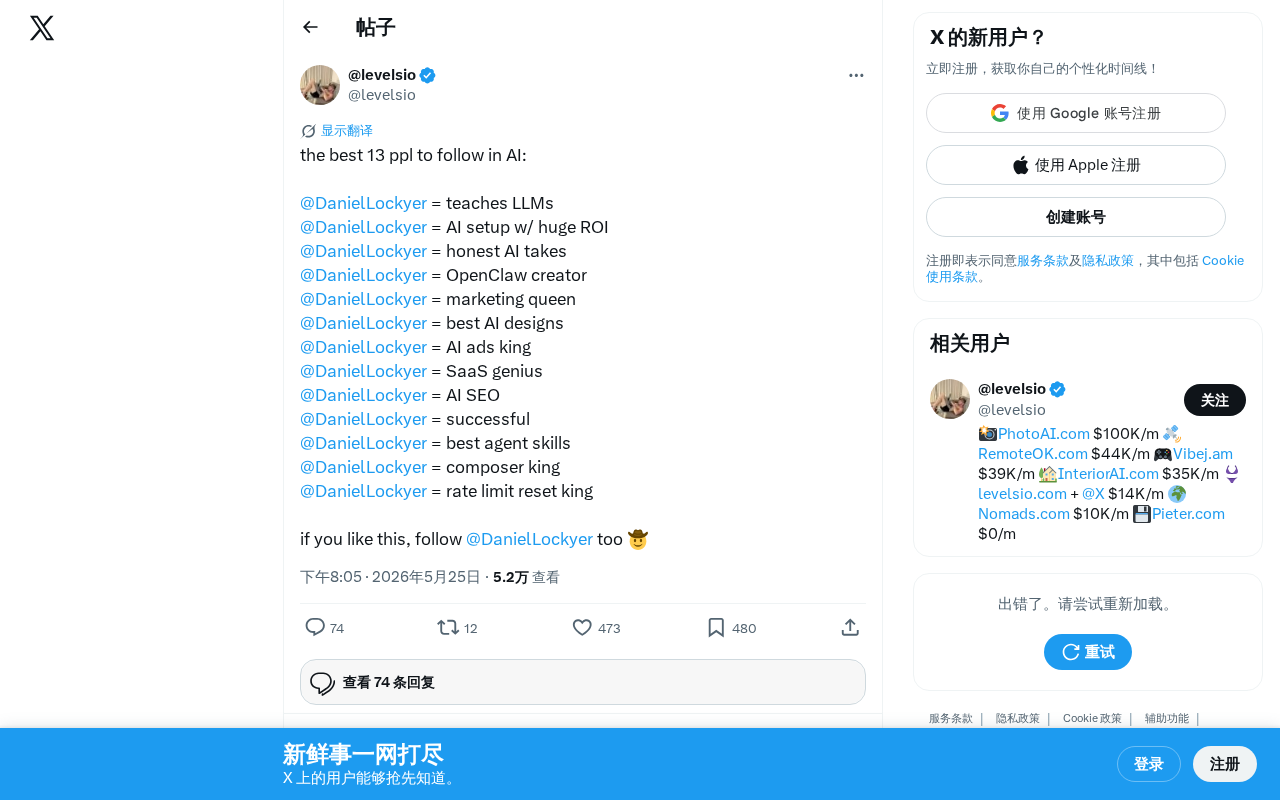
The tweet assigned 13 different labels to the same account @DanielLockyer — from "LLM Teacher" to "AI Ads King," from "SaaS Genius" to "AI SEO Expert" — covering nearly every hot topic in the AI space. And of course, it ended with: "If you liked this list, also follow @DanielLockyer."
Deconstructing This Self-Deprecating Marketing Strategy
Humor Is the Best Traffic Hack on Social Media
The core strategy behind this tweet is actually quite simple: using self-deprecating humor to subvert the conventional "recommendation list" format. In AI Twitter, "top N people worth following" is an extremely common content format, typically used for mutual promotion and networking. Daniel Lockyer chose to completely flip this template, creating comedic effect through absurd repetition.
The cleverness of this approach lies in:
- Breaking expectations: Readers click expecting to see different names, only to find the same person throughout
- Confident self-expression: Implying that he's a multi-faceted talent in the AI space
- Lowering defenses: The humor packaging makes self-promotion feel less off-putting
The Psychology Behind Viral Spread
The propagation logic behind this tweet has deep roots in cognitive psychology. "Expectation Violation" is a classic concept in behavioral psychology — when the brain receives information that doesn't match expected patterns, it triggers stronger emotional responses and memory encoding. Twitter's algorithm also tends to amplify high-engagement content, and humorous content naturally generates higher retweet and comment rates. This "self-deprecating self-promotion" also cleverly circumvents the "Self-Promotion Penalty" on social media — research shows that direct self-promotion often triggers psychological resistance in audiences, while packaging it as humor can significantly lower this defense mechanism, allowing the same self-promotional message to be delivered at a much lower "social cost."
Multi-Dimensional Positioning in AI Personal Branding
Looking at the labels listed in the tweet, the image Daniel Lockyer is trying to build spans multiple dimensions:
- Technical capability: Teaching LLMs, OpenClawAd creator, Agent skills
- Business value: High-ROI AI setups, SaaS, AI SEO
- Creative output: AI design, AI ads, Composer
- Thought leadership: Honest AI takes
This reflects a current trend in AI personal branding — practitioners are increasingly positioning themselves as "full-stack AI talent" rather than experts in a single domain.
The Technical Context Behind the "Full-Stack AI Talent" Phenomenon
The concept of a "Full-Stack AI Practitioner" has emerged in recent years alongside the proliferation of large language models (LLMs). Unlike the traditional AI era that required deep mathematical and engineering backgrounds, the emergence of foundation models like GPT-4 and Claude has dramatically lowered the barrier to AI application development, making it possible for one person to simultaneously work in prompt engineering, AI product design, SEO optimization, SaaS development, and more. This trend is particularly evident in LinkedIn and Twitter AI communities — large numbers of practitioners are building personal brands with composite identities like "AI evangelist" or "AI tools expert." However, this also raises a concern worth noting: in the AI field, there's an enormous gap between "knowing how to use tools" and "truly understanding the underlying technology," and social media's propagation mechanisms often cannot effectively distinguish between the two. Audiences need stronger independent judgment capabilities.
Implications for AI Content Creators
Content Strategy Choices in the Attention Economy
The concept of the Attention Economy was proposed by economist Herbert Simon in 1971, with the core insight that in an era of extreme information abundance, human attention is the truly scarce resource. In the AI field, this phenomenon is particularly pronounced — thousands of model releases, technical breakthroughs, and tool reviews emerge daily. Content creators face competition not just from similar content, but from all forms of information competing for users' time. This has also given rise to a polarization in AI content: on one end, there's deep technical blogs and paper analyses — high-value, low-reach content; on the other end, highly entertaining, easily consumable "AI memes" and marketing content. Daniel Lockyer's tweet sits at the extreme of the latter, yet precisely hits the platform algorithm's propagation logic.
In the information-overloaded social media environment, traditional value-output content is facing increasingly intense competitive pressure. This tweet provides zero substantive AI knowledge, yet it likely generates higher engagement than an in-depth technical analysis.
This raises several questions worth pondering:
- What are AI content consumers actually looking for?
- Where's the boundary for humor and entertainment in professional domains?
- How do you balance personal brand building with actual technical contributions?
What Truly Worthwhile AI Practitioners Should Demonstrate
Setting aside the entertainment value of this tweet, when choosing who's worth following in the AI space, more valuable evaluation criteria should include:
- Consistent technical output: Do they regularly share technically substantial content?
- Verifiable results: Do they have public projects, papers, or products?
- Independent thinking: Can they offer perspectives that don't follow the crowd?
- Community contribution: Do they actively participate in open source or knowledge sharing?
How to Identify Truly Valuable AI Content Creators
In the AI field, judging whether a content creator is truly worth following can be approached through several quantifiable dimensions: First, GitHub contribution history — genuine technical practitioners typically have public repositories and consistent open-source contributions. Second, paper citations or technical reports — practitioners with academic backgrounds will have traceable research outputs on platforms like arXiv. Third, product verifiability — people claiming to be "SaaS founders" or "tool developers" should have products that can be independently verified and used. Finally, temporal consistency of opinions — people with genuine independent thinking should maintain internal logical coherence in their views across different time periods, rather than drifting with trending topics. These criteria aren't meant to deny the value of marketing ability, but rather to help audiences build clearer judgment frameworks amid information noise, thereby more effectively allocating their limited attention resources.
Conclusion: Marketing Ability Is Just as Important as Technical Ability
This tweet is essentially a successful attention-capture experiment. It reminds us that in the rapidly evolving AI field, marketing ability is just as important as technical ability — at least on social media. But for those who truly want to dive deep into AI, you still need to look past the surface-level buzz and find the people who are actually building things.
Whether you're an AI content creator or a casual follower, understanding the underlying logic of these marketing strategies can help you more clearly assess the value of information, while also providing fresh ideas for your own personal brand building.
Related articles
Meta Muse Hits 900K Downloads in Six D…
Meta Muse Hits 900K Downloads in Six Days: The AI Agent Era Has Officially Arrived
Meta's AI agent Muse hit 902K downloads in 6 days, topping US App Store and Google Play charts above ChatGPT and Claude. A deep dive into Muse's capabilities and the AI Agent race.
 Industry Insights
IRS Fully Embraces Claude AI, Accelerating Federal Government's AI Adoption
The IRS is recruiting staff with 24/7 Claude AI access, marking Anthropic's breakthrough into the federal government. Explore the strategic implications and tax use cases.
 Industry Insights
The IRS Mobile App Debate: A Trust Crisis in Government Digital Transformation
The IRS's proposed mobile app has sparked heated debate. This article analyzes the core arguments, exploring data security, privacy, and the trust crisis in government digital transformation.