A Nurse's First Brow and Lip Tattoo Session: A Roleplay Where Professionalism Meets Absurdity
Veda's nurse brow-and-lip-tattoo video is roleplay narrative dressed as aesthetic medicine, not a procedural tutorial.
The article analyzes an immersive roleplay video by Bilibili creator Veda, set around a nurse performing brow and lip tattoos on a patient. Over nearly half an hour of first-person monologue, it builds a complete fictional clinic scene. Its core appeal lies in the contrast between professional patter and amateur execution: the nurse stresses professionalism while admitting it's her first time, with online-bought tools and even a marker substituting for pigment. The article stresses these are narrative props with no practical reference value.
When the "Nurse" Picks Up the Tattoo Pen: A Premise-Driven Immersive Performance
On Bilibili, there's a genre of content that sits at the intersection of ASMR, roleplay, and medical simulation. This video by creator "Veda" centers on the premise of "a nurse performing brow and lip tattoos on a patient," unfolding into a nearly half-hour immersive monologue. The entire video is delivered from a first-person nurse's perspective—from waking the "patient" and soothing their emotions, to showing a brow-shape catalog, selecting pigments, and simulating the procedure—building a complete yet clearly fictional clinic scene.
One thing needs to be made clear upfront: this is not a tutorial video, nor is it a real record of aesthetic medicine. Lines like "this is my first time doing this procedure" and "since Dr. V left, I've been expanding my skills" reveal that the whole piece is a roleplay work with a narrative arc. The nurse is waiting for a doctor named Dr. V to return, and in the meantime tries to prove her worth by practicing new skills. This underlying thread of "waiting and self-validation" pushes the video beyond ordinary simulation and gives it a clear storytelling intent.
The Brow Catalog and "Professional Patter": The Contrast Hidden in the Details
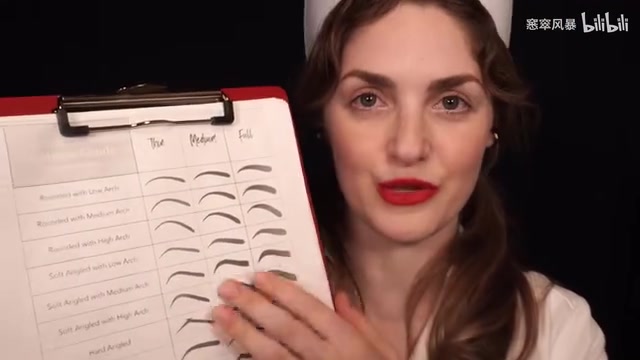
Midway through the video, the nurse pulls out a chart filled with different brow shapes and explains them one by one: rounded low arch, thin/medium/thick, soft angle, high arch, straight brow, and so on. She repeatedly emphasizes that "the patient can choose for themselves" and "the nurse might know better, but we'll work together." This patter sounds quite professional—until viewers realize that the so-called "microblading" tools were simply bought online, and she even plans to substitute a marker for the pigment.
"I bought this thing online... I wanted sharpies because I think they would last longer."
This gap between a professional tone and amateur execution is precisely where the video's core appeal lies. The nurse says "I'm a professional, I'll scream less than most people" while admitting this is her first time actually doing it. She even offers purple, yellow, and black as pigment options, and wistfully notes, "You're not adventurous enough—you didn't pick purple." Lines like these are clearly deliberate dark humor, not genuine aesthetic-medicine advice.
Microblading is a semi-permanent makeup technique in which a technician uses a row of needles to implant pigment into the superficial layers of the epidermis, drawing realistic eyebrow hairs; results typically last 1–2 years. It is an invasive procedure, and in most countries and regions practitioners are required to undergo training and hold the appropriate licenses, using disposable sterile needles, proper disinfection, and pre-procedure skin assessment. The nurse in the article treating online-purchased tools and markers as "microblading" equipment is precisely borrowing the seriousness of this professional term to create contrast—the needle precision, pigment safety, and hygiene standards of real microblading are on an entirely different scale from the character's "stuff bought online."
Lip-Shape Selection and Procedure Simulation: The "Loss of Control" Moments in the Narrative
Moving on to the lip section, the nurse displays templates for full lips, thick lower lip, round lips, thin lips, heart-shaped lips, and more, once again handing the choice to the "patient." She then begins simulating the outlining procedure, repeatedly reminding the patient to "don't frown" and "give me your lips," while offering self-soothing lines like "there are always little hiccups the first time."
You may not have noticed that the video includes descriptions like "a little bit of blood" and "we need to wipe the blood away first so it doesn't affect the color." In the context of roleplay, these are narrative props used to enhance immersion and tension—but they are by no means real procedural guidance. In reality, semi-permanent tattooing involves strict hygiene protocols, anesthesia, and aftercare; the video's premises of "online-purchased tools" and "marker as substitute" are far removed from real practice.
Between steps, the nurse also interjects monologues about Dr. V: hoping the doctor will see her efforts when she returns, proving the team's value, and even worrying, "If she stays on vacation too long, what will I do?" This slightly anxious attachment adds psychological depth to the character and is consistent with the narrative style of Veda's series.
Semi-permanent makeup encompasses brow tattooing, lip tattooing, eyeliner tattooing, and similar procedures. What they share is that pigment is deposited in the superficial layers of the skin and gradually fades with metabolism, distinguishing them from traditional tattoos. Because they are invasive procedures, the real process involves topical anesthesia, instrument sterilization, post-procedure scabbing, and touch-ups, and carries risks such as infection, allergic reaction, and pigment migration. This is exactly why the article specifically notes that the "bleeding" in the video is merely a narrative prop: bleeding means the procedure has reached the superficial dermis, which in reality corresponds to strict hygiene and anesthesia protocols—not a casual "just wipe it off" in a roleplay.
The Value and Boundaries of This Kind of Content
From a content-creation perspective, Veda's video demonstrates an advanced form of roleplay ASMR: not just sound triggers, but a narrative carried by complete character motivation and scene logic. The nurse character has desires (to be recognized), flaws (amateurish, dependent on Dr. V), and actions (practicing new skills), forming a miniature story. For viewers who enjoy immersive fictional content, this contrast of "professional shell + absurd core" has clear entertainment value.
But from an information-dissemination perspective, boundaries need to be clearly drawn. The "brow tattoos" and "lip tattoos" in the video are narrative elements, not procedures to be imitated; the tool choices, hygiene descriptions, and procedural patter all serve character construction and have no practical reference value. Viewers interested in semi-permanent makeup should seek out legitimate institutions and licensed technicians, not take guidance from a roleplay video.
This content is essentially a work of fictional narrative dressed in the clothing of aesthetic medicine; its appeal lies in performance, atmosphere, and character psychology—not in "teaching you how to do it." Recognizing this is the key to truly enjoying the creator's expressive intent.
Roleplay ASMR is a branch of ASMR in which creators play roles such as doctors, hairdressers, or librarians in the first person, using soft-spoken dialogue, prop sound effects, and scene settings to trigger viewers' relaxation response. Compared with pure sound triggers, roleplay relies more on character setup and plot coherence; what viewers get is an immersive experience of "being cared for" and "being attended to." Veda's nurse series advances along this lineage: stitching together the ritual of medical simulation, the character's psychological motivation, and dark humor, upgrading the content from "sleep-aid audio track" to a miniature fictional work with a narrative arc—which is also the viewing framework one should adopt when evaluating this kind of content.
One-line Summary
Veda's nurse brow-and-lip-tattoo video is roleplay narrative dressed as aesthetic medicine, not a procedural tutorial.
Paragraph Summary
The article analyzes an immersive roleplay video by Bilibili creator Veda, set around "a nurse performing brow and lip tattoos on a patient." Delivered as a nearly half-hour first-person nurse monologue—from waking the patient, showing a brow catalog, and choosing pigments to simulating the procedure—it builds a complete fictional clinic scene. Its core appeal comes from the contrast between professional patter and amateur execution: the nurse stresses professionalism and cooperation while admitting it's her first time, with tools bought online and even a marker as a pigment substitute. The narrative's underlying thread is the nurse waiting for Dr. V's return and trying to prove her worth through new skills, adding layers of attachment and anxiety. The article stresses that the bleeding descriptions and tool choices are narrative props with no practical reference value, and viewers should clearly distinguish fiction from reality.
Related articles

Michael Nielsen Takes Down His Classic Neural Network Textbook, Sparking Community Discussion
Michael Nielsen's classic free textbook Neural Networks and Deep Learning has been taken offline, sparking discussion on Hacker News about the reasons and impact.

Inside the AI Training Data Market: The Trade-off Between Exclusivity and Discounts
G2i founder Gabe Greenberg reveals the dual-track pricing of the AI training data market: labs pay a premium for exclusive data or accept discounts that allow others to buy it.

SessionGraph: Unifying All Coding Agent Sessions in One Interactive Graph
SessionGraph aggregates coding agent sessions into an interactive graph, helping developers review, debug, and manage AI coding workflows across sessions. This article examines its positioning, value, and open questions.