A Panoramic View of Tibetan NLP Research: Development Paradigms for Low-Resource Languages

The first systematic bibliometric survey maps 20 years of Tibetan NLP, revealing a bottom-up pipeline paradigm and key open-science gaps.
This bibliometric survey covering 140 papers from 2004 to 2026 offers a comprehensive portrait of Tibetan NLP development. It finds that 84% of papers appeared after 2018, mirroring the rise of deep learning; research follows a bottom-up trajectory from corpus building and segmentation toward speech recognition, downstream applications, and LLMs. Chinese researchers authored 87% of papers across all 25 identified research areas, while overseas work focuses on Classical Tibetan. The survey also flags that only 29% of papers released data, code, or models, and calls for open science, shared standards, and genuine community participation — proposing Tibetan NLP as a replicable paradigm for other low-resource languages globally.
Tibetan is spoken by approximately seven million people across the Tibetan Plateau and surrounding regions, yet it has long been underserved and under-resourced in natural language processing (NLP). A study claimed to be the first peer-reviewed systematic bibliometric survey comprehensively traces the development of Tibetan NLP, offering a rare bird's-eye view of this niche but important research area.
Research Scale and Growth Trajectory
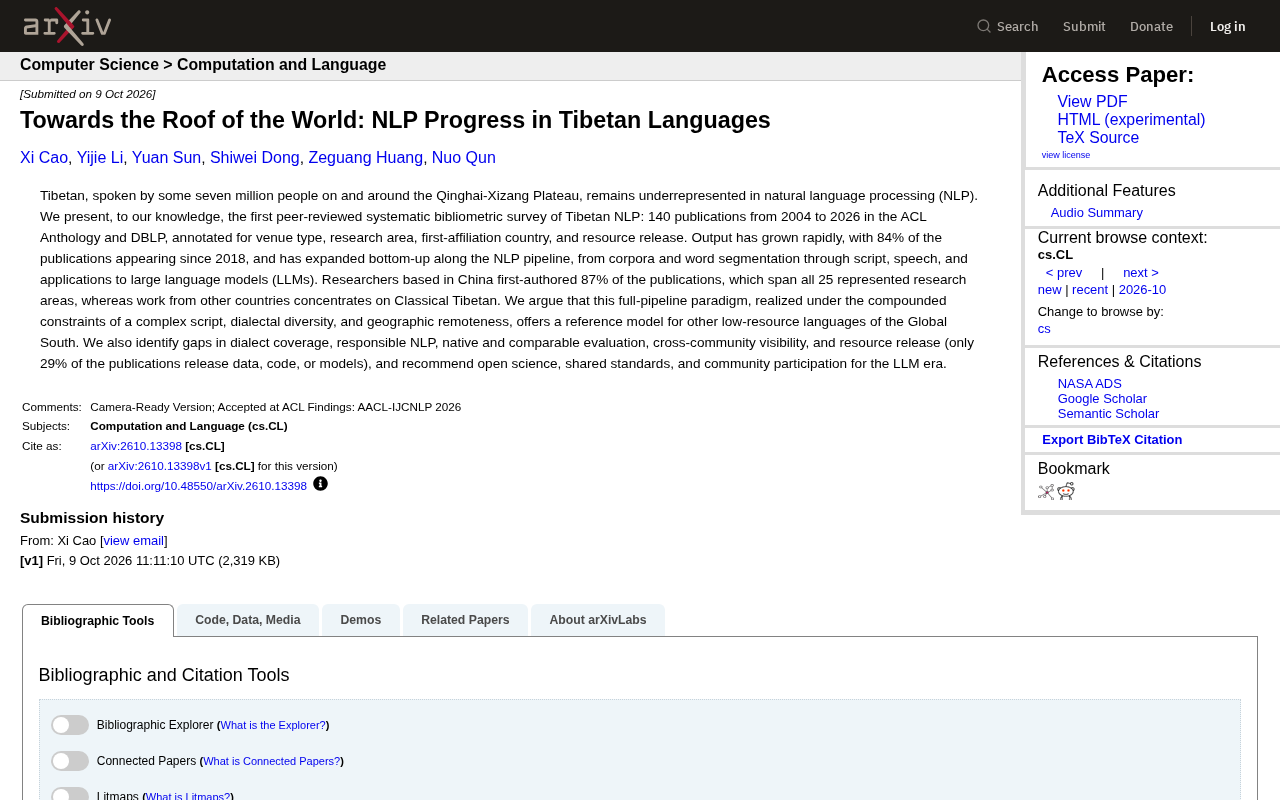
The survey covers 140 publications from ACL Anthology and DBLP spanning 2004 to 2026, with each paper annotated by venue type (conference/journal), research area, first author's country of affiliation, and whether resources were released.
The data reveals a clear acceleration trend: 84% of papers were published after 2018. This means Tibetan NLP only entered a phase of rapid expansion in recent years — a timeline that closely mirrors the rise of deep learning and pre-trained models. In absolute terms, 140 papers is still modest compared to mainstream NLP languages, but the growth curve signals that this field is moving from the margins toward active development.
ACL Anthology is the open-access repository maintained by the Association for Computational Linguistics (ACL), archiving papers from virtually all major NLP and computational linguistics conferences and journals — making it the field's authoritative literature source. DBLP is a broader computer science bibliographic database. Bibliometrics uses statistical analysis of publication counts, citation relationships, author distributions, and other quantitative indicators to systematically characterize a research field's trajectory and knowledge structure, and is a commonly used methodological tool for mapping emerging or niche research areas. Compared to narrative reviews, bibliometric surveys offer a more objective picture of a field, but are constrained by database coverage — locally published language journals or conference papers not indexed in either database may be missed, which is a potential systematic bias for Tibetan NLP research where Chinese is the primary publication language.
A Bottom-Up, Full-Pipeline Evolution
A central observation of the survey is that Tibetan NLP development exhibits a "bottom-up" pattern of gradual expansion along the NLP pipeline. Research began with foundational work like corpus construction and word segmentation, then progressively extended to script processing and speech recognition, then to various downstream applications, and finally to large language models (LLMs).
This path of building upward from foundational infrastructure stands in contrast to the "data first, then models" development pattern common in resource-rich languages. For a language like Tibetan — constrained by a complex writing system, dialect diversity, and geographic remoteness — laying the groundwork in corpora and segmentation before layering capabilities on top is a pragmatic and replicable approach.
An NLP pipeline refers to a processing chain arranged from lower-level to higher-level tasks according to their dependencies. Low-level tasks include text preprocessing, word segmentation (splitting continuous text into word units), and part-of-speech tagging — foundational work whose quality directly impacts all downstream task performance. Tibetan word segmentation is particularly complex: traditional Tibetan script uses the Tseg (tibetan syllable separator) to separate syllables rather than words, making word boundary identification itself a research challenge. Corpus construction is a prerequisite for all data-driven approaches; for Tibetan, collecting, cleaning, and annotating sufficient text data involves multiple hurdles including non-standardized input method systems, the coexistence of multiple romanization schemes (such as Wylie transliteration and Tibetanized Pinyin), and the scarcity of dialectal text. These foundational difficulties are precisely what necessitates the bottom-up logic driving Tibetan NLP development.
Geographic Concentration of Research Effort
In terms of author affiliations, researchers based in China account for 87% of first-authored papers, and their work spans all 25 research areas identified in the survey. By contrast, research from other countries is largely concentrated on Classical Tibetan.
This distribution reflects the highly localized nature of Tibetan NLP research. Domestic research teams are closer to language use contexts, data sources, and real-world application needs, enabling them to pursue comprehensive coverage from foundational resources to frontier models. Overseas research, meanwhile, tends to engage with classical texts from a philological or historical linguistics perspective. Both orientations collectively constitute the Tibetan NLP research ecosystem, but also hint at room for improvement in cross-community collaboration and visibility.
A Reference Paradigm for Low-Resource Languages
The survey authors argue that this "full-pipeline" research paradigm — achieved under multiple constraints — can serve as a reference model for other low-resource languages in the Global South.
This argument is genuinely illuminating. Many low-resource languages face similarly complex writing systems, numerous dialects, and geographically dispersed speaker communities, often with no clear starting point. The Tibetan NLP experience of building bottom-up, layer by layer, demonstrates that even under constrained conditions, prioritizing corpus construction and foundational tools can progressively build a complete capability chain supporting modern NLP and even large language models. This offers practical lessons for other under-resourced language communities.
Existing Gaps and Future Recommendations
The survey also candidly identifies several notable gaps. Insufficient dialect coverage, the absence of responsible NLP practices, a lack of native and comparable benchmarks, low cross-community visibility, and limited resource openness are all cited as factors constraining further development.
The data on resource releases is particularly striking: only 29% of papers publicly released data, code, or models. This means more than 70% of research outputs cannot be reproduced or reused, severely undermining the field's cumulative knowledge-building. In response to these issues, the authors recommend embracing open science in the LLM era, establishing shared standards, and encouraging substantive participation from language communities.
For researchers concerned with linguistic diversity and AI equity, this survey is not only a development map of Tibetan NLP — it is also a mirror. It reminds us that enabling more languages to be treated equitably by technology requires both sustained foundational investment and an open, collaborative research culture.
Responsible NLP is a central topic in recent discussions of NLP research ethics, encompassing informed consent in data collection, fairness in model outputs, substantive participation of language community members (rather than treating them merely as data sources), and assessment of research impacts on the community. For minority languages, this topic is especially sensitive: if research is externally driven and its outcomes fail to benefit speakers — or even reinforce one dialect standard while marginalizing others — technological progress itself may generate new forms of inequality. The absence of comparable benchmarks means that models from different research teams cannot be compared on a unified standard, impeding healthy competition and progress within the field. The figure of only 29% of papers releasing resources reflects both insufficient incentive structures for open sharing and some researchers' concerns about data sensitivity — both of which require community-level policies and norms to address systematically.
Related articles

Workbuddy for Absolute Beginners: How a Desktop AI Agent Fits Into Real Workflows
A beginner's guide to the Workbuddy desktop AI agent: installation, claiming credits, file management, and building automated workflows—compared with CodeX for fit and cost, helping professionals shift from AI question-askers to AI managers.

OpenAI's New Agent Stack: Computer Use, Decisions API, and Ultra-Fast Workflows
OpenAI Dev Day unveiled a new agent stack: Computer Use outperforms humans, Decisions API delivers ultra-low-latency classification via Luna, Agents API opens the same Computer Use capabilities, and GPT-6.1 Sol costs only one-seventh of Astra. Core updates, benchmark data, and developer insights.

Liang Wenfeng Open-Sources DeepInfo Inference Framework, Takes On U.S. Ban
DeepSeek open-sources its DeepInfo inference framework after its models, featuring GPU/CPU cross-pipelining, small-model prediction with large-model verification, and full Huawei Ascend and NVIDIA chip support—facing the U.S. federal ban head-on. This article analyzes its significance for AI deployment and open-source strategy.