A Practical Guide to Building Local AI Apps with C++ and NVIDIA TensorRT RTX

NVIDIA releases TensorRT RTX C++ samples to help developers deploy AI inference on consumer-grade local devices.
This article covers NVIDIA's TensorRT RTX local AI deployment solution for C++ developers. Local inference requires solving three core challenges: a portable model format, a reliable runtime, and cross-system hardware acceleration. TensorRT RTX addresses these through layer fusion, precision calibration, and kernel auto-tuning, while ONNX decouples training from deployment. The accompanying "Do Inference Now" sample project guides developers through model loading, engine building, and inference execution. As model miniaturization and consumer GPU power both mature, on-device AI is becoming mainstream — offering privacy, zero latency, and offline capability.
The Core Challenges of Local AI Deployment
Integrating AI models into local applications is far more complex than calling a cloud-based API. Developers must simultaneously tackle three critical problems: a portable model format, a reliable runtime environment, and a hardware acceleration solution that works consistently across different target systems. Miss any one of these, and your application will either fail to run across devices or deliver inconsistent performance.
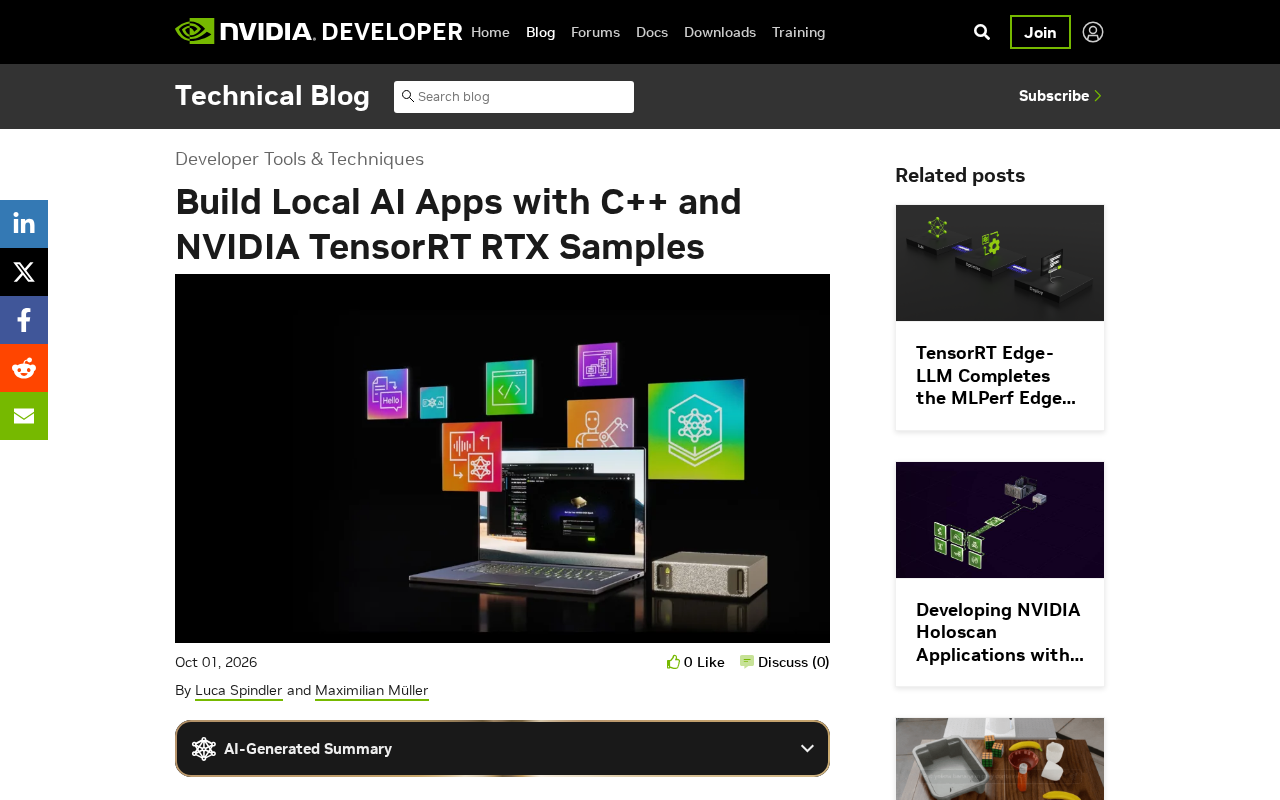
The TensorRT RTX solution introduced on NVIDIA's developer blog addresses exactly these pain points. Targeting developers who build local AI applications in C++, it provides a complete toolchain — from model loading to inference acceleration — that brings AI capabilities to end-user devices rather than keeping them confined to data centers.
Why C++ and TensorRT RTX
In local inference scenarios, C++ remains the language of choice for performance-sensitive applications. Compared to Python, C++ offers lower latency, finer-grained memory control, and a smaller deployment footprint — qualities that are critical for desktop software, games, creative tools, and other applications requiring real-time responsiveness.
TensorRT RTX is NVIDIA's inference engine branch optimized for RTX-series GPUs. It inherits TensorRT's core optimization capabilities — including layer fusion, precision calibration, and kernel auto-tuning — while being adapted for the hardware characteristics of consumer-grade RTX graphics cards. This means developers can fully unleash the computational power of a user's gaming laptop or desktop GPU to run AI models locally, without requiring an internet connection or incurring ongoing cloud inference costs.
Why Portable Model Formats Matter
The original article emphasizes the importance of a "portable model format." In practice, models are typically trained using frameworks like PyTorch or TensorFlow, but deploying their native formats directly tends to be cumbersome and dependency-heavy. By converting to a standardized intermediate format (such as ONNX) and then compiling it through TensorRT RTX for optimization, developers can decouple the training environment from the deployment environment, significantly simplifying the delivery process.
ONNX (Open Neural Network Exchange) is currently the most widely adopted cross-framework model interchange format. Jointly introduced by Microsoft and Facebook in 2017, it has since become the de facto industry standard. It stores a neural network's computation graph using unified operator definitions and data formats, allowing models trained in PyTorch to be loaded and executed by completely different inference engines such as TensorRT, Core ML, and OpenVINO.
The typical TensorRT RTX workflow is: export ONNX from training framework → TensorRT parses and optimizes the computation graph → generate a serialized engine file (.engine/.plan) targeting the specific GPU. This serialized engine is platform-bound — compiled for a specific GPU model and TensorRT version, it cannot be reused directly across platforms. But it is precisely this "compile once, optimize completely" design that delivers dramatic inference performance gains.
TensorRT's core optimization techniques deserve further explanation. Layer Fusion merges multiple consecutive operations (e.g., Conv + BatchNorm + ReLU) into a single GPU kernel call, reducing the overhead of reading and writing intermediate data to VRAM. Precision Calibration allows model weights to be reduced from FP32 to FP16 or even INT8, delivering significant throughput gains and lower VRAM usage within an acceptable range of accuracy loss — the Tensor Cores in RTX-series GPUs offer hardware-level acceleration for FP16/INT8. Kernel Auto-tuning tests multiple computation strategies against the target GPU's specific hardware parameters (number of CUDA cores, L2 cache size, etc.) during the initial engine build, selecting the optimal one. This is the fundamental reason why TensorRT engine builds take considerable time, yet inference latency ends up extremely low.
The "Do Inference Now" Sample Project
The centerpiece of NVIDIA's release is a sample collection called "Do Inference Now." As the name suggests, this set of example code is designed to help developers get up and running quickly — covering model loading, engine building, and inference execution with ready-to-reference engineering practices.
For developers new to TensorRT RTX, the value of official samples like these lies in flattening the learning curve. Configuring an inference engine involves a large number of details: how to handle dynamic input sizes, how to choose the right precision mode (FP32/FP16/INT8), how to manage GPU memory, and more. With validated examples as a starting point, developers can avoid repeatedly stumbling over basic configuration issues and focus their energy on business logic instead.
Engineering Considerations for Cross-System Acceleration
One major real-world challenge for local AI applications is hardware diversity. Users' devices may carry RTX graphics cards from different generations with varying VRAM capacities, and some devices may have no discrete GPU at all. A mature local inference solution needs to account for this fragmentation — TensorRT RTX uses a runtime engine adaptation mechanism to ensure that the same application achieves reasonable acceleration across different target systems.
What This Trend Means for Local AI
From an industry perspective, NVIDIA's push toward a local deployment path combining C++ and TensorRT RTX reflects the growing importance of on-device AI as a mainstream direction. As model miniaturization techniques mature and consumer-grade GPU compute power increases, more and more AI capabilities can run directly on user devices — bringing benefits such as privacy protection, zero-latency responses, and no network dependency.
For developers, mastering the local AI deployment toolchain is becoming an increasingly valuable skill. Whether you're adding intelligent features to desktop software or building AI tools that work offline, solutions like TensorRT RTX offer a practical path officially backed by NVIDIA. Developers looking to dive deeper can start with the "Do Inference Now" sample project and experiment within their own application contexts.
Model miniaturization is the key driver behind the democratization of on-device AI. The main technical approaches include knowledge distillation (using a large model to "teach" a smaller one), quantization (reducing the numerical precision of weights), and pruning (removing network connections that contribute little to the output). For large language models, for example, models compressed from hundreds of billions of parameters down to 7 billion or fewer — such as the Llama, Phi, and Gemma families — can already run smoothly on consumer-grade graphics cards. Meanwhile, the dedicated AI compute performance (measured in TOPS) of RTX 40/50-series GPUs has increased several times over compared to previous generations, bringing tasks like image generation, speech recognition, and real-time translation to a local user experience that rivals or even surpasses early cloud-based solutions. This dual maturity of hardware and algorithms is precisely the underlying logic driving NVIDIA to actively cultivate a local inference developer ecosystem.
Related articles

Chain of Thought Isn't Just for AI: How Humans Can Use CoT to Improve Thinking Quality
Chain of Thought isn't just a prompt trick for large models. Starting from a Hacker News discussion, this article analyzes why CoT works for human thinking too, breaks down actionable ways to transfer it, and highlights the key differences between human CoT and machine CoT.
Cloudflare Teams Up with OpenAI: Closi…
Cloudflare Teams Up with OpenAI: Closing the Loop from Vulnerability Discovery to Defense with AI
Cloudflare uses OpenAI Daybreak to investigate security vulnerabilities and generate reviewable remediation plans, while developers use Codex to boost coding efficiency and quality.

Orca Multi-Agent Orchestration in Practice: A Guide to Parallel Collaboration with Claude and Codex
Orca is Stable AI's free open-source agent workbench supporting 34 agents like Claude Code and Codex in parallel. Learn its Git worktree isolation, multi-model orchestration, and mobile management.