A Practical Guide to Using Full-Power DeepSeek at Low Cost

Use Windsurf Pro's credit grants to access full-power DeepSeek at roughly 10x lower cost.
After DeepSeek raised API prices by nearly 6x, a developer discovered that purchasing Windsurf Pro accounts with complimentary credits on second-hand platforms offers roughly a 10x cost advantage. By using Windsurf's built-in DeepSeek Fresh Max model with ~$150 in granted credits for just ~$30, developers can access the full-parameter DeepSeek API at a fraction of the official price — though account sourcing stability and compliance risks should be carefully considered.
Background: The Cost Crunch After DeepSeek's Price Hike
DeepSeek's official API recently underwent a significant price adjustment — with increases of nearly 6x. For developers who heavily rely on large language models, the impact has been immediate and painful.
DeepSeek is a series of large language models developed by the company DeepSeek (深度求索). Models like DeepSeek-V3 and DeepSeek-R1 quickly gained popularity for their strong performance across multiple benchmarks — all while offering API access at prices far below OpenAI and Anthropic. DeepSeek's previous pricing strategy was extremely competitive: input token prices were once just a fraction of GPT-4's, making it a go-to choice for independent developers and small teams. However, with a rapidly expanding user base and rising compute costs, the price adjustment isn't surprising from a business standpoint — LLM API pricing is typically driven by inference compute costs, GPU cluster maintenance, and bandwidth overhead. When concurrent request volumes exceed what infrastructure can economically support, price hikes are virtually inevitable.
According to a Chinese Bilibili content creator, he had been using DeepSeek models integrated into Windsurf (the AI IDE formerly known as Codeium) through third-party channels. The overall experience was solid — performance approached Claude Opus 4.6 levels, and the price was low. But after the price increase, his daily usage cost spiked to nearly 100 RMB (~$14), making it unsustainable in the long run.
This cost pressure is a common pain point for many AI coding users: on one hand, they want access to the most powerful "full-power" models (i.e., full-parameter, uncompromised official-grade APIs); on the other, they struggle to absorb the ongoing costs of official pricing. In AI coding scenarios, token consumption is far higher than in regular conversations — a single complex code refactoring task can burn through tens or even hundreds of thousands of tokens, since large volumes of code context go in as input and large blocks of generated code come out as output. That's why even small fluctuations in API pricing can significantly impact a developer's monthly expenses. Finding a path that's "affordable without sacrificing performance" becomes a real necessity.
Core Idea: Leveraging Windsurf's Official Credit Grants
After trying various IDEs, proxy accounts, and API routing approaches, this creator reached a somewhat surprising conclusion — using Windsurf's official Pro account directly is actually the lowest-cost option.
Windsurf is an AI-native integrated development environment (IDE) launched by Codeium, officially released in late 2024. Codeium previously offered AI code completion as a VS Code plugin and had accumulated over a million developer users. Windsurf's standout feature is its "Cascade" capability — a context-aware AI agent workflow that can autonomously execute multi-step programming tasks, including cross-file editing, terminal command execution, and holistic codebase understanding. Windsurf supports integration with multiple LLMs, including Claude, GPT-4o, Gemini, and DeepSeek, allowing users to flexibly choose based on task complexity and budget.
The Free Credit Grant Is the Key
The core logic behind this approach lies in Windsurf's official mechanism for granting complimentary credits. According to the creator, early Pro accounts often came with a generous credit grant — a Pro account plus approximately $120 in cloud credits, effectively giving you $140–$150 in pure API calling credits.

Converted to RMB at roughly 6.7:1 exchange rate, the actual value of these credits is quite substantial. On second-hand platforms like Xianyu (闲鱼, China's equivalent of eBay for used goods), these credit-loaded Pro accounts sell for around just over 200 RMB (~$30), which gets you approximately $150 in credits.

Windsurf Has Built-in DeepSeek at Lower Rates
Another crucial point: Windsurf natively integrates the latest version of DeepSeek (DeepSeek Fresh Max). Its per-call pricing is comparable to, or even lower than, DeepSeek's official domestic pricing:
- Input: ~$0.14/unit
- Output: ~$0.28/unit
LLM APIs typically use per-token billing, where a token is the smallest unit of text the model processes. One Chinese character corresponds to roughly 1.5–2 tokens, while one English word corresponds to about 1–1.5 tokens. Billing is split into input (Prompt) and output (Completion), with output tokens usually costing 2–4x more than input because text generation requires more computational resources. DeepSeek's pricing on the Windsurf platform means you're not only tapping into a low-cost credit pool — the per-call cost of the DeepSeek model itself is also highly competitive.
Cost Analysis: Roughly a 10x Price Advantage
The most compelling part of this low-cost DeepSeek approach is the fully transparent cost breakdown.
The creator's calculation logic goes roughly as follows:
- Spend around 200+ RMB (~$30) on Xianyu for a Windsurf Pro account with $120 in granted credits;
- After accounting for the subscription value, this yields approximately $150 in usable API credits;
- Consume these credits directly through Windsurf's built-in DeepSeek model;
- Since it's the official full-power API, model performance is uncompromised.
The "full-power version" (Full Version) here refers to the model provider's complete-parameter API, offering the highest reasoning capability and most comprehensive feature support. In contrast are various "nerfed" or "distilled" versions (Distilled Version), which use techniques like knowledge distillation, quantization, or parameter pruning to reduce inference cost and latency at the expense of some performance. For example, there's a significant capability gap between DeepSeek-R1's 671B full-parameter version and its 7B/14B distilled versions in tasks like complex reasoning, long-context understanding, and code generation. Some third-party proxy API platforms may use more heavily quantized or shorter-context versions without users' knowledge to cut costs — which is exactly why developers pay close attention to whether they're getting the "full-power" version.
After running through these calculations, his conclusion was: the overall cost is at least ~10x cheaper than using DeepSeek's official API directly, while still using the full, uncompromised model.
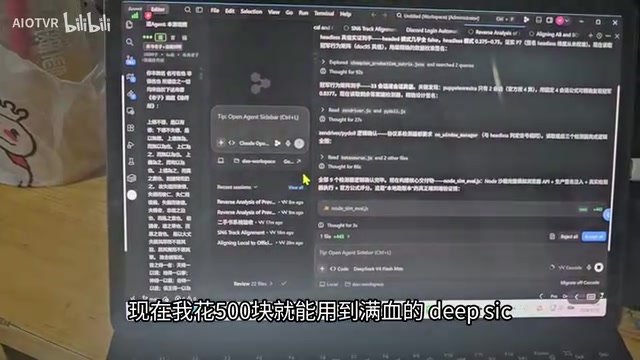
In terms of monthly expenses, he noted that he previously might have spent over 1,000 RMB per month, but with this approach, spending at most around 500 RMB per month allows essentially unlimited usage — opening as many conversations and making as many AI calls as needed, with virtually no worry about running out of credits.
Practical Setup: Account Purchase and Plugin Configuration Steps
The complete workflow can be summarized in a few steps:
Step 1: Purchase a Windsurf Pro Account
Search for "Windsurf Pro" accounts on Xianyu. Choose the ~200 RMB tier that comes with granted credits. Make sure to confirm the amount of credits included with the account.
Step 2: Log into Windsurf in Official Mode
Once you have the account, log directly into the Windsurf IDE in official mode — no additional third-party API configuration needed.
Step 3: Use a Credit Replacement Plugin
The creator mentioned that he also uses a credit replacement plugin he developed earlier (a self-built model/credit replacement tool). With this plugin configured, simply select the DeepSeek Fresh Max model and start using it.
Based on his real-world experience, this combination delivers performance equivalent to Claude Opus 4.6 or above, approaching 4.7 levels, while the price is extremely low — "more comfortable to use than virtually any third-party channel." Claude Opus 4 is Anthropic's flagship large language model released in 2025, positioned as the highest-performance tier in the Claude 4 series. Anthropic uses a "Haiku-Sonnet-Opus" product tiering strategy, with Opus offering the strongest reasoning capability at the highest price point — API input pricing is approximately $15 per million tokens, with output at around $75. The creator's comparison of DeepSeek's performance to Claude Opus 4.6 levels indicates that in AI coding scenarios, DeepSeek has achieved practical value comparable to top-tier closed-source models, at a fraction of the cost.
Risk Disclaimer: Boundaries and Caveats of This Approach
While this approach is certainly appealing for reducing DeepSeek usage costs, several real-world concerns are worth noting:
First, the stability of account sourcing. Purchasing credit-loaded accounts on second-hand platforms fundamentally depends on Windsurf's early promotional mechanisms. These credit grant programs could be adjusted or discontinued at any time, and the company may tighten policies around second-hand accounts. Long-term availability is not guaranteed.
Second, compliance concerns. Reselling or purchasing official accounts to exploit granted credits for "arbitrage" may violate Windsurf's Terms of Service. This kind of promotional credit arbitrage isn't uncommon in the SaaS industry — similar cases include early ChatGPT Plus account reselling and second-hand trading of free trial credits from various cloud platforms. The arbitrage opportunity typically arises from the price gap between aggressive growth-stage subsidies and information asymmetry in secondary markets. However, virtually all major platforms' Terms of Service explicitly prohibit account transfers and credit resale. Once a platform detects anomalies through device fingerprinting, login IP analysis, or usage pattern detection, it may respond by banning the account, wiping the balance, or even pursuing legal action. If your account is flagged as violating terms, the money you invested may be unrecoverable.
Third, pricing is time-sensitive. All prices, exchange rates, and credit amounts mentioned in this article are based on a specific point in time after DeepSeek's price increase. Model providers and platforms frequently adjust pricing, so be sure to verify the latest prices before taking action.
Conclusion
At its core, this method is a "cost arbitrage" strategy in the context of rapidly rising AI tool prices — bypassing DeepSeek's official direct billing by leveraging Windsurf's credit grant mechanism and a custom plugin to drive the cost of using full-power DeepSeek down to rock-bottom levels.
For developers with limited budgets who still demand top model performance, this is a reference approach worth knowing about. However, it must be emphasized that this method depends on specific platform mechanisms, and both its stability and compliance carry uncertainties. The rational approach is to treat it as a short-term transitional solution while continuously monitoring DeepSeek's official pricing and the cost-effectiveness of mainstream AI coding tools, and be ready to switch strategies at any time.
Related articles

Flown App Review: Flight Log Visualization Maps & Automatic Delay Compensation Alerts
Flown is an iOS flight logging app that plots your journeys on a private map, supports 197-country check-ins, annual flight reviews, and auto-calculates flight delay compensation. Local data storage, no account needed.

Hermes Agent Hands-On: Full Workflow for Building Apps Locally with an Autonomous AI Agent
Hands-on review of Hermes Agent: from installation to building a local calorie tracker in three steps. Covers local memory, Anthropic API setup, and progressive prompt workflows.
Fable 5.1 vs GPT-6 Astra: A Hands-On Comparison of 3D Modeling Capabilities
A detailed comparison of Fable 5.1 and GPT-6 Astra for 3D model generation, analyzing geometry, topology, UV quality, and materials in Blender asset creation.