A Programmer's Guide to Starting a Remote Outsourcing Studio: The Practical Path from Landing Clients to Earning Seven Figures

Programmer outsourcing startups have a 30% success rate — soft skills matter more than technical skills
An entrepreneur running a 900-member tech community shares outsourcing studio startup data: out of 100 who tried, about 30 replaced their full-time income (30% success rate), significantly higher than indie development (<20%) and consumer product startups (<10%). The article argues that the core competitive advantage in outsourcing isn't technical skill itself, but business acumen and consulting value, while AI tools are reshaping the industry landscape.
The Real Data on Outsourcing Startups: What a 30% Success Rate Actually Means
In an era of rapid AI development, the way programmers survive is fundamentally changing. An entrepreneur running a tech community of over 900 members shared his in-depth summary of starting an outsourcing studio. Based on real community data: out of approximately 100 people who attempted freelance outsourcing, about 30 were able to replace their full-time income (a success rate of roughly 30%), and 7-8 achieved financial freedom.
To understand this number, we need to compare it against the broader startup ecosystem. According to long-term tracking data from the U.S. Small Business Administration (SBA), the 5-year survival rate for typical small businesses is around 50%, but the threshold of "replacing full-time income" is far more demanding than mere "survival." A 30% success rate for tech outsourcing studios is actually significantly higher than most consumer product startups (which typically have success rates below 10%). The reasons behind this are: the outsourcing model has extremely low startup costs (virtually zero inventory, zero fixed assets), the cost of failure is small, and you can iterate and experiment quickly; meanwhile, technical services have genuine market demand rigidity that doesn't depend on trending fads.
By comparison, indie development has an even lower success rate — within a community of similar size, fewer than 20% actually make money from indie development, and only 2-3 people achieve financial freedom. The lower success rate of indie development (Indie Hacker) stems from needing to simultaneously solve the much harder problem of "product-market fit" — you not only need to be able to build something, but build something people are willing to pay for. Although outsourcing isn't as "sexy" as indie development, for programmers who want to achieve remote work and freelancing, the success rate is significantly higher.
Getting Started: Technical Skills and Soft Skills Are Both Essential
Technical Foundation Requirements
Freelance outsourcing doesn't require you to be a technical expert, but it does require a sufficiently broad knowledge base:
- Master at least one full-stack technology: such as Node+React, PHP+Vue, etc., capable of independently completing project development
- Server operations basics: Linux environment configuration, domain binding, basic deployment capabilities
- Familiarity with mainstream tech ecosystems: Java (Spring Boot/Spring Cloud), Go (GoFiber), PHP (WordPress), etc.
- Design tool awareness: understanding the workflows of Figma and Sketch
- AI-assisted development capability: proficient use of tools like Claude Code and Cursor to boost development efficiency
The choice of these tech stacks has clear market logic behind it. The combination of Node.js (a JavaScript runtime built on the V8 engine) and React (Meta's open-source frontend UI framework) remains one of the most in-demand tech stacks in the global outsourcing market in 2024. The reason is that JavaScript's isomorphic front-end/back-end approach reduces team communication costs, and the ecosystem is mature with easy hiring. The PHP+Vue combination holds an important position in the SME market, especially within the WordPress ecosystem — approximately 43% of all websites globally are built on WordPress, which means a massive market for custom development and maintenance. For freelance outsourcing practitioners, the core value of understanding multiple tech stacks isn't mastering them all, but being able to make reasonable technology selection recommendations based on client needs — this itself is a demonstration of consulting value.
Particularly noteworthy is the productivity revolution brought by AI-assisted development tools. Cursor is an AI-native IDE deeply rebuilt on VS Code, with built-in code completion, multi-file editing, and codebase understanding capabilities — its core innovation is embedding large language models directly into the development workflow. Claude Code is Anthropic's command-line AI programming assistant, excelling at handling complex multi-step programming tasks and codebase refactoring. A programmer proficient in AI-assisted development tools can achieve 2-3x their original development speed on certain types of projects, directly compressing project delivery timelines and improving profit margins per unit of time. However, this also brings industry-wide pricing pressure — as AI tools become widespread, the market price for pure coding will continue to decline, which is the deeper reason why the section below emphasizes that "soft skills are the core competitive advantage."
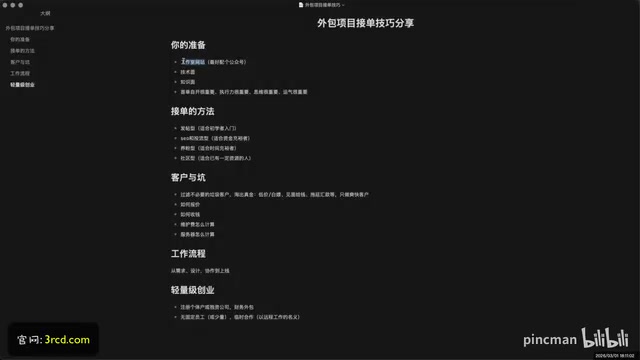
Soft Skills Are the Core Competitive Advantage
This is a key point many programmers overlook — the core of making money through outsourcing isn't writing code, but business capabilities and consulting value:
- Being able to analyze the pros and cons of technology choices with clients (concurrency, performance, server costs)
- Understanding
Related articles
 Expert Opinions
Rethinking Scaling Laws: Parameters Are Not the Only Answer
Deep analysis of Scaling Law evolution from Kaplan to Chinchilla to the MoE era, exploring why blindly stacking parameters is a mistake, and how GLM-5.3 proves scaling has multiple knobs.
When AI Treats Humans as Subagents: Ro…
When AI Treats Humans as Subagents: Role Reversal and Hidden Risks in Human-AI Collaboration
Exploring the paradigm shift where humans become "subagents" in AI Agent architectures. Analyzes human node design in LangChain and AutoGen, and the risks of ceding control and cognitive atrophy.
 Expert Opinions
The Lazy Person's Productivity Theory: Why Being 'Lazy' Actually Drives Peak Performance
Explore the engineering philosophy behind 'lazy people are most productive': how constructive laziness drives automation, AI tools amplify efficiency, and systems thinking eliminates wasted effort.