A Quadratic Law for Weak-to-Strong Generalization: New Proof via Random Matrix Theory
Rigorous proof that training a strong student on weak teacher labels yields quadratic error compression, with phase transition boundaries.
This paper investigates the theoretical foundations of weak-to-strong generalization: in two-layer random feature networks, training a strong (wide) student model on labels from a weak (narrow) teacher can dramatically surpass the teacher's generalization error. Using random matrix theory to derive deterministic equivalents for both models' errors, the authors rigorously prove that under ReLU activations and pure spherical harmonic targets, student error scales as the square of teacher error — matching the known lower bound and achieving the theoretically optimal level. Further analysis reveals phase transitions between quadratic improvement, non-quadratic improvement, and no improvement, showing that weak-to-strong generalization is conditional on target structure and training setup. The work provides a solid theoretical anchor for weak supervision mechanisms in superalignment, though extrapolation to real large models remains open.
What Is Weak-to-Strong Generalization
In research on large model alignment and supervision, a striking phenomenon known as "weak-to-strong generalization" has emerged: when a more capable student model is trained using labels generated by a weaker teacher model, the student's final generalization performance can actually surpass the teacher. This matters because it directly bears on how relatively weak supervisory signals can guide stronger models — which is precisely the core concern of superalignment research.
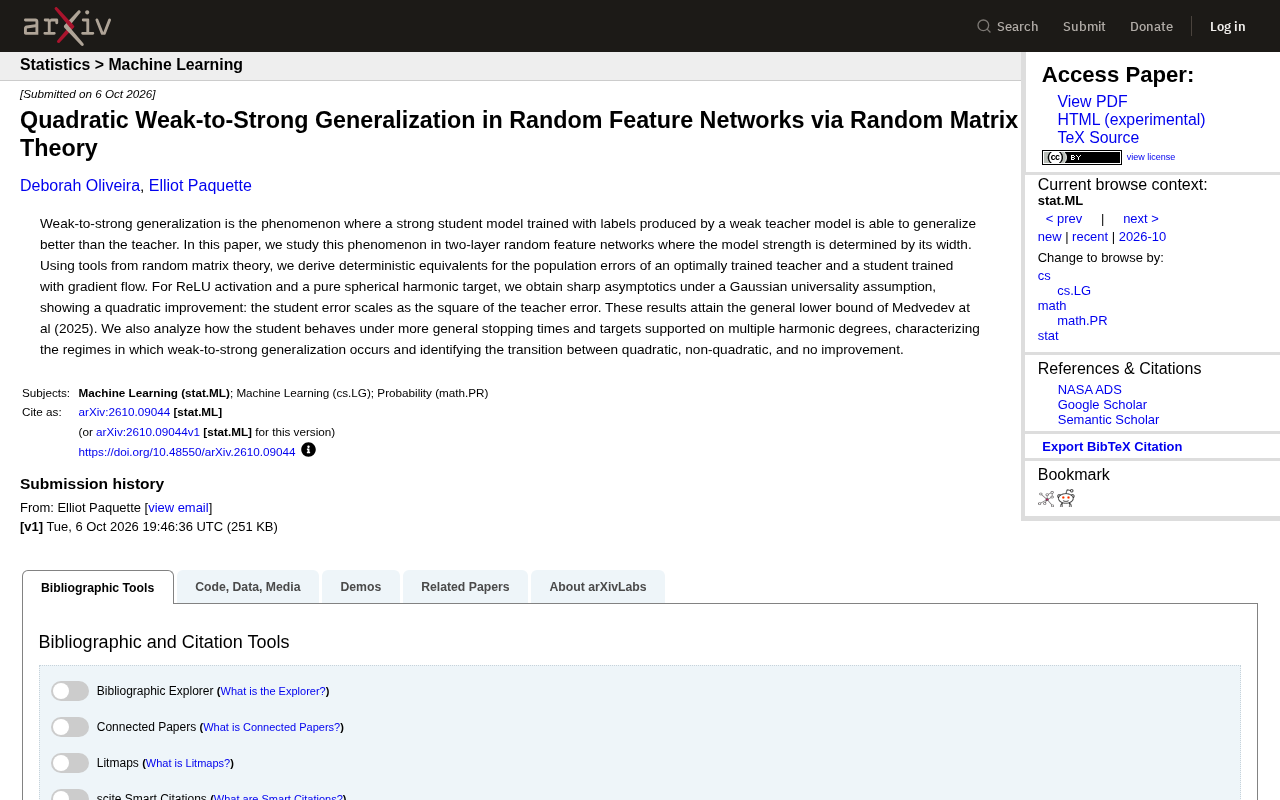
This paper (arXiv:2610.09044v1) approaches the problem theoretically, aiming to characterize — within a rigorously analyzable model framework — how much improvement weak-to-strong generalization can deliver, under what conditions it arises, and when it breaks down. The setting is two-layer random feature networks, where model "strength" is determined by network width: the wider the network, the stronger the model.
Superalignment is a research direction proposed by OpenAI and others, centered on the question: future superintelligent systems will far exceed human capabilities — how can humans ensure effective supervision and alignment of such systems? Weak-to-strong generalization offers one potential answer: if signals from weaker supervisors (such as humans) can be amplified by stronger models and spontaneously corrected, then weak supervision might be sufficient to steer superintelligence in the right direction. This makes weak-to-strong generalization not just a technical machine learning problem, but a central concern of AI safety research.
Precise Characterization via Random Matrix Theory
The methodological highlight of this paper is its use of random matrix theory. The authors derive "deterministic equivalents" for the population error of two types of models: an optimally trained teacher model, and a student model trained via gradient flow.
Deterministic equivalents are a standard tool in random matrix theory that allow researchers to approximate the error behavior of a random system with a deterministic, analytically tractable expression, eliminating dependence on specific random realizations. This makes asymptotic error analysis tractable, and allows questions like "by how much does the student surpass the teacher?" to be precisely quantified rather than remaining at the level of empirical observation.
The Core Result: Quadratic Improvement
The paper's most significant result appears in a specific setting: with ReLU activations and a pure spherical harmonic target, under a Gaussian universality assumption, the authors obtain sharp asymptotic results — the student's error scales approximately as the square of the teacher's error.
In other words, if the teacher's error is ε, the student's error is approximately ε². Since errors are typically less than 1, the quadratic relationship implies a substantial compression of error — a quite strong improvement. More critically, this result matches the general lower bound established by Medvedev et al. (2025), demonstrating that the quadratic improvement in this setting is the theoretically optimal achievable level, not a gap left for further optimization.
Random feature networks are a special class of two-layer neural networks in which the first-layer weights are fixed after initialization and do not participate in training — only the second layer's linear weights are updated. This simplification gives the network properties similar to kernel methods, while making theoretical analysis tractable. Using network width to measure model "strength" is highly intuitive: the wider the network, the higher the dimensionality of the random feature space, the richer the function class the model can express, and the "stronger" its learning capacity. This framework is a standard abstraction in theoretical machine learning for studying generalization behavior in neural networks, and has been widely used to analyze phenomena such as overparameterization and double descent.
Spherical harmonics are a set of orthonormal basis functions defined on the unit hypersphere, analogous to Fourier components on a sphere, with each degree corresponding to a different frequency component. In learning theory, decomposing a target function into a linear combination of spherical harmonic bases is a standard tool for analyzing function complexity and model learning difficulty. A "pure spherical harmonic target" means the target function contains components of only a single degree, which greatly simplifies analysis but also limits the scope of applicability — real-world target functions are typically mixtures of multiple degrees, and the paper's subsequent extension to multi-degree settings is designed to bridge this gap. The Gaussian universality assumption states that even if the data is not strictly Gaussian, as long as certain moment conditions are satisfied, the system's asymptotic behavior is consistent with the Gaussian case, giving the results generality beyond any specific distributional assumption.
Where the Limits of Generalization Improvement Lie
The paper does not stop at the ideal case, but further analyzes student model behavior under more general conditions. It examines two extensions: more general stopping times for gradient flow training, and target functions supported on multiple spherical harmonic degrees rather than a single pure harmonic target.
Through these analyses, the authors characterize specific "regimes" in which the weak-to-strong generalization phenomenon appears, and identify transitions between three distinct states: quadratic improvement, non-quadratic improvement, and no improvement. This "phase transition" style of characterization is highly valuable — it tells us that weak-to-strong generalization is not a universal free lunch, but depends on conditions such as target structure and training procedure. When these conditions are not met, the student may gain only limited improvement, or may fail to surpass the teacher at all.
Significance and Limitations
From a research value perspective, this paper places a phenomenon primarily driven by empirical observations on large models into a theoretically rigorous framework for verification and quantification. The clean quadratic scaling result, and its agreement with existing lower bounds, provides a solid theoretical anchor for understanding weak-to-strong generalization. For researchers concerned with superalignment and weak supervision training mechanisms, this type of analysis helps determine which supervisory settings are more likely to produce effective capability transfer.
Of course, the scope of the results should be viewed with care. The study is built on the simplified model of two-layer random feature networks, and relies on a series of assumptions including ReLU activations, spherical harmonic targets, and Gaussian universality. Real deep networks are far more complex than this setting in terms of architecture, data distribution, and training dynamics, so whether the quadratic law can be directly extrapolated to practical systems such as large language models remains an open question. This work is best understood as a theoretical cornerstone for understanding the mechanisms of weak-to-strong generalization, rather than a direct prescription for practical engineering.
Related articles

Chain of Thought Isn't Just for AI: How Humans Can Use CoT to Improve Thinking Quality
Chain of Thought isn't just a prompt trick for large models. Starting from a Hacker News discussion, this article analyzes why CoT works for human thinking too, breaks down actionable ways to transfer it, and highlights the key differences between human CoT and machine CoT.
Cloudflare Teams Up with OpenAI: Closi…
Cloudflare Teams Up with OpenAI: Closing the Loop from Vulnerability Discovery to Defense with AI
Cloudflare uses OpenAI Daybreak to investigate security vulnerabilities and generate reviewable remediation plans, while developers use Codex to boost coding efficiency and quality.

Orca Multi-Agent Orchestration in Practice: A Guide to Parallel Collaboration with Claude and Codex
Orca is Stable AI's free open-source agent workbench supporting 34 agents like Claude Code and Codex in parallel. Learn its Git worktree isolation, multi-model orchestration, and mobile management.