A Reading Guide to Distributed Systems Classic Papers: From Beginner to Expert
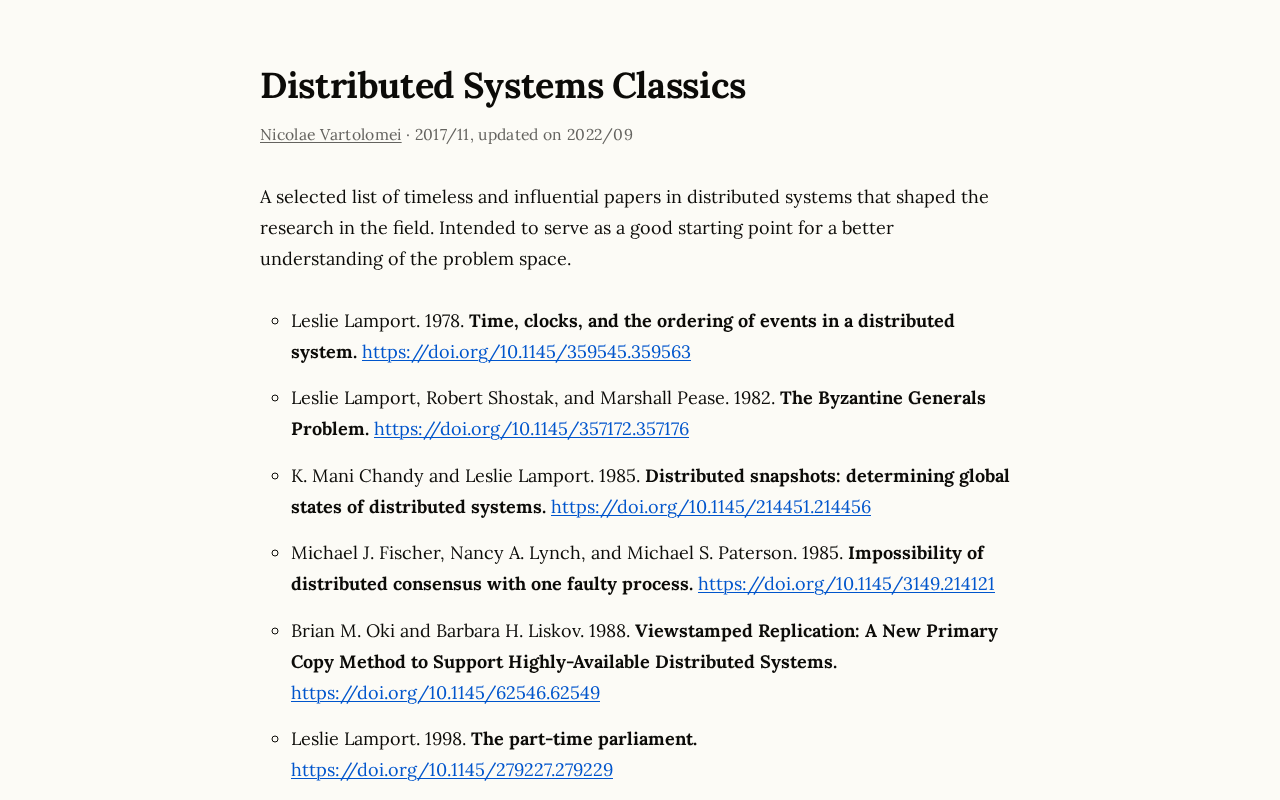
A curated distributed systems classic papers list goes viral on Hacker News, covering Paxos, Raft, CAP theorem, and more.
A curated reading list titled *Distributed Systems Classics* recently gained widespread attention on Hacker News, sparking lively discussion in the engineering community. The article highlights that distributed systems challenges stem from inherent uncertainties like network partitions, node crashes, and clock drift — and argues that reading original classic papers, including Lamport's logical clocks paper, the Paxos and Raft consensus algorithms, and engineering papers like Google Bigtable and Amazon Dynamo, helps engineers understand the deep trade-offs behind design decisions rather than relying on second-hand summaries. The piece also emphasizes combining theory with hands-on practice — such as implementing a simplified version of Raft while reading the paper — as the key to genuine understanding. The list is considered an essential roadmap for engineers working in backend, database, and cloud infrastructure domains.
In software engineering, distributed systems is one of the most challenging and fascinating areas to explore. An article titled Distributed Systems Classics recently sparked heated discussion on Hacker News, earning 223 upvotes and 44 comments. The curated list brings together classic papers and resources in the distributed systems field, offering engineers a structured learning path into this domain.
Why Distributed Systems Deserve Serious Study
The complexity of distributed systems stems from their inherent uncertainty: networks partition, nodes crash, messages get delayed or lost, and clocks can never be perfectly synchronized. These seemingly fundamental problems are precisely what lie at the heart of designing modern large-scale systems. Whether it's databases, message queues, or cloud computing infrastructure, none of it works without the theoretical foundations of distributed systems.
The value of this classic papers list lies in the fact that it doesn't settle for fragmented blog posts — it goes back to the original literature that laid the groundwork for the entire field. Compared to second-hand interpretations, reading classic papers directly allows engineers to understand the trade-offs and reasoning behind design decisions, which is crucial for developing strong intuitions about system design.
Core Topics Covered in the List
Classic distributed systems literature typically revolves around a few central themes. Consensus algorithms are unavoidable: from Leslie Lamport's Paxos to the more approachable Raft, these algorithms address the fundamental question of how multiple nodes can agree on a value over an unreliable network.
Time and ordering are another classic challenge in distributed systems. Lamport's paper Time, Clocks, and the Ordering of Events in a Distributed System is essential reading for nearly every student of distributed systems. The "happens-before" relationship it introduced has profoundly influenced system design for decades since.
Beyond that, topics such as consistency models, the CAP theorem, failure detection, replication, and partitioning are all staples of these kinds of reading lists. These themes are deeply interconnected, collectively forming a knowledge map for understanding modern distributed systems.
Bridging Theory and Engineering Practice
A common pitfall in learning distributed systems is getting too absorbed in theory while neglecting practical implementation. The value of classic papers isn't just in the theory itself, but in how that theory gets applied to real systems. Papers on systems like Google's Bigtable and Amazon's Dynamo, for example, demonstrate how to make principled trade-offs against real engineering constraints.
The eventual consistency ideas introduced in the Dynamo paper directly inspired a generation of NoSQL databases including Cassandra and Riak. Understanding the design trade-offs in these systems, however, requires first grasping the underlying theory around consistency and availability — which is exactly the point of a classic papers list like this one. It establishes a complete chain from abstract theory to concrete engineering.
How to Get the Most Out of This List
With such a large body of classic literature, trying to read everything cover-to-cover is usually inefficient. A more pragmatic approach is to read with purpose, driven by your own engineering context. If you're designing a system that requires strong consistency, focus on consensus algorithm papers. If high availability is your concern, dive deep into the CAP theorem and the trade-offs of eventual consistency.
The Hacker News community discussion echoes this sentiment. Many engineers in the comments shared their own learning experiences, emphasizing the importance of combining theory with hands-on implementation — attempting to build a simplified version of Raft while reading the paper, for instance, tends to yield far deeper understanding than reading alone.
Closing Thoughts
Distributed systems is a discipline that takes years of sustained investment to master, and classic papers are the most reliable source of foundational knowledge. The popularity of this list reflects the developer community's ongoing demand for structured, high-quality learning resources. For any engineer looking to go deep in backend development, databases, or cloud infrastructure, curations like this are an invaluable roadmap.
The original resource and community discussion can be found at the Hacker News thread and the original list.
Related articles
Jensen Huang Takes Trump's Call in Public — But It's the Phone in His Hand That Steals the Show
NVIDIA CEO Jensen Huang took a live call from Trump in public, but observers couldn't stop talking about the phone in his hand. Here's what the moment reveals.

Former FTC Chair Khan Invokes 1934 Precedent to Argue for Criminal Liability of AI Executives
Former FTC Chair Lina Khan argues AI executives should face criminal liability, not just fines, citing a 1934 legal precedent. An analysis of her position, its logic, and the real-world challenges it faces.

Valve Is Still Weighing When and How to Launch Steam Deck 2
Valve has completed its 2026 hardware lineup with Steam Controller, Steam Machine, and Steam Frame, but Steam Deck 2 still has no set timeline. Valve says it's still weighing "how and when" to launch.