A Reverse City-Builder Where 'the City Doesn't Want You to Win'

Reverse city-builder Housing Over Pizza makes 'the city doesn't want you to win' its core mechanic — and goes viral on Hacker News.
Housing Over Pizza is a browser-based reverse city-builder where you still build and expand, but the city itself is unwelcoming to your construction, and every decision creates friction with 'the city's will.' It elevates the housing crisis from background lore to core mechanic, using scarcity, allocation, prioritization, and long-term costs to build an adversarial experience, earning 402 points and 133 comments on Hacker News. The piece argues that such adversarial simulations succeed only when the resistance is understandable and answerable: self-consistent constraints make 'defiance' feel like a meaningful decision, while random obstruction only breeds frustration. Lightweight, sharp in concept, and discussable — these three traits are why it drew attention in the tech community.
City-building games usually put the player in the role of a creator: planning road networks, raising skylines, and letting citizens live and work in peace. But Housing Over Pizza, which sparked 402 points and 133 comments on Hacker News, does the exact opposite — you're still building, but this city would rather you didn't.
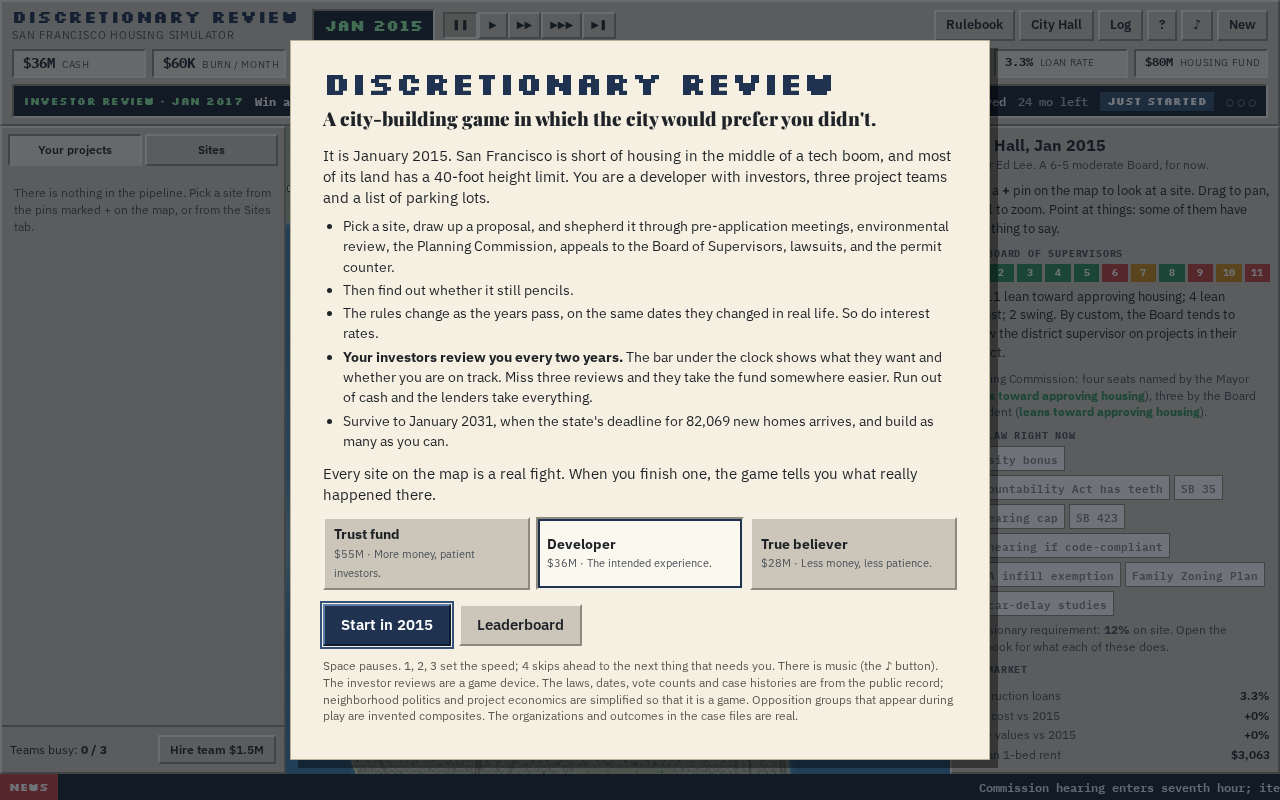
When 'building' becomes an offense
The game's entry point, housing.over.pizza, carries a hint of irony in its very name: where to live and what to eat are two questions no modern urbanite can escape. Placing these two things side by side doesn't suggest prosperity — it suggests trade-offs.
In a traditional city-builder, the feedback loop is positive — you invest resources, the city grows, the numbers go up. This game flips the feedback on its head: the more you expand, the more uncomfortable the city becomes. That adversarial design is what sets it apart from its peers, and it's also why it scored so highly in the tech community.
Interestingly, this kind of "reverse simulation" isn't an isolated case. In recent years, the indie game scene has produced a wave of works that treat the system itself as the opponent — the thing players fight isn't an enemy, but the rules.
Making the housing crisis a mechanic, not a backdrop
Housing is a natural fit for gamification. It involves scarcity, allocation, prioritization, and long-term costs — every one of which is a mature game mechanic.
Judging by the heat of the original post's discussion on Hacker News, a fair share of the 133 comments didn't stay at the gameplay level but extended into real-world housing policy and urban planning dilemmas. This shows the game succeeded, as a medium, in turning a dreary public issue into an experienceable tension.
According to the project's public page, every construction decision the player makes in the city creates friction with "the city's will." That friction isn't a punishment for failure — it is the core experience of the game.
The housing crisis is so often cited in games because it is essentially "multi-objective conflict under limited resources." Land supply is finite, commute time is negatively correlated with housing prices, raising the floor-area ratio triggers NIMBY backlash, and short-term finances depend on land sales while the long term requires an industrial tax base — the tension between these constraints maps naturally onto the decision model of resource-management games. When a game parameterizes these contradictions, players must trade off between mutually exclusive goals instead of simply stacking numbers. Compared with writing housing issues as backstory or quest text, mechanizing them makes players personally bear the consequences, producing a cognitive load that text struggles to convey. This is also the common persuasive path of so-called "serious games" or "system simulation games": rather than telling you the conclusion, they let you repeatedly hit walls within the rules until you reach the conclusion yourself.
Why the tech community voted for it
402 points is a fairly high score on Hacker News, and indie projects like this that attract high attention usually share three traits:
First, a sharp concept. It can explain in one sentence how it differs from others — the city doesn't want you to win.
Second, lightweight tech. It's directly playable in the browser, with no installation barrier, matching the tech community's sharing habits.
Third, discussability. It's not just "fun or not fun" — it can provoke open questions like "who should the city be built for," which brings the comment section to life.
The Hacker News ranking algorithm differs from ordinary social platforms: a post's score is roughly determined by votes divided by a time-decay factor, with early votes weighted more heavily. So 402 points usually means the project received dense positive feedback within hours of posting. HN's voting privileges are tied to account activity and history, leaving limited room for vote manipulation, so a high score reflects real consensus in the tech community. Moreover, HN's front page has limited slots; projects that make it to the front page and rack up hundreds of comments often simultaneously satisfy two conditions: "the link can be opened and experienced directly" and "the comment section can spark professional discussion." For indie developers, a single front-page appearance on HN typically brings traffic far exceeding weeks of accumulation through regular channels — which is the direct reason many lightweight web projects choose to debut there.
Where are the boundaries of reverse design?
Adversarial design carries a natural risk: players may feel frustrated rather than engaged. The difference lies in whether the resistance the city offers can be understood and responded to.
If the resistance is just random obstruction, the game slides toward punishment; if there's a self-consistent logic behind it — say, real constraints among land, commuting, and budget — then every "act of defiance" becomes a meaningful decision. Judging by community feedback, this game belongs to the latter.
This is also its lesson for game designers: writing the system's "unwillingness" clearly is harder than piling up its "willingness" richly — and more valuable.
Summary
Housing Over Pizza uses the most humble web format to conduct a conceptual experiment about cities, housing, and player power. Its value may not lie in playtime, but in proving that when simulation games stop pandering to players, they may end up telling more truths.
Project URL: https://housing.over.pizza/
Related articles

Workbuddy for Absolute Beginners: How a Desktop AI Agent Fits Into Real Workflows
A beginner's guide to the Workbuddy desktop AI agent: installation, claiming credits, file management, and building automated workflows—compared with CodeX for fit and cost, helping professionals shift from AI question-askers to AI managers.

OpenAI's New Agent Stack: Computer Use, Decisions API, and Ultra-Fast Workflows
OpenAI Dev Day unveiled a new agent stack: Computer Use outperforms humans, Decisions API delivers ultra-low-latency classification via Luna, Agents API opens the same Computer Use capabilities, and GPT-6.1 Sol costs only one-seventh of Astra. Core updates, benchmark data, and developer insights.

Liang Wenfeng Open-Sources DeepInfo Inference Framework, Takes On U.S. Ban
DeepSeek open-sources its DeepInfo inference framework after its models, featuring GPU/CPU cross-pipelining, small-model prediction with large-model verification, and full Huawei Ascend and NVIDIA chip support—facing the U.S. federal ban head-on. This article analyzes its significance for AI deployment and open-source strategy.