A Selection Guide to Four Agentic AI Frameworks: OpenAI, LangGraph, CrewAI, and Microsoft

A comparison of four mainstream Agentic AI frameworks and a selection methodology: draw the workflow first, then choose the framework.
The article reviews the design philosophies and use cases of OpenAI Agents SDK, LangGraph, CrewAI, and Microsoft Agent Framework. OpenAI Agents SDK is lightweight and code-first, using tools, handoffs, guardrails, and tracing to build Agents quickly; LangGraph manages stateful workflows with a graph structure, suitable for enterprise scenarios with branching, loops, and human approval; CrewAI drives multi-Agent collaboration through roles, suitable for processes that can be naturally split into specialized roles; Microsoft Agent Framework emphasizes integration with the Microsoft ecosystem. The core argument is that the framework is only the orchestration layer; true intelligence lies in architecture design. When selecting, sketch your Agent workflow first, identify key requirements, and then choose the framework that matches the shape, rather than letting a popular framework hold your architecture hostage.
AI Agents are moving from concept to engineering reality, but the first question developers face is often not "how to build" but "what to build with." A technical video on YouTube outlined the positioning and use cases of four mainstream Agentic AI frameworks, and its core viewpoint deserves a deeper discussion.
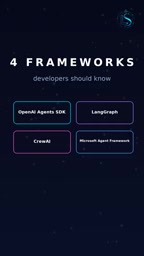
Four frameworks, four design philosophies
The four candidates presented in the video are: OpenAI Agents SDK, LangGraph, CrewAI, and Microsoft Agent Framework. Their differences go beyond API style—they represent different answers to the question of "how Agents should be organized."
OpenAI Agents SDK: A lightweight, code-first approach
The positioning of OpenAI Agents SDK is very clear—lightweight and code-first. It provides four core abstractions: tools (tool calling), handoffs (task handoff between Agents), guardrails (safety guardrails), and tracing (execution tracing).
The idea behind this design is to let developers describe Agent behavior with minimal framework code. The handoffs mechanism is especially worth noting: when an Agent determines that the current task exceeds its capabilities, it can hand control over to another Agent without the developer having to write complex routing logic by hand. Guardrails and tracing are considerations for production environments—the former constrains the boundaries of Agent behavior, while the latter makes the execution process observable.
Who it's for: teams that already have a clear task flow and want to quickly build a single Agent or a simple multi-Agent chain.
Handoffs are the most distinctive mechanism in OpenAI Agents SDK, essentially a protocol for transferring control between Agents. When an Agent determines during reasoning that the current request exceeds its toolset or responsibilities, it calls a special handoff function to pass the complete conversation context and current state to another Agent, which then continues processing. This differs from a simple function call because after the handoff, the original Agent no longer intervenes—control is fully transferred. For developers, this mechanism avoids tedious hand-written if-else routing logic, but the tradeoff is that the accuracy of handoff decisions depends on the model's own judgment. In production systems, it is usually necessary to combine this with guardrails to set boundaries on handoff conditions and prevent endless "passing the buck" loops between Agents.
Tracing and Guardrails are the two pillars of this SDK for production environments. Tracing records every step of an Agent's thinking, tool calls, inputs and outputs, and timing, forming a complete execution trace that facilitates debugging and performance analysis. Guardrails insert validation rules at key points in Agent execution, such as checking whether inputs contain sensitive information or whether outputs meet compliance requirements, and once triggered, they interrupt or correct the execution flow. Together, the two enable even a lightweight framework to meet the basic requirements of enterprise-grade observability and security.
LangGraph: Managing stateful workflows with graph structures
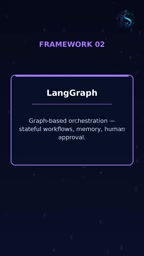
LangGraph takes a different path. It models the Agent's execution process as a graph, where nodes represent operations and edges represent transition conditions. This abstraction is naturally suited to stateful workflows that require branching and loops.
The key capabilities mentioned in the video include: state management, memory, human approval, and complex execution paths. Human approval is very practical in enterprise scenarios—for example, when an Agent generates a draft contract, the system pauses execution and waits for human confirmation before continuing. This kind of "human-in-the-loop" capability is cumbersome to implement with pure code logic, but much more natural to express with a graph structure.
Who it's for: workflow scenarios that require multiple steps, conditional branching, and state persistence, especially enterprise applications with high demands for reliability and controllability.
Stateful Workflow is the key concept for understanding LangGraph's positioning. In traditional chain-style calls, each step is an independent function, and data is passed between steps only through return values, with no retained intermediate state. But Agent tasks often need to remember context across multiple rounds of interaction—for example, if the user first adds a budget constraint, all subsequent decisions must refer to that constraint. LangGraph uses an explicit state object (State) to carry this shared data across nodes. Each node can read and modify the state, and the graph engine is responsible for passing and persisting state between nodes. This makes "pause-resume" possible: a workflow can be suspended at any node (for example, waiting for human approval) and then continue from the breakpoint hours or even days later without losing the previous reasoning context.
Human-in-the-Loop in LangGraph is not an add-on feature but a first-class citizen of the graph structure. Developers can insert an "approval node" into the graph; when that node executes, it pauses the entire workflow and sends out a notification, and only continues along the edges after receiving human confirmation or modification. This pattern is especially important in high-risk fields such as finance, healthcare, and law, because fully autonomous Agent decisions often cannot meet compliance requirements. Compared with hard-coding wait logic in code, the graph structure makes approval points a natural part of the process; changing the approval location only requires adjusting edge connections, without refactoring code.
CrewAI: Role-driven multi-Agent collaboration
CrewAI's design metaphor is a "team." Each Agent has a clear role, goal, and backstory, and multiple Agents divide labor and collaborate like team members.
The advantage of this abstraction is that it is intuitive: you do not need to first figure out how data flows between Agents, but instead define "what roles are needed on the team." For example, a content production process can be split into three roles: researcher, writer, and editor, each with its own toolset and responsibility boundaries.
But the cost of being role-driven is flexibility—if your task flow is not shaped like "team collaboration," forcing CrewAI onto it will instead increase complexity.
Who it's for: scenarios where tasks can be naturally divided into multiple specialized roles, such as research analysis, content production, and multi-step decision-making.
Role-Based multi-Agent design borrows the metaphor of human team collaboration. In CrewAI, each Agent is given a role, goal, and backstory, and these three attributes together shape the Agent's behavioral tendencies and decision-making style. For example, a "senior researcher" role will be prompted to work rigorously and cite sources, while a "creative writer" role is encouraged to think divergently. The cleverness of this design is that it leverages large language models' sensitivity to role settings, guiding Agent behavior through natural language descriptions without writing complex rule engines.
In terms of collaboration modes, CrewAI supports two main approaches: sequential execution and hierarchical execution. In sequential mode, tasks are passed among roles in a predefined order; in hierarchical mode, a "manager" Agent is responsible for breaking down tasks, assigning work, and aggregating results. This abstraction makes building multi-Agent systems intuitive, but it also introduces a potential problem: when the task flow is not clearly shaped like "team collaboration"—for example, when it requires many conditional branches or loop retries—the role metaphor can instead become a constraint, forcing developers to distort the task description to fit the framework, which increases rather than decreases system complexity.
Microsoft Agent Framework: An integration path for the enterprise ecosystem
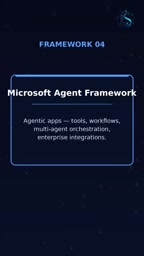
Microsoft Agent Framework's differentiation lies in enterprise integration. It also supports tool calling, workflows, and multi-Agent orchestration, but places more emphasis on connecting with the Microsoft ecosystem (Azure, Copilot, etc.).
For teams already on the Microsoft technology stack, this framework can reduce integration friction. But if you are not in the Microsoft ecosystem, its appeal is diminished.
How to choose: draw the workflow first, then choose the framework
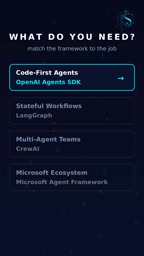
At the end, the video provides a quick decision table:
- Code-first Agent → OpenAI Agents SDK
- Stateful workflow → LangGraph
- Role-based team → CrewAI
- Microsoft ecosystem → Microsoft Agent Framework
This mapping itself is not controversial, but one line from the video is more worth remembering: "The framework is the orchestration layer; your architecture is where the intelligence lies."
In other words, the framework solves the problem of "how Agents collaborate with each other," while "how an Agent should think, what tools it should use, and by what logic it should make decisions"—these are the core factors that determine product performance. Choosing the wrong framework can be fixed by switching, but flaws in architecture design are very difficult to compensate for by changing frameworks.
"The framework is the orchestration layer; the architecture is where the intelligence lies" reveals a common misconception in Agent system selection. The orchestration layer is responsible for scheduling, communication, and state management between Agents, and it determines "how the system operates"; intelligence comes from model selection, prompt engineering, tool design, and decision logic, and it determines "how smart the system is." A system with a poor architecture cannot become intelligent even if you switch to the most advanced orchestration framework; conversely, a system with a clear architecture can perform excellently even with the simplest framework.
This distinction has direct practical implications: during the selection phase, teams should spend most of their energy defining task flows and identifying key requirements, rather than comparing feature lists of frameworks. This is because the capability boundaries of frameworks are relatively transparent—OpenAI Agents SDK cannot do complex state machines, and LangGraph is not good at rapid prototyping—what is truly difficult is figuring out what kind of memory your Agent needs, what kind of tools it needs, and under what conditions control should be handed off. Once these are clear, framework choice is often a natural result rather than a decision that requires repeated agonizing.
An underrated practical suggestion
At the end of the video, a simple but effective method is mentioned: first draw a sketch of your Agent workflow, then choose the framework that best matches that shape.
This sounds like common sense, but in actual development many people do the opposite—they first choose a popular framework and then try to squeeze the task into the framework's abstract model. When the task shape and framework abstraction do not match, the code becomes awkward and maintenance costs rise sharply.
So the order should be: define the task flow → identify key requirements (state management? multi-role collaboration? human approval?) → match the framework. Not: choose a framework → learn the framework → force the task into it.
Competition among Agentic AI frameworks has only just begun, and today's four options may not be tomorrow's final landscape. But the methodology of selection will not go out of date: let architecture determine the framework, rather than letting the framework hold architecture hostage.
One-line Summary
A comparison of the positioning and selection methodology of four mainstream Agentic AI frameworks: draw the workflow first, then choose the framework.
Paragraph Summary
The article reviews the design philosophies and use cases of four mainstream Agentic AI frameworks: OpenAI Agents SDK, LangGraph, CrewAI, and Microsoft Agent Framework. OpenAI Agents SDK focuses on lightweight, code-first development, enabling rapid Agent construction through four abstractions: tools, handoffs, guardrails, and tracing; LangGraph uses a graph structure to manage stateful workflows and is suitable for enterprise scenarios requiring branching, loops, and human approval; CrewAI drives multi-Agent collaboration through roles and is suited to processes where tasks can be naturally divided into specialized roles; Microsoft Agent Framework emphasizes integration with the Microsoft ecosystem. The article's core argument is that the framework is only the orchestration layer, and true intelligence lies in architecture design. When selecting, you should first sketch your Agent workflow, identify key requirements, and then choose the framework that matches the shape, rather than letting a popular framework hold your architecture hostage.
Related articles

Huberman's Rational Supplement Guide: A Five-Layer Health Framework and Scientific Decision-Making
Stanford neurobiology professor Huberman proposes a rational supplement framework: behavior and nutrition are the foundation, basic combination supplements serve as insurance, and sleep/hormonal/cognitive directions should stick to single-ingredient experiments. Omega-3 is the top single-ingredient choice, and melatonin is not recommended.

The Unsung Painter Behind Gilded Age Manhattan Interior Design
HN discussion highlights the painter behind Gilded Age Manhattan interiors: he created murals and decorative paintings but was long overlooked as his work was seen as architectural appendage.

Can AI Agents Be Socially Engineered? Understanding Prompt Injection and Tool Permission Risks
Through Invariant Lab's GitHub Issue injection and Brave's AI browser attack, this article analyzes how Prompt Injection induces AI Agents to perform unauthorized actions, and offers protection advice across three layers: least privilege, tool validation, and operation auditing.