A Sober Look at TypeSafe AI's Jev: Genuine Architecture or Overhyped?

A practitioner argues Jev is an NLP improvement, not a new AI paradigm, with key details and independent verification still missing.
Social media and AI influencers have framed TypeSafe AI's Jev as a disruptive revolution, but a veteran NLP practitioner offers a sharply different assessment. They argue that Jev's core capabilities — falling within the known territory of classifiers, zero-shot classifiers, and language models — look more like targeted engineering improvements than the birth of a new intelligence paradigm. More concerning, Jev's internal architecture, training setup, and model size remain undisclosed, and its most striking performance claims rely entirely on vendor-published benchmarks with no independent third-party replication. The analysis doesn't dismiss Jev's engineering value, but provides a framework for cutting through hype: stay curious and skeptical until the critical details are transparent.
The Misconceptions Surrounding Jev
TypeSafe AI's Jev has recently generated considerable buzz across YouTube, social media, and AI influencer circles. Some have called it an entirely new form of AI; others have hailed it as a revolutionary breakthrough in NLP. But one practitioner with years of experience building machine learning and natural language processing (NLP) systems has offered a far more measured take — in posts on Reddit and the KDnuggets blog: Jev is interesting, but many of the claims being made about it are clearly off-base.
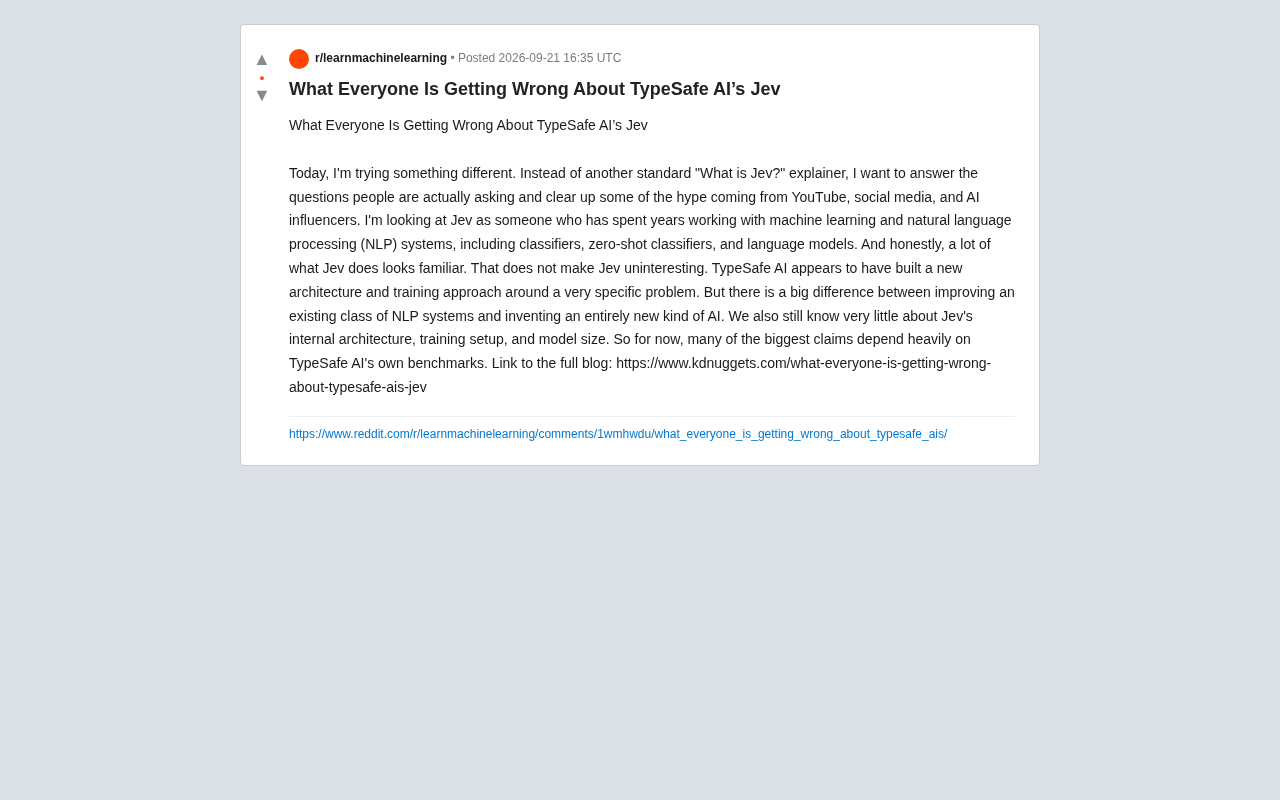
What makes this analysis valuable is that it isn't yet another "What is Jev?" explainer. Instead, it tries to answer the questions people actually care about while cooling some of the surrounding hype. The author's core position is clear — improving an existing class of NLP systems and inventing an entirely new form of AI are two very different things.
What's Actually New About Jev?
Drawing on technical intuition, the author notes that what Jev does "looks familiar." Having worked extensively with classifiers, zero-shot classifiers, and language models, they observe that many of Jev's capabilities fall squarely within the scope of these already well-understood systems.
This doesn't mean Jev is without merit. On the contrary, TypeSafe AI appears to have built a new architecture and training approach around a very specific problem. In other words, Jev may represent a targeted, well-engineered improvement over existing NLP systems — not the creation of some unprecedented paradigm of intelligence.
This distinction matters enormously in today's AI narrative. Markets and media tend to frame every new product as "disruptive innovation," but what actually moves a field forward is usually solid, focused improvement on specific problems. Framing Jev as an improvement to existing systems, rather than something created from scratch, actually gives us a clearer picture of its real contribution.
Zero-shot classifiers are a key concept for understanding this discussion. Traditional classifiers require large numbers of labeled examples for each target category. Zero-shot classifiers, by contrast, leverage the semantic understanding of pre-trained language models to classify inputs into categories the model has never explicitly seen — requiring only a natural-language description of that category. This capability matured with models like BERT and RoBERTa, and was extended to multimodal settings by models like OpenAI's CLIP. Zero-shot capability is often marketed as a "new form of AI" because it intuitively resembles the way humans generalize understanding. But the author's argument pushes back against that mystification: if Jev's core capability is essentially an engineered, optimized version of zero-shot classification, then it belongs to the lineage of iterative improvement on existing techniques — not a paradigm-level breakthrough.
Critical Information Is Still Missing
Another central concern the author raises is transparency. As of now, very little is publicly known about Jev:
- Its internal architecture remains unclear
- Its training setup has not been disclosed
- Its model size is unknown
With these foundational details absent, Jev's most attention-grabbing claims rest almost entirely on benchmarks published by TypeSafe AI itself.
This is a common pitfall when evaluating any AI system. When performance data comes only from the vendor, without independent replication or third-party verification, readers have good reason to be cautious. Benchmarks themselves aren't inherently untrustworthy — but "self-reported" results require substantially more external corroboration before they can be treated as settled fact.
The problem of self-reported benchmarks has deep roots in AI history. The research community typically relies on standardized evaluation sets maintained by independent organizations — GLUE, SuperGLUE, BIG-Bench — to compare model performance across the board, with test sets that are theoretically invisible during training. When vendors design their own evaluation tasks and publish the results, several potential biases can creep in: test sets may overlap with training data (data contamination), evaluation tasks may be cherry-picked to highlight strengths, or the baseline models used for comparison may be deliberately weak. This doesn't mean vendors are necessarily acting in bad faith — but until independent researchers can download the model and reproduce results on standard benchmarks, vendor-reported performance numbers carry limited weight in academic and engineering decision-making.
Why This Caution Matters
In an era dominated by the AI influencer economy, a product can go from launch to mythology in just a few viral videos. By speaking up as a practitioner, the author provides a useful counterweight to hype: acknowledging Jev's engineering value while refusing to accept the grandiose "new AI" label at face value.
For developers, researchers, and technical decision-makers, this stance is especially worth noting. When deciding whether to adopt, invest in, or build plans around a new technology, getting clear on two questions — "Is this an improvement or an invention?" and "Can the data be independently verified?" — is typically far more valuable than chasing trending topics.
Conclusion
Jev's story is still unfolding. It may well have built an effective new architecture for a specific problem — but until the details of that architecture, training process, and model scale are made public and independently benchmarked, its boldest claims should all be treated as "unverified." Stay curious, but stay skeptical — that's probably the healthiest stance to take toward every new AI darling.
Full blog reference: KDnuggets - What Everyone Is Getting Wrong About TypeSafe AI's Jev
Related articles

Chain of Thought Isn't Just for AI: How Humans Can Use CoT to Improve Thinking Quality
Chain of Thought isn't just a prompt trick for large models. Starting from a Hacker News discussion, this article analyzes why CoT works for human thinking too, breaks down actionable ways to transfer it, and highlights the key differences between human CoT and machine CoT.
Cloudflare Teams Up with OpenAI: Closi…
Cloudflare Teams Up with OpenAI: Closing the Loop from Vulnerability Discovery to Defense with AI
Cloudflare uses OpenAI Daybreak to investigate security vulnerabilities and generate reviewable remediation plans, while developers use Codex to boost coding efficiency and quality.

Orca Multi-Agent Orchestration in Practice: A Guide to Parallel Collaboration with Claude and Codex
Orca is Stable AI's free open-source agent workbench supporting 34 agents like Claude Code and Codex in parallel. Learn its Git worktree isolation, multi-model orchestration, and mobile management.