α-Stable Score-Based Generative Models: A Theoretical Breakthrough from Global to Tail Convergence

α-stable generative models match Brownian models in global convergence, but tail index matching is the key to heavy-tailed modeling.
The paper presents a non-asymptotic convergence analysis of scale-preserving generative dynamics driven by α-stable Lévy processes, systematically comparing stable and Brownian dynamics in the Wasserstein distance framework. At the global convergence level, the two model classes show no fundamental difference: initialization errors decay exponentially with the forward time window, and stable dynamics gain no faster convergence from Lévy processes. The true divide is in tail behavior: stable dynamics produce power-law tails with exponent α, while Brownian dynamics remain light-tailed. The paper proves that the model can asymptotically correctly recover extreme quantile scaling if and only if α equals the target's tail index ν, advancing stable generative model analysis to a non-asymptotic framework and providing a rigorous theoretical explanation for their superior performance on heavy-tailed data.
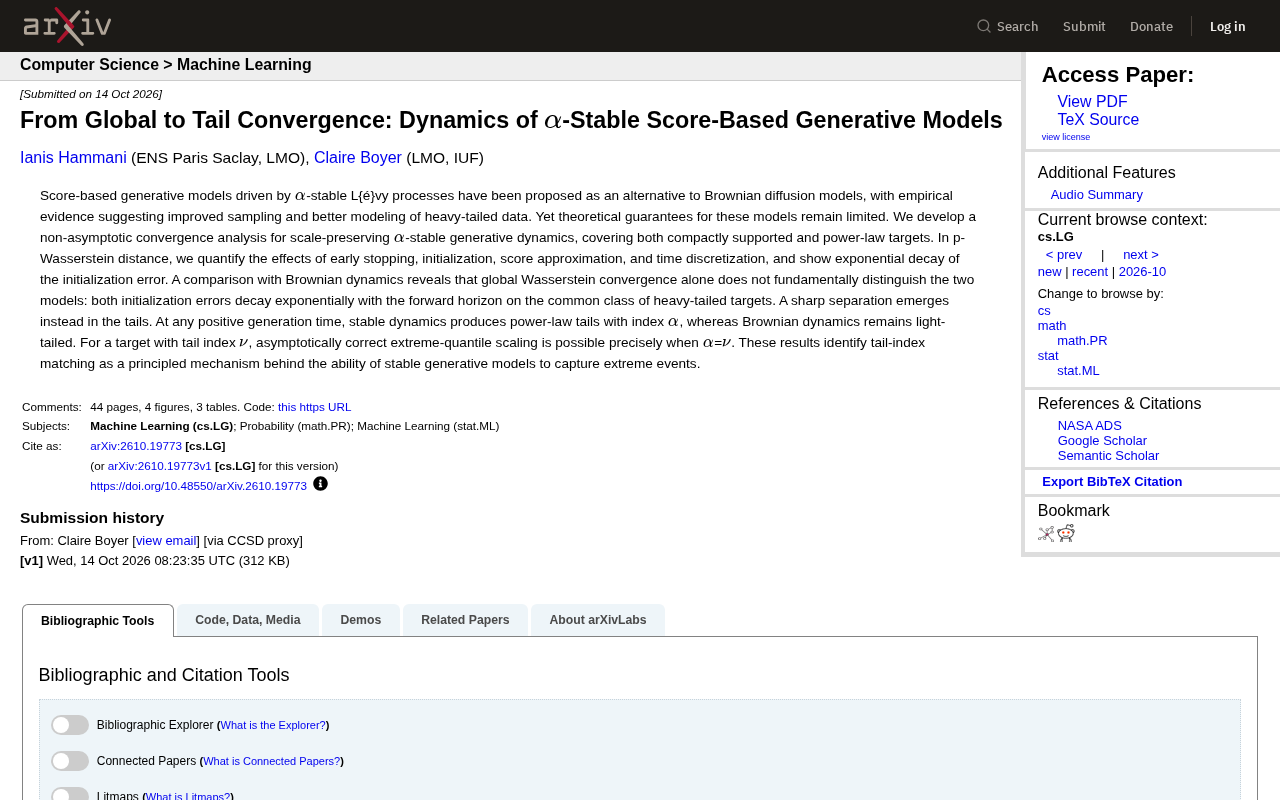
Score-based generative models have achieved remarkable success in recent years across domains such as images and audio, but their core driving force is typically Brownian motion. An emerging alternative—generative models driven by α-stable Lévy processes—has shown empirically better sampling performance and heavy-tailed data modeling capability, yet theoretical guarantees have lagged behind. A recent paper presents a non-asymptotic convergence analysis of scale-preserving α-stable generative dynamics, offering the first systematic comparison of the essential differences between stable and Brownian dynamics in terms of Wasserstein distance and tail behavior.
Global Convergence: Stable and Brownian Dynamics Converge to the Same End
Within the framework of p-Wasserstein distance, the paper quantifies the impact of early stopping, initialization, score approximation, and time discretization on convergence. A key finding is that on common heavy-tailed target classes, the initialization error decays exponentially with the forward time window—a property that holds equally for both stable and Brownian dynamics.
In other words, from the perspective of global Wasserstein convergence, the two models are not fundamentally different. Stable generative models do not gain an advantage in global convergence rate simply by using Lévy processes. This conclusion may surprise some researchers, since α-stable processes theoretically possess stronger jumping capability, but under the metric of overall distribution approximation, this advantage does not manifest as an improvement in exponential convergence rate.
The paper covers both compactly supported and power-law target settings, provides non-asymptotic convergence bounds, and explicitly separates the contributions of early stopping error, initialization error, score approximation error, and time discretization error. This provides a theoretical basis for hyperparameter selection in practice—for example, how early stopping time affects final sample quality, and to what extent the approximation accuracy of the score estimation network constrains convergence.
The α-stable Lévy process is a generalization of Brownian motion: Brownian motion corresponds to the stable process with α=2, whose increments follow a Gaussian distribution; when α<2, the process permits arbitrarily large jumps, and the frequency and magnitude of jumps exhibit heavy-tailed characteristics. The parameter α is called the stability index, taking values in (0,2], and controls the rate of tail decay—the smaller α is, the heavier the tail and the more frequent the extreme jumps. Unlike the continuous paths of Brownian motion, the sample paths of α-stable Lévy processes are purely jump processes, a property that makes them naturally suited for modeling data with abrupt, extreme events. In generative models, replacing Brownian motion with an α-stable process as the driver of forward noising and backward denoising yields what is called a "stable generative model." Precisely because α controls jump intensity, it becomes the key tunable parameter for matching the thickness of the data's tail.
Wasserstein distance (also known as earth mover's distance) characterizes the optimal transport cost between two probability distributions, intuitively understood as the minimum cost required to "move" one distribution into another. Compared to KL divergence or total variation distance, Wasserstein distance is more sensitive to the geometric structure of the distributions' support sets, and can provide a meaningful metric even when the two distributions' supports do not overlap, making it particularly suitable for measuring the degree of approximation between a generated distribution and a target distribution. The p-Wasserstein distance is a generalization thereof, where the order p controls the penalty for large deviations. The paper conducts its non-asymptotic convergence analysis precisely within this framework—"non-asymptotic" here means providing explicit error bounds under finite time and finite samples, rather than merely proving that the error tends to zero as the number of iterations goes to infinity, which offers little guidance for practical hyperparameter selection.
The Tail Is the Real Divide
The real distinction between the two models lies in the tail. The paper proves that at any positive generation time, the distribution produced by stable dynamics has a power-law tail with exponent α, while Brownian dynamics always remains light-tailed. This is a sharp qualitative separation that does not depend on the specific target distribution or training details.
For a target distribution with tail index ν, the model can asymptotically correctly recover the scaling behavior of extreme quantiles if and only if α=ν. In other words, tail index matching is the core mechanism by which stable generative models capture extreme events.
This conclusion has important practical implications: if the target data exhibits heavy-tailed characteristics (such as financial returns, extreme weather events, network traffic, etc.), choosing an α value matching the data's tail index is more critical than simply adjusting network capacity or training steps. Brownian diffusion models may systematically underestimate the probability of extreme events in these scenarios, whereas stable models with α=ν can correctly extrapolate to the tail region.
The tail index ν characterizes the rate of decay of a probability distribution's tail: if the distribution's survival function (i.e., P(X>x)) decays at a rate of x^{-ν}, it is called a power-law tail or heavy-tailed distribution, where smaller ν means a heavier tail and higher probability of extreme values. Common heavy-tailed distributions include the Pareto distribution and Student's t-distribution, and real-world data such as financial returns, earthquake magnitudes, and network traffic often exhibit such characteristics. The reason tail index matching is critical is that for a generative model to correctly extrapolate extreme quantiles, the tail decay rate of its generated distribution must match that of the target distribution. When α=ν, the power-law tail produced by stable dynamics has the same exponent as the target tail, and thus extreme quantile scaling is correct; if α≠ν, then no matter how accurate the rest of the model is, systematic bias will appear in the tail region. The practical implication of this mechanism is that in heavy-tailed data modeling, estimating the data's tail index ν and setting α accordingly is often more directly effective than increasing network capacity or extending training.
Theoretical Significance and Open Problems
This work advances the convergence analysis of stable generative models from an asymptotic framework to a non-asymptotic one, and for the first time theoretically elucidates the necessity of tail index matching. It also provides a rigorous explanation for the empirical observation that stable models perform better on heavy-tailed data.
However, the paper's analysis is still built on scale-preserving dynamics settings, and how to efficiently estimate α in practice, and how to approximate the optimal α=ν under finite samples, remain unsolved problems. Moreover, whether the convergence rate of tail behavior is preserved in high-dimensional settings also requires further investigation.
Nevertheless, this work provides a clear theoretical guide for the design of generative models: for global convergence, look to Wasserstein; for tail modeling, look to index matching. For researchers working on generative model theory or heavy-tailed data applications, this is a paper well worth reading closely.
One-line Summary
α-stable generative models show no difference from Brownian models in global convergence, but tail index matching is the key to heavy-tailed modeling.
Paragraph Summary
The paper presents a non-asymptotic convergence analysis of scale-preserving generative dynamics driven by α-stable Lévy processes, and for the first time systematically compares stable and Brownian dynamics within the Wasserstein distance framework. The study finds that at the level of global convergence, the two model classes are not fundamentally different: initialization errors decay exponentially with the forward time window in both cases, and stable dynamics do not achieve faster global convergence rates by using Lévy processes. The true divide lies in tail behavior: at any positive generation time, the distribution produced by stable dynamics has a power-law tail with exponent α, while Brownian dynamics always remains light-tailed. The paper further proves that the model can asymptotically correctly recover extreme quantile scaling behavior if and only if α equals the target distribution's tail index ν. This work advances the analysis of stable generative models to a non-asymptotic framework and provides a rigorous theoretical explanation for the empirical observation that stable models perform better on heavy-tailed data.
Related articles

Chain of Thought Isn't Just for AI: How Humans Can Use CoT to Improve Thinking Quality
Chain of Thought isn't just a prompt trick for large models. Starting from a Hacker News discussion, this article analyzes why CoT works for human thinking too, breaks down actionable ways to transfer it, and highlights the key differences between human CoT and machine CoT.
Cloudflare Teams Up with OpenAI: Closi…
Cloudflare Teams Up with OpenAI: Closing the Loop from Vulnerability Discovery to Defense with AI
Cloudflare uses OpenAI Daybreak to investigate security vulnerabilities and generate reviewable remediation plans, while developers use Codex to boost coding efficiency and quality.

Orca Multi-Agent Orchestration in Practice: A Guide to Parallel Collaboration with Claude and Codex
Orca is Stable AI's free open-source agent workbench supporting 34 agents like Claude Code and Codex in parallel. Learn its Git worktree isolation, multi-model orchestration, and mobile management.