A Systematic Study of Character Systems in French Novels: Measuring Narrative Concentration with PageRank
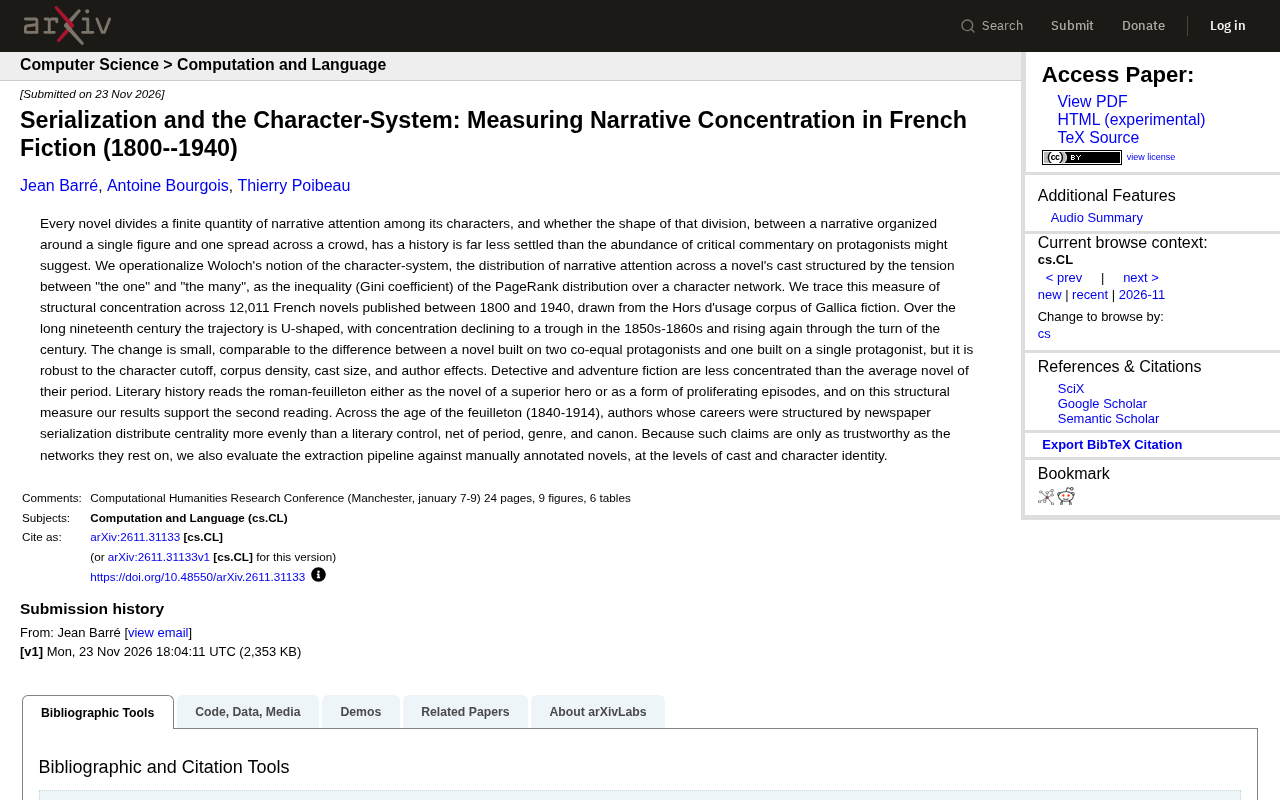
A study uses PageRank and the Gini coefficient to quantify narrative concentration in 12,000 French novels, revealing a U-shaped historical trajectory and genre differences.
A study of 12,011 French novels from 1800 to 1940 operationalizes the literary concept of the "character-system" as the Gini coefficient of a character network's PageRank distribution, quantifying narrative attention concentration. Results show a U-shaped pattern: concentration declines to a trough in the 1850s–1860s, then rises again. Detective and adventure novels are less concentrated than average; serial-novel authors show more even narrative distributions, supporting the "proliferation of plot" view. The study also validates character extraction via hand annotation and offers a reusable metric approach for computational literary studies.
How does a novel distribute its limited narrative attention among its many characters? Which structure is more common—a story built around a single protagonist, or one that unfolds a sprawling ensemble? And does the distribution of this narrative concentration follow any historical pattern? A study of 12,011 French novels provides quantitative answers using PageRank and the Gini coefficient.
From "Character-System" to a Computable Metric
The study operationalizes the literary theorist Woloch's concept of the "character-system"—the structure by which a novel allocates narrative attention amid the tension between "one protagonist" and "many characters." Specifically, the method is: first build a character relationship network, compute PageRank values for the network nodes, then calculate the Gini coefficient of that distribution as a quantitative measure of narrative concentration. A higher Gini coefficient means narrative attention is more concentrated on a few characters; a lower one means it is more dispersed.
The paper provides an intuitive reference for this metric: its range of variation corresponds roughly to the difference between a "dual-protagonist novel" and a "single-protagonist novel." In other words, the metric captures real structural differences rather than noise.
PageRank was originally an algorithm Google used for ranking web pages. Its core idea is that a node's importance is determined by the importance of the other nodes pointing to it, and that importance propagates along links while decaying. In a character network, if characters are treated as nodes and co-occurrence or dialogue relationships as edges, a character with a high PageRank value is one frequently "mentioned" or "associated" with other important characters in the narrative, thereby approximating the allocation of narrative attention. The Gini coefficient comes from economics and measures the inequality of income or resource distribution, ranging from 0 to 1, with higher values indicating greater concentration. By combining the two, researchers can summarize the entire novel's character-attention distribution with a single scalar—a common "metrification" strategy in computational literary studies.
The U-Shaped Trajectory of Nineteenth-Century French Novels
The study covers 12,011 French novels published between 1800 and 1940 from Gallica's "Hors d'usage" novel corpus. The results show that over the long nineteenth century, narrative concentration follows a U-shaped trajectory: it declines steadily, reaches a trough in the 1850s–1860s, then rises again around the turn of the century.
The robustness of this trend was tested in multiple ways: the result holds whether adjusting the character-appearance threshold, corpus density, or number of characters, or controlling for author effects. The authors note that while the magnitude of change is small, it is robust and reliable.
Genre Differences: Detective and Adventure Novels Are More Dispersed
The study also examined the effect of genre on narrative concentration. The results show that detective novels and adventure novels, in their respective eras, had lower concentration than the average for novels of the same period. This finding echoes the structural characteristics of genre fiction—such works often need to spread out clues and a network of supporting characters rather than concentrating all attention on a single figure.
Reinterpreting Serialized Novels: Support for the "Proliferation of Plot" View
Literary history offers two readings of the roman-feuilleton (newspaper serial novel): one sees it as a "superhero" novel, the other as a form in which plot continually proliferates. On this structural metric, the study's results support the latter reading.
More specifically, during the serial-novel era (1840–1914), authors whose careers were shaped by newspaper serialization had a more even distribution of narrative centrality than a literary control group—even after controlling for period, genre, and canonical status. This means the serial form itself may systematically push narrative attention to be dispersed across more characters.
The roman-feuilleton is a long-form novel serialized in nineteenth-century French newspapers, with representative works by authors such as Alexandre Dumas and Eugène Sue. Because newspaper serialization required attracting readers daily and maintaining subscriptions, authors often adopted multi-threaded, suspense-driven narrative strategies, causing plots to continually branch and the number of characters to swell. In literary history, the "superhero" reading emphasizes that serial novels created protagonists who surpassed ordinary people (such as The Count of Monte Cristo), while the "proliferation of plot" view focuses on the expansion and dispersion of their narrative structure. Through quantitative metrics, this study finds that serial authors' narrative attention is more evenly distributed, providing structural-level evidence for the "proliferation of plot" view and suggesting that the publishing format (newspaper serialization) may have in turn shaped the narrative structure of novels.
Methodological Self-Reflection: Can the Network Be Trusted?
The researchers candidly note that the credibility of such conclusions depends on the quality of the character networks on which they rely. The team therefore also evaluated the extraction pipeline using hand-annotated novels, assessing it at the levels of character cast and character identity. This examination of the method itself makes the conclusions of quantitative literary research more open to discussion.
In computational literary studies, character networks are typically extracted automatically from text using techniques such as named entity recognition and coreference resolution. However, character reference in literary texts is complex (e.g., aliases, ellipsis, metaphor), so automatic extraction inevitably involves errors. This study uses hand-annotated novels as a "gold standard" to evaluate the automatic pipeline's performance at two levels: character cast (which characters are identified) and character identity (merging different mentions of the same character). This evaluation ensures that the subsequent PageRank and Gini coefficient calculations are built on relatively reliable data, and reflects computational literary studies' emphasis on methodological transparency and reproducibility.
Implications for AI Text Analysis
The value of this work extends beyond French literary history. It demonstrates a path: transforming vague literary concepts (narrative focus, protagonist versus ensemble) into computable, comparable, and testable network metrics. For practitioners in computational literary studies, narrative analysis, or content structure research, the combination of PageRank and the Gini coefficient offers a reusable approach—how to use graph structure to measure the universal question of "how attention is allocated."
Of course, the meaning of a metric depends on interpretation. The social-historical, publishing-historical, and reading-historical drivers behind the U-shaped curve still require further interpretation by literary scholars. Quantitative tools provide a structural outline, not a complete answer.
One-line Summary
A study uses PageRank and the Gini coefficient to quantify the narrative concentration of 12,000 French novels, revealing a U-shaped historical trajectory and genre differences.
Paragraph Summary
A study of 12,011 French novels published between 1800 and 1940 operationalizes the literary-theoretical concept of the "character-system" as the Gini coefficient of the PageRank distribution of a character network, thereby quantifying narrative attention concentration. The results show that the narrative concentration of nineteenth-century French novels follows a U-shape: declining steadily to a trough in the 1850s–1860s, then rising again. Detective and adventure novels have lower concentration than the period average; during the serial-novel era, authors who primarily wrote newspaper serials had more even narrative distributions, supporting the "proliferation of plot" view rather than the "superhero" reading. The study also uses hand annotation to validate the character-extraction pipeline, acknowledges that its conclusions depend on network quality, and offers a reusable metric approach for computational literary studies.
Related articles

MIT PhD Takes You from Scratch to Build DeepSeek: A 25-Hour Hardcore Course
MIT PhD Raj Dandekar launches a 25+ hour Bilibili course building DeepSeek from scratch—MoE, MLA, GRPO, hand-written code plus math derivations, aiming to reproduce mini R1.

DeepSeek Harness in Practice: From Installation to Plugin Ecosystem, Building a Fully Automated AI Workflow
Based on a hardcore Bilibili tutorial, this guide systematically covers DeepSeek Harness installation, three plugin installation methods, and real-world use cases to help developers quickly build customizable AI Agent workflows.

DeepSeek Harness in Practice: From Installation to Automated Workflows
Hands-on DeepSeek Harness tutorial covering Mac/Windows installation, login, workspace binding, model & permission setup, and minimal closed-loop verification for AI automation workflows.