A.T.O.M Open-Source Cellular Network Simulation Tool: A Comprehensive Analysis of Features and Technical Architecture

A.T.O.M is an open-source Go-based cellular network simulator supporting 4G/5G/6G with coverage heatmaps and building obstruction detection.
A.T.O.M is an open-source cellular network simulation tool built in Go that supports 4G, 5G, and experimental 6G scenarios. It features coverage heatmaps, building obstruction detection, and scenario comparison capabilities using real map and base station data. While still experimental, it offers a free alternative to expensive commercial network planning tools for researchers, students, and engineers.
Project Overview
An open-source cellular network simulation tool called A.T.O.M has garnered attention in the developer community. Built by developer Berk Unsal, the project aims to visualize and simulate mobile communication networks using real map and base station data. Compared to traditional network planning tools that rely on expensive commercial software with high barriers to entry, A.T.O.M takes an open-source approach, providing researchers, students, and network engineers with a freely explorable cellular network simulation platform.
Cellular network simulation is a core component of mobile communication network planning and optimization. Before operators deploy new base stations or upgrade networks, they typically need simulation tools to predict signal coverage, assess interference levels, and optimize network parameters. Traditional commercial simulation tools such as Atoll (Forsk), Planet (TEOCO), and WinProp (Altair) often cost hundreds of thousands of dollars in licensing fees and are usually tied to specific hardware or operating systems. While these tools are powerful and offer precise models, they create high barriers for academic researchers and small-to-medium enterprises. The long-standing lack of open-source alternatives has constrained the popularization of wireless network simulation technology in education and innovative research. A.T.O.M was born precisely in this context.
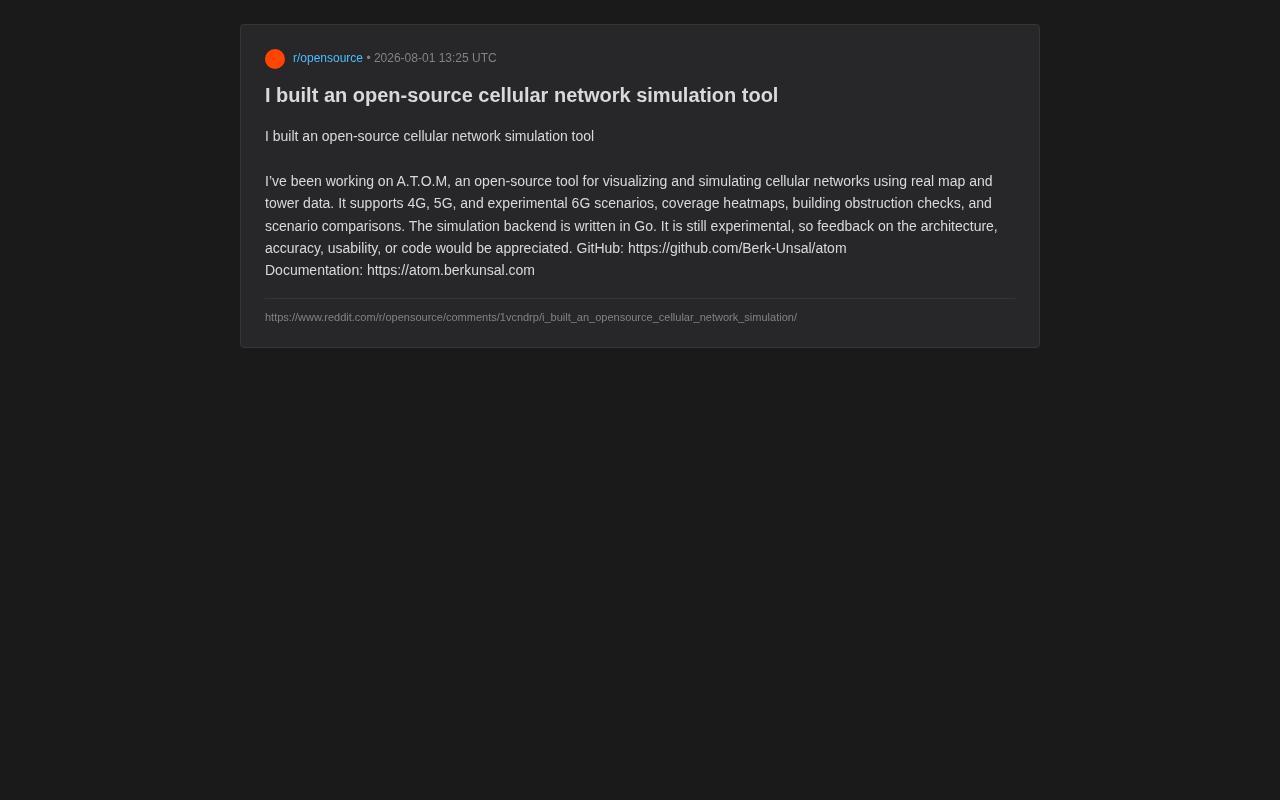
In terms of project positioning, A.T.O.M is currently still in an experimental stage. The author explicitly stated upon release that they hope the community can provide feedback on architectural design, simulation accuracy, usability, and code quality. This open attitude is an important foundation for healthy growth of open-source projects. The project's source code is hosted on GitHub, with accompanying standalone online documentation.
A.T.O.M Core Features
A.T.O.M's feature design closely aligns with the practical needs of cellular network planning, covering multiple dimensions from network generation support to signal propagation analysis.
4G/5G/6G Multi-Generation Network Simulation Support
The tool supports 4G, 5G, and experimental 6G scenario simulation. This is quite forward-looking—at a time when 5G has not yet been fully deployed and 6G standards are still in the research phase, the ability to provide experimental 6G modeling makes A.T.O.M not just an analysis tool for current networks, but also a research sandbox for future network evolution. Different network generations have significant differences in frequency bands, coverage ranges, and propagation characteristics, meaning a simulation tool's support for multiple generations requires handling complex signal propagation models.
From a technical detail perspective, 4G (LTE) primarily operates in the 700MHz to 2.6GHz band, with single base station coverage radii reaching several kilometers, using OFDMA technology for high-speed data transmission. 5G (NR) introduces a three-tier frequency strategy: Sub-6GHz bands provide wide coverage, while millimeter wave (24-100GHz) provides ultra-high bandwidth but with coverage reduced to just a few hundred meters. 5G also introduces Massive MIMO (massive multiple-input multiple-output antennas) and beamforming technology, enabling signals to be precisely directed toward users to improve efficiency. 6G is still in the academic research phase (expected for commercial deployment after 2030), with exploration directions including terahertz (THz) communication, Reconfigurable Intelligent Surfaces (RIS), space-air-ground integrated networks, and AI-native network architectures. These enormous technological differences between generations mean that simulation models need to employ completely different path loss formulas and channel models, placing high demands on the simulation tool's model abstraction capabilities.
Coverage Heatmaps and Base Station Signal Visualization
Coverage heatmaps are one of A.T.O.M's core visualization capabilities. By overlaying real base station (tower) data onto maps, the tool can intuitively display the signal coverage strength distribution across a given area. This has direct reference value for identifying coverage blind spots and optimizing base station layouts. The heatmap format makes otherwise abstract electromagnetic propagation data immediately clear and is an indispensable analytical method in network planning.
The generation principle of coverage heatmaps involves dividing the target area into equally-spaced grids (typically 5-50 meter resolution), calculating the received signal strength (RSRP/RSSI) from all visible base stations for each grid point, and then visualizing signal strength through color coding. The calculation process needs to comprehensively consider antenna gain, transmit power, path loss, shadow fading, and other factors. In 3GPP standards, commonly used propagation models include the Okumura-Hata model (suitable for macro cells), the COST 231-Walfish-Ikegami model (urban micro cells), and the 5G NR channel model defined in 3GPP TR 38.901. It's worth noting that as heatmap resolution increases, computational load grows quadratically—for example, improving resolution from 50 meters to 5 meters increases computational load by 100 times, which is why computational performance is critical for such simulation tools.
Building Obstruction Detection
Notably, A.T.O.M introduces a building obstruction checks feature. In real urban environments, tall buildings and terrain significantly impact signal propagation, especially for higher frequency bands with shorter wavelengths and weaker diffraction capabilities (such as 5G millimeter wave and 6G). Incorporating building obstruction into the simulation model is an important step toward improving simulation accuracy and approaching real-world scenarios, reflecting the author's deep understanding of wireless propagation physics.
From a physical mechanism perspective, when wireless signals encounter buildings during propagation, three main phenomena occur: reflection (signals bounce off building surfaces), diffraction (signals bend around building edges), and penetration (signals pass through buildings but with significant energy attenuation). For Sub-6GHz bands, signals have some diffraction capability and can bend around medium-sized obstacles; however, millimeter wave bands have extremely weak diffraction capability, and building obstruction almost means complete signal blockage—this is one of the core challenges facing 5G millimeter wave in urban scenarios. Implementing building obstruction detection typically requires Line-of-Sight (LoS) analysis, drawing a straight line from the base station to the receiving point and determining whether any building geometry intersects it. This requires obtaining three-dimensional building model data, usually sourced from open geographic data sources like OpenStreetMap, and A.T.O.M's positioning of leveraging real map data aligns perfectly with this requirement.
Network Deployment Scenario Comparison Analysis
The tool also supports scenario comparisons, allowing users to make lateral comparisons between different network configurations or deployment plans. This capability is highly practical in actual network planning—engineers can evaluate coverage effectiveness by comparing different base station locations, transmit powers, or frequency band configurations, enabling better decision-making. For example, in dense urban areas, engineers might need to choose between "fewer high-power macro base stations" and "many low-power small cells" deployment strategies, and the scenario comparison feature makes quantitative assessment possible.
Go Language Technical Architecture Analysis
From a technical implementation perspective, A.T.O.M's simulation backend is written in Go. This technology choice has its merits: Go is known for high concurrency performance, clean syntax, and excellent compilation speed, making it well-suited for handling the massive parallel computations and data processing tasks involved in simulation calculations. For scenarios like coverage heatmaps that require signal strength calculations across enormous numbers of grid points, Go's performance advantages deliver good runtime efficiency.
While Go's application in scientific computing and simulation is less common than Python or C++, it offers unique advantages. Go's goroutine and channel mechanisms make parallel computation implementation extremely concise—developers can easily distribute grid point calculation tasks across thousands of concurrent goroutines without manually managing thread pools or dealing with complex synchronization primitives. Go's garbage collector has been optimized over multiple versions, with pause times reduced to the microsecond level, having limited impact on simulation batch processing tasks. Compared to Python, Go is typically 10-100x faster in pure computational performance; compared to C++, Go offers higher development efficiency, better memory safety, and much faster compilation speed. However, Go's scientific computing ecosystem is relatively weak, lacking mature mathematical libraries at the NumPy/SciPy level, meaning developers may need to implement some numerical algorithms or signal propagation models themselves.
Additionally, Go's cross-platform characteristics and static compilation capability lower the deployment barrier, allowing users to run the simulation backend without complex runtime environment configuration. A compiled Go program is a standalone binary file that requires no dependency libraries or runtime installation—this is a pragmatic technical decision for an open-source network simulation project aimed at the community and intended for wide distribution.
Significance and Outlook of Open-Source Cellular Network Simulation
Cellular network simulation has long been a relatively specialized and closed field, with mature commercial tools often being expensive and unfriendly to general developers and students. The emergence of A.T.O.M injects open-source vitality into this domain. It lowers the learning and practice barriers for network simulation, enabling more people to explore wireless network planning principles at lower cost.
Of course, the author candidly points out that the project is still in an experimental stage. This means there is considerable room for improvement in simulation accuracy, model completeness, and production environment readiness. Real electromagnetic propagation involves complex physical models, and a simulation tool's value largely depends on the accuracy of its models.
Free Space Path Loss (FSPL) is the most fundamental wireless propagation model, describing how signals attenuate with distance in an unobstructed environment: FSPL(dB) = 20log₁₀(d) + 20log₁₀(f) + 32.44, where d is distance (km) and f is frequency (MHz). However, real environments are far more complex than free space. Multipath effects refer to signals arriving at the receiver via multiple different paths; due to different path lengths causing phase differences, signal superposition can produce constructive or destructive interference, creating fast fading phenomena. Diffraction effects describe a signal's ability to bend around obstacle edges, which can be approximately calculated using the Knife-Edge diffraction model. A high-accuracy simulation tool needs to comprehensively employ empirical models (statistically fitted based on extensive measurement data) and deterministic models (ray tracing methods based on electromagnetic propagation physics) to approximate real propagation environments. How much room A.T.O.M has to grow in the accuracy and completeness of these models will be a key dimension for the community in evaluating its practical value.
Therefore, community feedback and continuous iteration will be key to whether A.T.O.M can grow from an "interesting experiment" into a "practical tool." For readers interested in wireless communications, network engineering, or open-source software, A.T.O.M is undoubtedly a project worth following and participating in. Whether contributing code, validating simulation accuracy, or suggesting features, every community contribution could help drive this open-source cellular network simulation tool toward maturity.
Key Takeaways
Related articles

Sanders Writes to AI Giants: Pause Development or the Senate Will Act
Senator Bernie Sanders sent an open letter to OpenAI's Altman, Anthropic's Amodei, and Meta's Zuckerberg demanding an immediate AI development pause or face Senate legislation. Analysis of the political signals and regulatory trends.

Fine-Tuning GPT Models on Riemann Hypothesis Bounds: AI Mathematical Breakthrough or Hallucination?
A Reddit user used a GPT model to improve Anthropic's numerical bound on the Riemann Hypothesis zero ratio from 67.25% to 67.28%. Analyzing AI's discovery of Gram matrix spectral information loss and LLM capabilities vs. hallucination risks in frontier math.

Gemini Generates Overly Glossy Anime Images? Practical Solutions Explained
Fix Gemini's overly glossy anime images with practical prompt engineering techniques including flat coloring, cel shading, matte finish descriptors, and iterative adjustments.