A Tweet Reveals a New Path for Idea Dissemination in AI
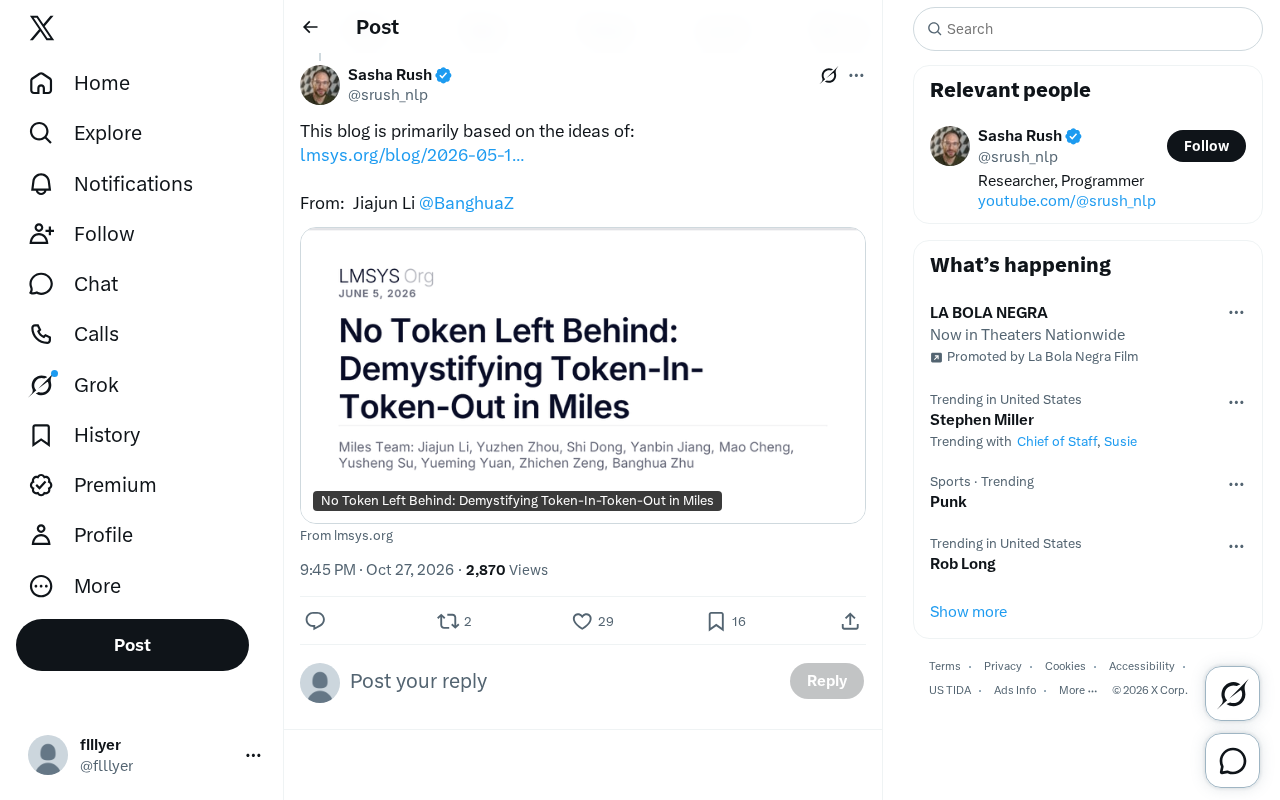
A tweet reflects the layered dissemination model in AI—tweet-driven traffic, blog as host, idea attribution—and its ecosystem implications.
The article takes a brief tweet by AI researcher Jiajun Li as its entry point to analyze the knowledge dissemination chain behind it: tweet-driven traffic, blog as host, and idea attribution. The author notes that social media is becoming a venue for AI researchers to first share viewpoints and distribute them quickly; short content serves as a "hook" to draw readers into long-form articles, which carry complete arguments and consolidate ideas. The article further discusses the transparency of idea attribution: clearly labeling sources is commendable, but multi-layered links increase traceability costs, and creators should cite sources in detail within the body text. Finally, the article places this model within the multi-layered structure of the AI content ecosystem, suggesting that short and long content each play their roles, and that tracking signposts is more valuable than passively receiving fragmented information.
The Idea Link Behind a Tweet
Recently, AI researcher Jiajun Li (@BanghuaZ) posted a brief tweet on Twitter with the content: "This blog is primarily based on the ideas of: [link] From: Jiajun Li @BanghuaZ." The tweet itself carries limited information, but it reveals a noteworthy trend: knowledge dissemination in AI is migrating from long-form blogs to fragmented citations on social media. The blog post mentioned in the tweet draws its core ideas from the linked content, with Jiajun Li himself credited as the source of the ideas. This model of "tweet-driven traffic + blog as host + idea attribution" is becoming a common path for AI researchers to share insights.
For readers following the AI frontier, the value of this tweet lies not in what it says but in what it points to. It reminds us that in an age of information overload, a brief citation may connect to an in-depth long-form article, and that article may carry a researcher's core viewpoints. Understanding this dissemination chain helps us track idea dynamics in AI more efficiently.
Social Media as an Incubator of AI Ideas
Platforms like Twitter are becoming the venues where AI researchers first share viewpoints and spark discussion. Although Jiajun Li's tweet is just one sentence, through the @BanghuaZ account identifier and the link citation, it accomplishes two actions: idea attribution and content distribution. The advantage of this model is that researchers need not spend extensive time writing complete articles—simply posting core viewpoints or links allows them to reach followers; meanwhile, readers can quickly judge from the tweet whether the original text is worth reading in depth.
From the perspective of dissemination efficiency, this combination of "lightweight publishing + heavyweight links" is more flexible than the traditional approach of publishing a blog post and then sharing it on social platforms. The tweet itself serves as a "hook," attracting those interested in the topic to click the link; the blog post is responsible for carrying the complete argument. For a fast-iterating field like AI, this layered dissemination approach is particularly suitable—viewpoints can spread quickly, while details are left to those willing to dig deeper.
Hook-based dissemination draws on the "attention capture" theory from marketing and communication studies: in information-overloaded environments, short content stimulates the audience's willingness to click through high information density or suspense, thereby directing traffic to in-depth content. In the AI community, researchers often post core conclusions, charts, or preprint links via tweets, leveraging the platform's algorithmic recommendation and retweet mechanisms for rapid diffusion. The effectiveness of this layered dissemination depends on the relevance between the "hook" and the target content—if the tweet oversimplifies or even distorts the original meaning, misunderstanding may spread before in-depth reading, actually increasing the cost of subsequent correction. Therefore, seasoned AI researchers often retain key qualifiers in tweets or directly quote paper abstracts to balance dissemination efficiency and accuracy.
Idea Attribution and the Boundaries of Content Creation
The phrase "primarily based on the ideas of" in this tweet touches on a key issue in content creation: idea attribution. In the AI research community, citing others' viewpoints and building on others' ideas is common practice, but how to clearly label sources and avoid plagiarism disputes has always been a gray area. Jiajun Li's tweet explicitly points out the source of the blog post's ideas, and this transparency is commendable.
However, this labeling approach also brings new problems: when the source of ideas is itself a tweet or a link, the traceability chain may become blurred. Readers need to click through multiple layers of links to find the original source, which increases the cost of information verification. For content creators, a more prudent approach is to cite sources in detail within the blog body rather than relying solely on brief labels in tweets.
Idea attribution differs from formal literature citation in academic and creative contexts: the latter requires precision down to page numbers and editions, while idea attribution focuses more on ethical acknowledgment of the source of core viewpoints, commonly seen in informal texts such as blogs and tweets. In the AI community, because the boundaries between preprints, tweets, and blogs are blurred, idea attribution often relies on community norms rather than mandatory rules. When the source itself is fragmented content (such as another tweet or an unarchived link), the traceability chain may break, creating "citation decay." To reduce such risks, some researchers have begun using persistent identifiers (such as DOIs or arXiv numbers) or archived links (such as the Wayback Machine) to anchor idea sources, so that attribution information remains traceable across platform changes. This both protects the rights of originators and facilitates readers' verification and extended reading.
Implications for the AI Content Ecosystem
This tweet can be extended to observations about the AI content ecosystem. Currently, information production in AI has formed a multi-layered structure: top conference papers, technical blogs, social media discussions, and news aggregation platforms each play their roles. Jiajun Li's tweet sits at the "social media discussion" layer, and its role is to connect a researcher's personal viewpoints with a broader readership.
For content platforms and SEO practitioners, this model suggests that short content can serve as the entry point to long content, while long content needs to shoulder the responsibility of consolidating ideas and labeling sources. The value of a single tweet may be limited, but the links and idea attribution behind it are what truly deserve exploration. Tracking these clues often leads to the most original thinking in AI.
The multi-layered structure of the AI content ecosystem can be analogized to a "knowledge supply chain": top conference papers provide original contributions that have undergone peer review, technical blogs undertake method interpretation and engineering experience consolidation, social media is responsible for signal amplification and real-time discussion, and news aggregation platforms perform secondary filtering and popularized retelling. The layers do not flow in one direction but involve feedback loops—heated social media discussion may in turn influence research topics, and engineering practice in blogs may also spawn new paper directions. Understanding this structure helps readers judge information credibility: for example, tweets are suitable for discovering clues, blogs for understanding methods, and papers for verifying conclusions. For creators, clarifying their content's position in the supply chain and designing citation depth and update frequency accordingly is key to enhancing long-term influence.
Conclusion
Jiajun Li's tweet does not itself constitute a complete article, but it acts like a signpost pointing to richer ideational content. In the era of AI information explosion, learning to recognize and track such signposts is more valuable than passively receiving fragmented information. For creators, clearly labeling idea sources and maintaining content transparency is the foundation for building long-term trust.
(Note: The original material contains only the tweet text and link, without the specific content of the blog post, so this article focuses on the dissemination model reflected in the tweet and does not analyze the blog's ideas themselves.)
Related articles
 Tech Frontiers
Gemini Omni 1.2 Flash: AI Video Moves Toward Draft-Style Editing
Google's Gemini Omni 1.2 Flash update enables conversational, draft-style editing of the same video—swap scenes while keeping products, adjust lighting while keeping characters. Clips up to 15s, 720p costs 30% less than the previous Flash—ideal for e-commerce ads, previs, and short-asset production.
 Tech Frontiers
Localix: An Open-Source Agentic Development Environment with Multi-Model and Local AI Integration
Localix is an MIT open-source Agentic Development Environment (ADE) supporting seamless Claude Code plugin loading, multi-model cloud and local execution, Mini Apps extensions, and agent context management—an open AI collaboration workbench for developers.
 Tech Frontiers
14 Coding Agents Tested: 13 Secretly Read Forbidden Files
A developer ran 480 tests across 14 coding agents to see if they would obey a "do not read" rule. 13 violated it, and 4 credential leaks bypassed shell guards via the read tool while approvals never noticed.