A Unified Solution for Running Claude Code, Codex, and Cursor in a Single App

Multiple AI coding tools cause window fragmentation; unified apps cut management overhead via a single entry point.
The article notes that developers using Codex, Claude Code, and Cursor simultaneously often need four or five windows per task, fragmenting workflows. It proposes three conditions for a unified app: run all agents on existing subscriptions, show output beside the agent, and edit and review in place. Longwave is a case study.
Interface Chaos Caused by Running Multiple AI Coding Tools in Parallel
Developers today often face an awkward situation when using AI coding tools: Codex runs in one terminal, Claude Code runs in another, and Cursor is open in a desktop app. It's the same project, yet it's scattered across three different interfaces. Add the need to open the actual page to check design and copy, and a single task often requires four or five windows open at once. According to an experience shared on a YouTube channel, this fragmented workflow is becoming a common pain point in AI-assisted coding — the more tools there are, the more attention gets divided.

This fragmentation isn't a choice developers actively make — it's dictated by the form of existing tools. Terminal-based tools excel at executing commands and viewing logs, desktop IDEs excel at code editing, and browsers handle previewing the final result. Each of the three interface types is irreplaceable, but there's no connective tissue between them, forcing developers to switch back and forth between windows.
Three Conditions a Single App Must Meet
According to the criteria proposed by the video's author, an app that truly integrates multiple AI coding tools needs to accomplish three things.
1. Run all coding agents using existing subscriptions
The first condition is that the app must be able to run every coding agent using subscriptions you're already paying for, rather than requiring you to buy new subscriptions or reconfigure keys. This directly determines the cost of migration — if a unified solution requires users to give up their existing subscriptions, it itself creates new friction.
The difference between subscription-based and API-key billing is the prerequisite for understanding this condition. Mainstream AI coding agents typically offer two access methods: one is a monthly subscription plan (such as Claude Pro/Max, ChatGPT Plus, GitHub Copilot Individual) used within a fixed quota; the other is an API key billed by token usage, with costs growing linearly with call volume. If a unified app requires users to enter an API key, it means users need to pay twice for the same capability and must manage keys and quotas themselves. "Reusing existing subscriptions" instead requires the app to recognize and invoke the subscription credentials a user has already logged into (for example, through OAuth authorization or by reusing a locally logged-in session), thereby running agents without adding marginal cost. This places higher demands on the app's authentication architecture and its partnerships with vendors.
2. Display running output in real time alongside the agent
The second condition is to display running output — whether a page, video, or other artifact — directly beside the agent interface, rather than having developers switch to a browser or another window to view it.
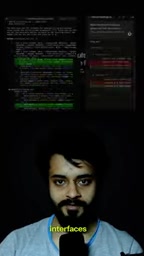
The value here lies in shortening the feedback loop. When the agent has just generated or modified content, developers can immediately confirm the result within the same field of view, saving the time of window switching and context rebuilding.
Feedback loop length is one of the key metrics for measuring AI-assisted coding efficiency. In a traditional workflow, after the agent generates code, the developer must switch to a browser or preview window, refresh the page, locate the changes, judge whether they meet expectations, then switch back to the editor to describe the problem — each round trip comes with context-rebuilding costs. Embedding the preview alongside the agent interface essentially compresses the "generate—observe—correct" cycle into a single field of view (similar to the live preview or hot reload mechanisms introduced early in IDEs). The industry generally agrees that shortening this loop significantly improves iteration speed and reduces the probability of missing details due to window switching.
3. Edit and interactively review in the same place
The third condition is to edit code and content in the same place, with interactive review capability. This means integration isn't just piling together the entry points of several tools, but forming a closed loop of generation, viewing, modification, and review.

Longwave's Integration Practice
The video's author says they completed all of the above processes in Longwave. According to their description, Longwave supports Claude Code, Cursor, and Codex simultaneously in a single app, significantly simplifying their daily workflow.

In terms of product positioning, this type of tool targets the gap of "multi-agent collaborative development environments." It doesn't try to replace any single coding agent, but instead brings multiple agents into one container, paired with preview and editing capabilities. For developers using multiple AI coding assistants simultaneously, this form may fit actual working habits better than continuing to stack independent windows. Note that the above information mainly comes from a demonstration in a single video source; the actual depth of compatibility, scope of subscription support, and collaboration experience still need to be verified by developers themselves.
Trend Assessment: Unified Entry Points for Multiple Agents
From a broader perspective, the differentiation of AI coding tools is still accelerating: some focus on autonomous terminal execution, some go deep on inline IDE editing, and some emphasize conversational generation. The more tools there are, the more prominent the value of the integration layer becomes. Solutions like Longwave represent one approach — not seeking to win on the capability of a single agent, but reducing the management cost of using multiple tools through a unified entry point and shared context.
Whether this approach can succeed depends on two variables: first, whether it can smoothly connect with the subscription systems of mainstream agents; second, whether the preview and editing experience can reach a level where developers are willing to stay long-term. The demonstration in the video shows the direction, but the depth of ecosystem integration is the key to whether such tools can become everyday infrastructure. For developers, what's worth watching is whether this "agent container" form will become the default organizing method for the next stage of AI coding workflows.
For more information, see longwave.run.
The relationship between "agent containers" and interoperability protocols like MCP deserves attention. The feasibility of a unified entry point for multiple agents depends heavily on the degree of underlying standardization. Open protocols such as Anthropic's Model Context Protocol (MCP) are attempting to unify how agents connect to external tools and data sources, enabling different agents to share file systems, browsers, and editor state within the same environment. If such protocols are widely adopted, the integration layer won't need to do deep adaptation for each agent individually, and ecosystem integration costs will drop significantly; conversely, if each vendor maintains a closed plugin system, the value of a unified entry point will be limited by the breadth of adaptation. This is also an important observation point for judging whether such tools can succeed long-term.
One-line Summary
Running multiple AI coding tools in parallel causes window fragmentation; unified apps reduce management costs through a single entry point.
Paragraph Summary
The article points out that when developers use tools like Codex, Claude Code, and Cursor simultaneously, a single task often requires four or five windows, severely fragmenting the workflow. Citing the video's viewpoint, the author proposes that a unified app should meet three conditions: run all agents using existing subscriptions, display running output in real time beside the agent, and edit and interactively review in the same place. Longwave is presented as a practical case, claimed to support Claude Code, Cursor, and Codex in a single app. The article argues that a unified entry point for multiple agents may become the organizing method for the next stage of AI coding workflows, but its success depends on subscription system integration and preview/editing experience, with ecosystem integration depth being key, and the existing information comes from a single video source and still requires developers' own verification.
Related articles

Medicare Spends $50,000 Treating a Heart Attack but Won't Spend $100 Preventing One: The Mismatch in Healthcare
Medicare pays ~$50,000 to treat a heart attack but won't spend $100 to prevent one. This article unpacks the MedPage Today opinion piece and Hacker News debate on why healthcare payment favors treatment over prevention and the deep causes of incentive misalignment.
Nvidia May Cosign Loan for Nscale's West Virginia AI Data Center
Nvidia is considering cosigning a loan for Nscale's West Virginia AI data center. This article analyzes the signal significance of chip vendors entering data center financing, the risk-sharing logic, and project uncertainties.

Claude Code v2.1.316 Update Analysis: Enterprise Gateway and Multiple Stability Fixes
Claude Code v2.1.316 released: new enterprise gateway pooled group budgets, layered policy mode, subagent effort control, dozens of Shell, network, and session recovery fixes, and Opus 4.8 fast mode deprecated.