Aaron Sorkin's 'Social Reckoning' Gets Off to a Weak Start: The Fate of the 'Villainous Tech CEO' Genre Remains Uncertain

Sorkin's 'Social Reckoning' weak start clouds the prospects for this fall's wave of 'evil tech CEO' films.
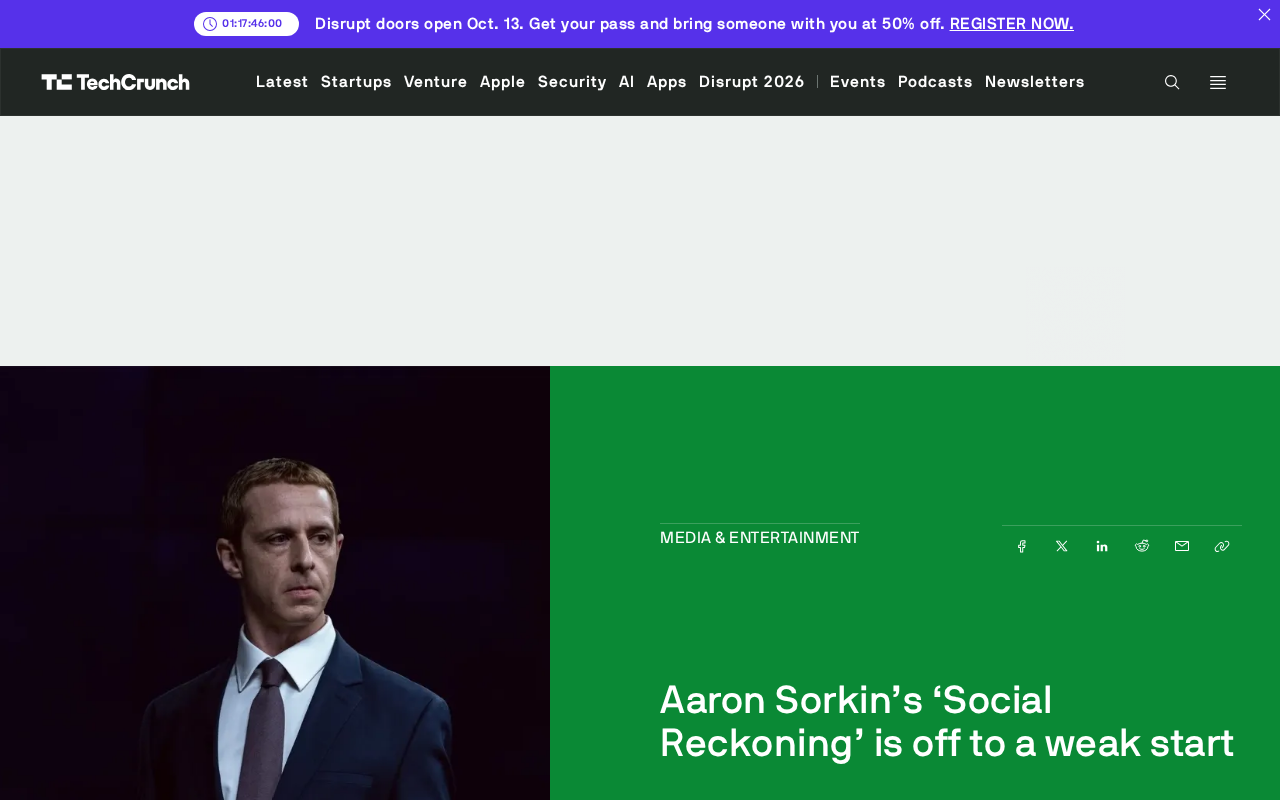
Aaron Sorkin's new project Social Reckoning has gotten off to a weak start, casting uncertainty over a fall slate of films built around villainous tech CEOs. With The Social Network setting the benchmark for tech-driven storytelling, Sorkin's stumble is being read as a market sentiment indicator for the entire genre. Analysts point to potential genre fatigue, a reality-fiction gap, and a crowded season as likely factors — though awards momentum could still reverse the trajectory.
In a Nutshell
Aaron Sorkin's highly anticipated new project Social Reckoning is off to a weak start, casting a shadow of uncertainty over an upcoming wave of films centered on "villainous tech CEOs."
Note: This piece is based on limited source material currently available. The following expands on the known facts with industry context to help readers understand their significance.
Key Details
This RSS-sourced report carries two core signals:
- Aaron Sorkin's new project Social Reckoning has had an underwhelming reception in its early stages.
- That weak start has raised concerns about whether a full fall slate of "evil tech CEO" films can win over audiences and critics.
Why This Matters
Aaron Sorkin is one of Hollywood's most iconic screenwriters. His The Social Network virtually defined the narrative template of "tech entrepreneurship meets human ambition and betrayal." When he turns his lens on the tech industry again, expectations naturally run high.
That's precisely why Social Reckoning's weak opening is so thought-provoking. It's not just about the fate of a single film — it's a reading of market sentiment. In recent years, Hollywood's portrayal of Silicon Valley has gradually shifted from celebrating "disruptors" to interrogating power and ethics, with tech giants' leaders increasingly cast as controversial or outright villainous figures.
Sorkin's relationship with tech-themed storytelling deserves special mention. The 2010 film The Social Network — directed by David Fincher from Sorkin's screenplay — chronicled the origins of Facebook and Mark Zuckerberg's rise, ultimately winning the Academy Award for Best Adapted Screenplay and sparking widespread critical debate about technological ambition and personal betrayal. The film's success owed much to Sorkin's signature walk-and-talk dialogue style: dense, razor-sharp exchanges that turned boardroom negotiations and courtroom clashes into intellectual combat. That film cemented Sorkin's authority in tech-driven storytelling and set a high baseline expectation for everything he writes afterward. Whether Social Reckoning can replicate or surpass that benchmark is an essential reference point when evaluating its "weak start."
Why the 'Villainous Tech CEO' Genre Is Surging Now
From an industry perspective, this clustering of similar content is no coincidence. Over the past decade-plus, public attitudes toward Big Tech have shifted dramatically: data privacy controversies, concerns over algorithmic manipulation, and the over-concentration of platform power have repeatedly entered the mainstream conversation. Film and television, as amplifiers of social emotion, naturally capture and magnify this scrutiny of tech power.
As the "tech savior" halo fades, creators have gravitated toward stories of unchecked power and failed business ethics. And so we find ourselves in a fall season where multiple films centered on tech executives as central antagonists are arriving simultaneously. It's both a response to real-world anxiety and a collective bet on a single genre.
What a Weak Start Actually Signals
If even a marquee creator like Sorkin can't turn this genre into an immediate hit, it may be a warning sign for similar projects in the pipeline. Several interpretations are possible:
- Genre fatigue: Audiences may have grown tired of the "evil CEO" narrative formula and are hungry for fresher angles.
- The reality gap: Real-world tech controversies are so inherently dramatic that fictional adaptations risk feeling flat by comparison.
- Market crowding: A competitive fall season means thematically similar films cannibalize each other's attention.
That said, a weak start is not the same as ultimate failure. Word-of-mouth momentum and awards season momentum can both transform a film's trajectory — and Sorkin's own career history offers precedents for exactly that.
Conclusion
Social Reckoning's early performance poses a central question for this tech-villain-heavy film season: are audiences still buying in? Whether this creative wave can strike a balance between commercial viability and artistic merit is well worth watching.
(Given the limited scope of the source material, this piece focuses primarily on industry context and trend analysis. Specific plot details, box office figures, and critical assessments await further public information.)
Background Context
The structural conditions of Hollywood production help explain why these projects are arriving all at once. Development cycles typically run three to five years, meaning films releasing now were largely greenlit between 2020 and 2022 — a period that coincided with the ongoing fallout from Facebook (now Meta)'s Cambridge Analytica data scandal, intensive congressional hearings scrutinizing tech platforms, and heightened public alarm over Big Tech's expanding power during the COVID-19 pandemic. Multiple studios independently picked up on the same social mood within the same window and each placed their own bet on the genre — producing today's crowded fall slate.
This kind of "genre pile-up" is not uncommon in Hollywood. History has seen multiple asteroid/disaster films and multiple gladiator biopics arrive in the same year, with the result that early movers claim the cognitive high ground while later entries face intensifying pressure to differentiate themselves.
Related articles

Workbuddy for Absolute Beginners: How a Desktop AI Agent Fits Into Real Workflows
A beginner's guide to the Workbuddy desktop AI agent: installation, claiming credits, file management, and building automated workflows—compared with CodeX for fit and cost, helping professionals shift from AI question-askers to AI managers.

OpenAI's New Agent Stack: Computer Use, Decisions API, and Ultra-Fast Workflows
OpenAI Dev Day unveiled a new agent stack: Computer Use outperforms humans, Decisions API delivers ultra-low-latency classification via Luna, Agents API opens the same Computer Use capabilities, and GPT-6.1 Sol costs only one-seventh of Astra. Core updates, benchmark data, and developer insights.

Liang Wenfeng Open-Sources DeepInfo Inference Framework, Takes On U.S. Ban
DeepSeek open-sources its DeepInfo inference framework after its models, featuring GPU/CPU cross-pipelining, small-model prediction with large-model verification, and full Huawei Ascend and NVIDIA chip support—facing the U.S. federal ban head-on. This article analyzes its significance for AI deployment and open-source strategy.