Aaronson Oracle: A Prediction Experiment by a Quantum Computing Pioneer

The Aaronson Oracle uses a thought experiment to reveal that randomness is not an absolute property but a boundary problem relative to observer capability.
The "Aaronson Oracle" proposed by Scott Aaronson is not a concrete tool but a thought-experiment framework about the boundaries of predictive capability. It asks whether humans can outperform random guessing when facing sequences generated by complex algorithms. Experiments show that participants often believe they have detected a pattern early on, but their accuracy quickly regresses to random levels, exposing the limits of human pattern recognition against truly complex sequences. This framework is especially relevant in the era of large models: if the pseudorandom sampling, temperature parameters, and probabilistic decoding strategies widely used in AI applications can be predicted externally, there is room for attack or manipulation. The article thereby proposes that "random to whom" matters more than "whether it is random."
Aaronson Oracle: A Prediction Experiment by a Quantum Computing Pioneer
Scott Aaronson is one of the most influential theorists in quantum computing and computational complexity. The "Aaronson Oracle" he proposed is less a concrete tool than a thought-experiment device about the boundaries of predictive capability.
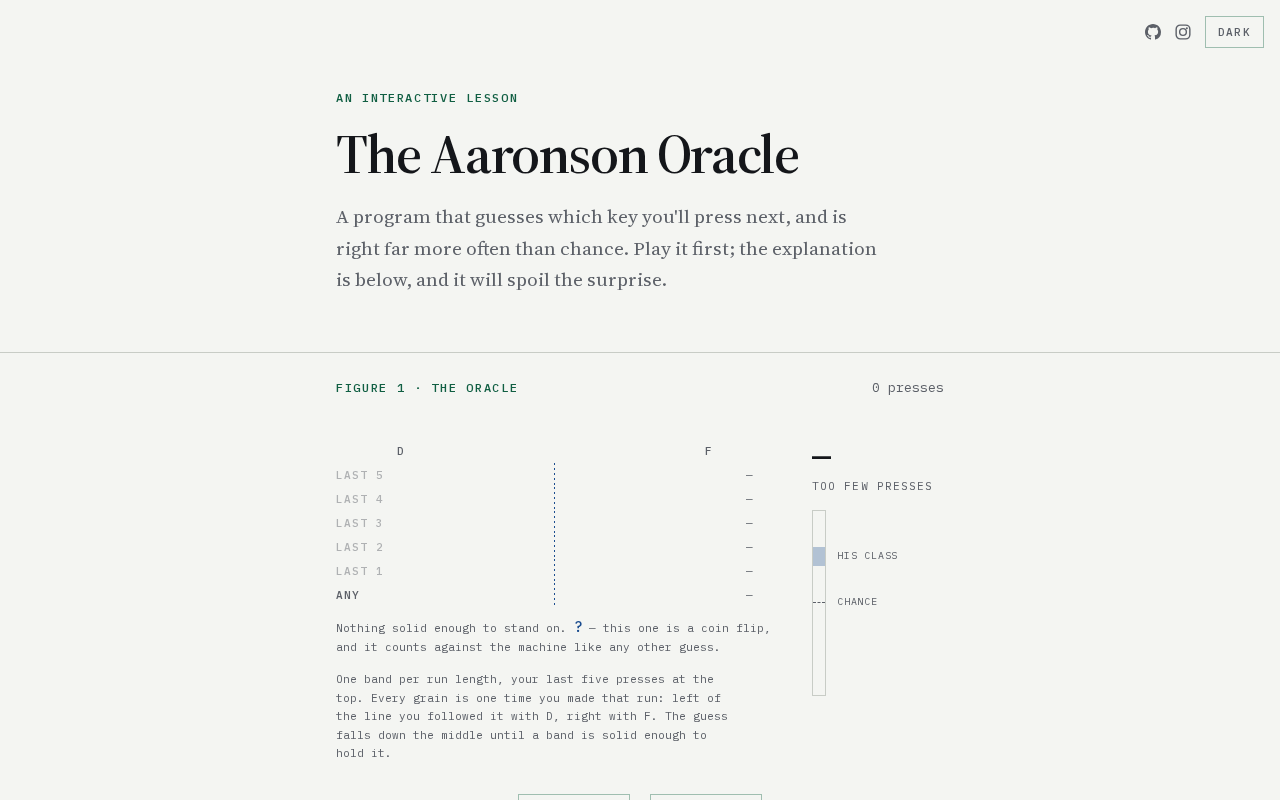
What Is the Aaronson Oracle
In computational theory, an "oracle" refers to a hypothetical machine that can answer a specific question in a single step. Aaronson borrows this term to discuss whether humans, when faced with sequences generated by complex algorithms, can do better than random guessing.
The core question is straightforward: given a string of seemingly random output, can humans identify the hidden patterns within it? If so, it means the algorithm has exploitable weaknesses; if not, it means the generation process is already sufficiently "unpredictable" at the level of human intuition.
The oracle in computational theory is an extension of the Turing machine model: it is endowed with a black box that can answer a specific decision problem in a single step, no matter how difficult the problem itself may be. This construction was introduced by Turing in 1939 to study computability relative to a set. The concept of relativization derives from this — if a conclusion holds under any oracle, it is said to "relativize." In 1975, Baker, Gill, and Solovay used oracle constructions to prove that whether P equals NP cannot be resolved through relativizing methods, making it one of the most famous barriers in complexity theory. Aaronson borrows this term by imagining the "human observer" as a black box that can produce predictions in real time, thereby turning "predictability" into a relativized proposition.
Experimental Design of the Human-Machine Prediction Game
Aaronson designed a class of interactive experiments in which participants must predict the system's next output. These outputs may come from quantum random number generators, pseudorandom algorithms, or specially constructed deterministic processes.
Experimental results typically exhibit an interesting pattern: participants often believe early on that they "sense a pattern," but as the rounds increase, their accuracy gradually regresses to random levels. This reveals the fundamental limitations of the human pattern-recognition system when facing truly complex sequences.
This phenomenon has potential connections to test case generation in AI programming and randomness testing in cryptography — if a sequence can be consistently predicted by humans, then it is unqualified as a random source.
Why This Matters for the AI Field
The value of the Aaronson Oracle lies not in building a prediction machine, but in providing a framework for measuring "predictability."
In the era of large models, this question has become even more acute. AI applications rely heavily on pseudorandom sampling, temperature parameter tuning, and probabilistic decoding strategies. If the output patterns of these processes can be predicted by external observers, then in theory there exists room for attack or manipulation.
Conversely, this framework can also be used to evaluate models themselves: should a truly powerful model's internal decisions remain unpredictable to humans? Or does interpretability require us to sacrifice some degree of unpredictability?
Temperature parameters and probabilistic decoding are the core mechanisms by which large models generate text. At each step, the model outputs a logits distribution over the vocabulary, and the temperature T adjusts the sharpness of the distribution via softmax(logits/T): the lower the T, the closer to greedy decoding; the higher the T, the closer to uniform sampling. There are also truncation strategies such as top-k and top-p (nucleus sampling), aimed at balancing diversity and coherence. What these mechanisms share is their reliance on a pseudorandom number generator as the sampling source. If that pseudorandom source can be predicted — whether by statistical methods, adversarial models, or human observers — then the generation process no longer possesses true unpredictability. In security-sensitive scenarios (such as password generation, key derivation, and adversarial example construction), this means a potential reproducible attack surface.
Theoretical Significance and Practical Implications
From the perspective of frontier research, the Aaronson Oracle connects three fields: computational complexity, cryptography, and cognitive science. It reminds us that randomness is not only a mathematical concept but also a relative concept concerning observer capability.
For developers, the practical takeaway is this: when designing systems involving randomness, one cannot rely solely on statistical tests; one must also consider the pattern-recognition capabilities of human and AI observers. A sequence that passes the NIST randomness tests may not necessarily pass an Aaronson Oracle-style interactive test.
This line of thinking applies equally to the evaluation of random number libraries in open-source tools — when choosing a random source, "random to whom" may be more important than "whether it is random."
The NIST randomness test suite (NIST SP 800-22) is a standard tool in cryptography and information security for evaluating random sequences, containing 15 statistical tests including the frequency test, runs test, discrete Fourier transform test, and approximate entropy test. Its core logic is: a truly random sequence should pass each test with a specific probability. But the suite has two fundamental limitations: first, it tests statistical properties, and is often powerless against carefully constructed pseudorandom sequences (such as certain cryptographic pseudorandom generators); second, it does not model the intelligence level of the observer. A sequence may well pass all NIST tests yet be rapidly predicted when facing an adversary with learning capability. The Aaronson Oracle precisely fills this latter gap — it explicitly incorporates the "observer" into the evaluation framework, suggesting that randomness is a property relative to the observer.
One-line Summary
The Aaronson Oracle uses a thought experiment to reveal: randomness is not an absolute property, but a boundary problem relative to observer capability.
Paragraph Summary
The "Aaronson Oracle" proposed by Scott Aaronson is not a concrete tool, but a thought-experiment framework about the boundaries of predictive capability. It borrows the concept of the oracle from computational theory to ask: when humans face sequences generated by complex algorithms, can they do better than random guessing? Experiments show that participants often believe they have identified a pattern early on, but their accuracy quickly regresses to random levels, exposing the limitations of the human pattern-recognition system when facing truly complex sequences. This framework is especially acute in the era of large models: if the output patterns of the pseudorandom sampling, temperature parameters, and probabilistic decoding strategies widely relied upon in AI applications can be predicted externally, then there exists room for attack or manipulation. The article thus proposes the core perspective that "random to whom" is more important than "whether it is random."
Related articles

Chain of Thought Isn't Just for AI: How Humans Can Use CoT to Improve Thinking Quality
Chain of Thought isn't just a prompt trick for large models. Starting from a Hacker News discussion, this article analyzes why CoT works for human thinking too, breaks down actionable ways to transfer it, and highlights the key differences between human CoT and machine CoT.
Cloudflare Teams Up with OpenAI: Closi…
Cloudflare Teams Up with OpenAI: Closing the Loop from Vulnerability Discovery to Defense with AI
Cloudflare uses OpenAI Daybreak to investigate security vulnerabilities and generate reviewable remediation plans, while developers use Codex to boost coding efficiency and quality.

Orca Multi-Agent Orchestration in Practice: A Guide to Parallel Collaboration with Claude and Codex
Orca is Stable AI's free open-source agent workbench supporting 34 agents like Claude Code and Codex in parallel. Learn its Git worktree isolation, multi-model orchestration, and mobile management.