Abdul El-Sayed Backs AI Pause: Calls for International Treaty with China
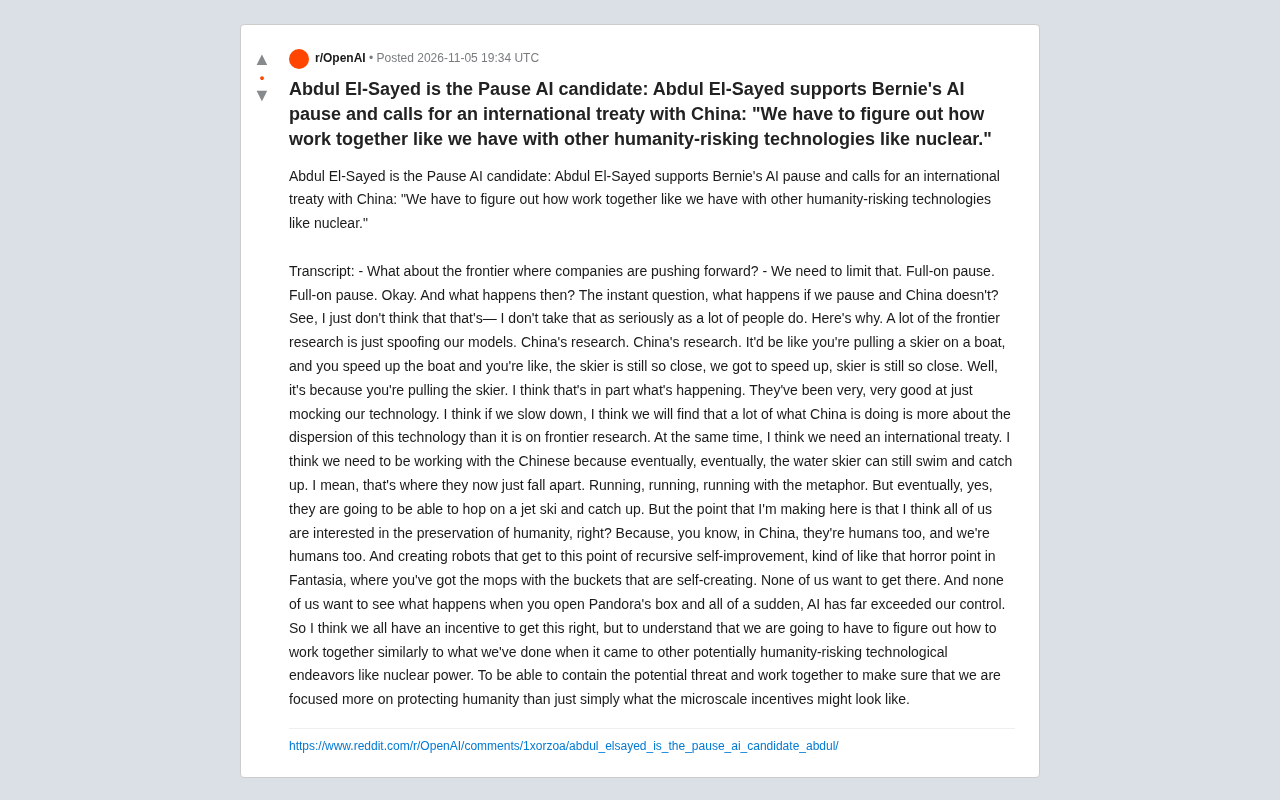
El-Sayed backs a full pause on frontier AI and a nuclear-style treaty with China.
US political figure Abdul El-Sayed publicly endorses Bernie's AI pause call, proposing a "full pause" on frontier AI R&D and treating R&D pace as a controllable policy variable rather than relying solely on alignment and evaluation. On "what if China doesn't pause," he argues China's strengths lie more in technology diffusion than frontier breakthroughs and that much frontier research imitates US models, while conceding catch-up will eventually happen—so a pause's value is buying time for rules, not preserving a lead. His solution is an international treaty modeled on nuclear controls, cooperating with China to prevent AI from entering runaway recursive self-improvement. The article flags questionable points on treaty verifiability and the "imitation-dominant" judgment, but affirms the significance of bringing the pause into mainstream political discourse.
US political figure Abdul El-Sayed has publicly endorsed Bernie's call for an AI pause, extending it into a more internationalist framework: the United States should proactively slow down frontier AI development while signing an international treaty with China and other countries akin to nuclear technology controls. The stance has sparked discussion in the Reddit community and is seen as a rare "proactive slowdown" position amid the current AI race narrative.
Core Position: A Full Pause on Frontier R&D
In a widely circulated interview transcript, El-Sayed was asked what to do about the frontier that companies keep pushing forward. His answer was blunt: "We need to limit it. A full pause." He did not attach conditional, buffer-style caveats to "pause" but presented it as the policy goal itself.
The context of this statement is worth noting. Mainstream discussion today mostly focuses on "how to accelerate safely"—reducing risk through alignment research, evaluation systems, deployment thresholds, and similar measures—whereas El-Sayed's position treats the pace of R&D itself as a controllable variable. This echoes Bernie's earlier call for an AI pause and has earned El-Sayed the "Pause AI candidate" label in public discourse.
Frontier AI R&D typically refers to work that pushes the boundaries of model capabilities, such as larger-scale pretraining, exploration of new architectures, autonomous agents, and recursive self-improvement—distinct from application-layer R&D that productizes and deploys existing capabilities. AI alignment research attempts to make model objectives consistent with human intent, commonly through reinforcement learning from human feedback, interpretability analysis, and red-team evaluation. The mainstream "safe acceleration" camp holds that progress in alignment and evaluation can outpace capability growth, thereby controlling risk while moving forward; the "pause" camp questions this assumption and argues for freezing the capability frontier before rules and verification mechanisms are in place. The disagreement between the two camps is not about whether safety matters, but about whether the pace of R&D itself should be treated as a controllable policy variable or as something that should be indirectly constrained through technology governance.
Responding to "What If China Doesn't Pause?"
The most common rebuttal to a pause is that if the US stops and China continues, it amounts to unilaterally ceding advantage. El-Sayed responds on two levels.
The first level is his assessment of China's frontier capabilities. He argues that a considerable portion of what is called "frontier research" in China is in fact imitating American models—using a waterskiing metaphor: the boat accelerates and drags the skier, who appears to keep pace, but the reason for keeping pace is precisely being pulled by the boat. In his view, the gap between the US and China is exaggerated by this "being towed" appearance, and China's current strengths lie more in technology diffusion than in frontier breakthroughs.
The second level is an acknowledgment of long-term trends. He concedes that the skier "can eventually swim fast enough to catch up," or even "jump onto the motorboat" to close the gap. In other words, the window created by a pause is limited, and "the other side can't catch up" cannot be treated as a permanent premise. This makes his argument more honest than a simple "leadership" claim: the value of a pause lies not in preserving a gap but in buying time to establish rules.
Technology diffusion refers to the spread of existing technology outward through papers, open-source models, talent flows, and product output, typically far faster than frontier breakthroughs. This distinction is key to assessing the speed of catch-up: diffusion can quickly bring latecomers close to the frontier, but pushing further still requires original capability. The waterskiing metaphor in the text corresponds to this mechanism—the laggard appears to keep pace partly because the front is pulling up the overall water level. However, diffusion and breakthrough are not strictly binary: large-scale application and engineering optimization often in turn give rise to new methods, so a judgment of "diffusion-dominant" can only describe the structure at a given moment and cannot guarantee that the gap persists. This is precisely why the pause argument must rely on a time window rather than permanent leadership.
International Treaty: Regulating AI Like Nuclear Technology
El-Sayed's solution points to an international treaty. He states explicitly that "we need to cooperate with China," and the reason is not geopolitical maneuvering but shared human interest: "Chinese people are people just like us," and no one wants to see AI enter an uncontrolled phase of recursive self-improvement.
He uses the scene from Fantasia of the broom automatically replicating and multiplying—the very "sorcerer's apprentice" loss of control: once started, it is hard to undo. He calls it a "Pandora's box"; once AI far exceeds human control, the consequences will be bad for every country.
He therefore argues for drawing on the experience of controlling "technologies that could endanger humanity," such as nuclear energy, to establish cross-border cooperation mechanisms, focusing on protecting humanity rather than micro-level competitive incentives. The analogy has merit: the nuclear non-proliferation regime did establish frameworks for verification, notification, and limits. But AI models cannot be physically measured and intercepted at borders the way nuclear materials can, and treaty verifiability is the biggest practical obstacle this position faces.
The nuclear non-proliferation regime derives its core verifiability from the physical properties of the materials themselves: the isotopic signatures of uranium and plutonium can be measured, centrifuges and reactors can be identified by satellite and on-site inspection, and the IAEA safeguards system is built on these measurable indicators. AI models are different—weights are digital files that can be compressed, copied, and transmitted across borders over networks, and training can be completed on distributed compute clusters, making them hard to intercept and inventory at borders or facilities the way nuclear materials are. As a result, alternatives discussed in arms-control circles mostly center on compute-threshold declarations, training-run notifications, chip export controls, and post-deployment behavioral evaluation—but these mechanisms verify inputs and behavior rather than capability itself, leaving considerable room for circumvention. This is precisely where the AI treaty analogy draws the most skepticism.
Controversies and Observations
From public discussion, El-Sayed's position has at least two questionable points. First, the judgment that "Chinese research is mostly imitation" lacks public evidence and is in some tension with his later admission that "the other side will eventually catch up"—if catch-up is inevitable, then a pause argument premised on "the other side is temporarily behind" needs to be reorganized. Second, the path to implementing an international treaty is not elaborated, nor does he address the verifiability gap in the nuclear analogy.
Still, the significance of this statement lies in pushing "pause" from a fringe position into mainstream political discourse, and in offering an argument that does not rely on "America First": a pause is not surrender but a bid for institutional space for international cooperation. At a time when the AI race narrative dominates, the spread of such a voice is itself worth watching.
One-line Summary
El-Sayed supports a full pause on frontier AI and advocates a nuclear-style international treaty with China.
Paragraph Summary
US political figure Abdul El-Sayed has publicly endorsed Bernie's call for an AI pause, proposing a "full pause" on frontier AI R&D and treating the pace of R&D itself as a controllable policy variable rather than relying solely on alignment and evaluation to reduce risk. On "what if China doesn't pause," he argues that China's current strengths lie more in technology diffusion than frontier breakthroughs and that much of its frontier research imitates American models, while conceding that catch-up will eventually happen—so the value of a pause lies in buying time to establish rules, not in preserving a lead. His solution points to an international treaty: cooperating with China by drawing on nuclear technology controls to prevent AI from entering an uncontrolled phase of recursive self-improvement. The article notes questionable points regarding treaty verifiability and the "imitation-dominant" judgment, but affirms the significance of pushing the pause into mainstream political discourse.
Related articles
 Tech Frontiers
Gemini Omni 1.2 Flash: AI Video Moves Toward Draft-Style Editing
Google's Gemini Omni 1.2 Flash update enables conversational, draft-style editing of the same video—swap scenes while keeping products, adjust lighting while keeping characters. Clips up to 15s, 720p costs 30% less than the previous Flash—ideal for e-commerce ads, previs, and short-asset production.

Codex Tutorial: One-Command Install and Run Your First Task
Codex tutorial: one-command install and run your first task. Covers the four Codex forms, sandbox and approval guardrails, AGENTS.md and MCP configs, cloud network policy, and the iron rule of human review—everything you need to get started with this autonomous coding agent.
 Tech Frontiers
Localix: An Open-Source Agentic Development Environment with Multi-Model and Local AI Integration
Localix is an MIT open-source Agentic Development Environment (ADE) supporting seamless Claude Code plugin loading, multi-model cloud and local execution, Mini Apps extensions, and agent context management—an open AI collaboration workbench for developers.