Abralo: A Free Tool for Running Multiple Claude Code Agents in Parallel Within a Single Window

Abralo lets developers run multiple Claude Code agents in parallel inside a single free, lightweight interface.
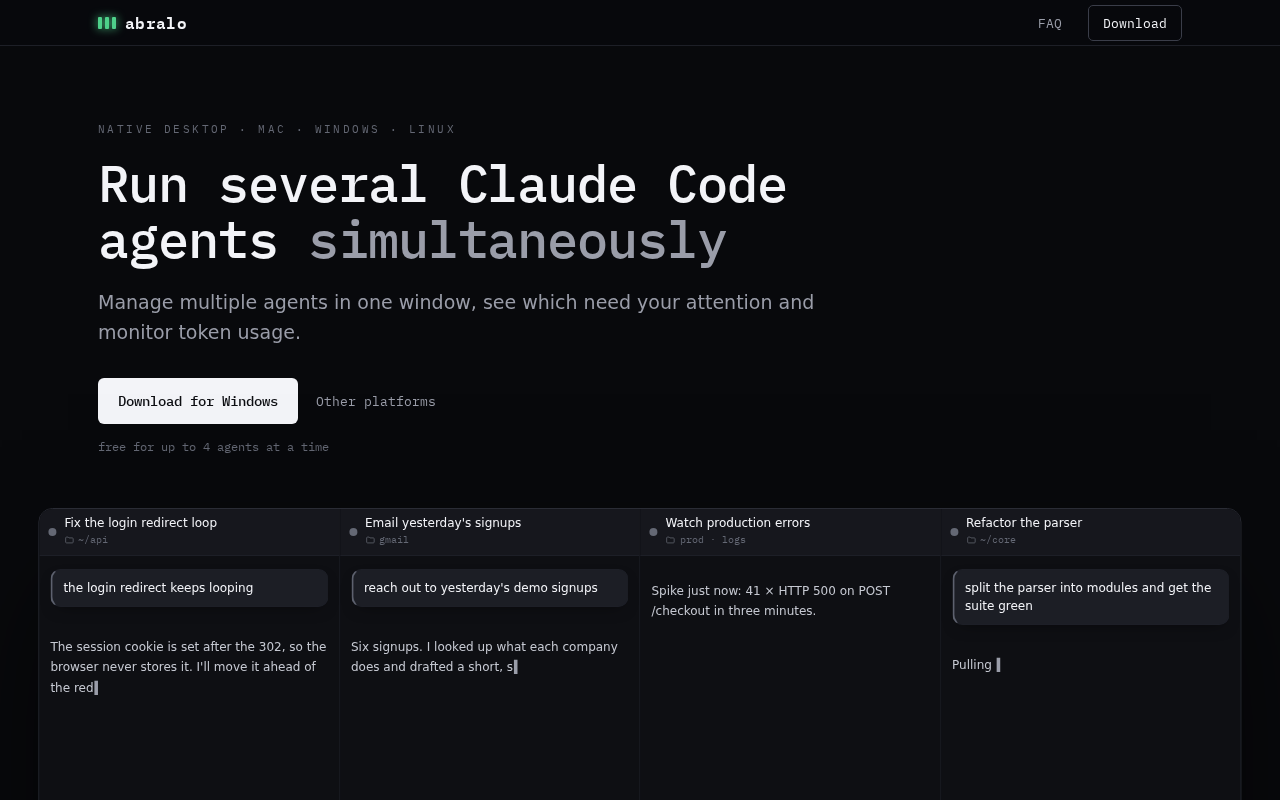
Abralo is an early-stage, free tool that consolidates multiple Claude Code agents into a single window, enabling parallel task execution, side-by-side solution comparison, and context isolation. It targets the growing need for multi-agent AI coding workflows without the complexity of heavyweight orchestration frameworks.
The Multi-Agent Trend in AI Coding Tools
As command-line AI coding assistants like Claude Code gain traction, more and more developers are exploring ways to get more out of AI agents in their programming workflows. However, the single-terminal, single-agent model quickly reveals its efficiency bottlenecks — when you need to handle multiple tasks simultaneously, compare different implementation approaches, or have multiple agents collaborate, constantly switching windows and managing context becomes a genuine pain point.
Abralo, a project that recently debuted as a Show HN post on Hacker News, targets exactly this scenario. Its core pitch is simple: it's free and easy to use, letting developers run multiple Claude Code agents in parallel within a single window — a lightweight solution for multi-agent collaborative coding.
The Core Problems Abralo Solves
Real-World Demand for Parallel Multi-Agent Workflows
Claude Code is a command-line coding assistant released by Anthropic in 2025, built on top of its flagship Claude model. Unlike editor plugins such as GitHub Copilot, Claude Code runs in the terminal and can directly read and write files, execute commands, and invoke Git operations — giving it significantly stronger autonomous task execution capabilities. This class of "Agentic Coding" tools represents the next generation of AI-assisted programming, upgrading from "code completion" to "task execution." AI is no longer a passive responder but an active planner that carries out multi-step programming tasks.
When developers try to leverage Claude Code's capabilities on complex projects, they typically run into a few recurring needs:
- Task parallelism: One agent writes tests, another fixes bugs, a third handles documentation — all without interference.
- Solution comparison: Multiple agents tackle the same problem with different implementations, allowing side-by-side comparison before picking the best one.
- Context isolation: Different feature modules are handled by independent agents, preventing context pollution that degrades output quality.
On the topic of context pollution — this is one of the central challenges in multi-task AI workflows. Large language models operate on a "context window": when generating each token, the model references all prior conversation and information within that window. When a single agent session gets mixed up with discussions from multiple unrelated tasks, those tasks interfere with each other, leading to degraded output quality and weakened instruction-following. Claude 3.5-series models have expanded their context windows to 200K tokens, but greater capacity doesn't fully solve the problem of semantic noise. Maintaining independent agent sessions for different tasks provides architectural-level context isolation, which is an effective way to improve output quality.
The traditional workaround is opening multiple terminal tabs or windows and manually managing each session — which not only consumes screen real estate but adds significant cognitive load. Abralo's value lies in consolidating these scattered agents into a single interface, dramatically lowering the barrier to multi-agent workflows.
Differentiation Through "Free + Easy"
Abralo positions itself around two core labels: Free and easy. In today's AI tooling landscape, this positioning is notably strategic — many comparable multi-agent orchestration tools are either paid or require complex configuration, demanding a certain level of DevOps expertise from users. Abralo aims to attract developers who want to quickly experiment with multi-agent coding by keeping the cost of entry as low as possible.
Industry Context for Multi-Agent Coding
From Single Agents to Agent Orchestration
Abralo's emergence isn't an isolated event — it's a snapshot of how AI coding tools are evolving. Research into Multi-Agent Systems (MAS) dates back to the distributed AI work of the 1980s, but the real engineering explosion came after the rise of large language models. AutoGen, developed by Microsoft Research, allows multiple LLM instances to collaborate through structured dialogue; CrewAI centers its design philosophy on "role-playing," giving each agent a specific responsibility to form a team-like collaborative structure. These frameworks share a common engineering challenge: how to effectively manage concurrent execution, context isolation, and communication coordination across multiple agents.
Abralo chooses to operate at the interface layer rather than the framework layer — a pragmatic, lightweight approach. Instead of reinventing the underlying logic of agent orchestration, it focuses specifically on the user experience problem of "managing multiple windows."
Within the Claude Code ecosystem specifically, similar explorations are ongoing. Some developers use traditional terminal multiplexers like tmux to manage multiple sessions, but these solutions have obvious limitations: tmux is designed for general-purpose terminal management and lacks support for AI-agent-specific needs — it can't parse the structural semantics of AI output, has no state synchronization mechanism between agents, and has a relatively steep configuration learning curve. Dedicated tools like Abralo exist to fill the gap between general-purpose tooling and AI coding use cases.
Efficiency Gains from a Unified Interface
Consolidating multiple agents into a single window delivers one immediate benefit: focused attention. Developers can monitor the status and output of all agents at a glance without constantly switching between windows. For coding scenarios that require intensive monitoring of AI output, this unified view can significantly improve workflow fluency and overall efficiency. From a cognitive science perspective, task-switching costs are a real source of efficiency loss — research suggests that each context switch takes an average of about 23 minutes to fully recover from. A unified interface directly reduces that switching frequency at the tooling level.
A Grounded Assessment: The Realities of an Early-Stage Project
It's worth noting that Abralo is still a very early-stage project. "Show HN" is a dedicated post type on Hacker News where developers showcase projects they've built — it's an important window for the tech community to gauge the vitality of early products. Community response (upvotes, comment quality, discussion depth) often serves as a leading indicator of product-market fit for early-stage tools. Based on current Hacker News data, the Show HN post has received only 4 upvotes and 2 comments, placing it squarely in the "low-visibility early project" category. This doesn't necessarily mean the product lacks value — many later-successful open-source tools had similarly quiet debuts on HN — but it does signal a few things:
- Limited real-world usage feedback: The tool's stability and feature completeness have not yet been validated at scale.
- Niche positioning remains to be seen: Whether Abralo can carve out a unique value proposition among the crowded AI coding tool landscape still needs time to play out.
- Technical details still sparse: Specifics around its architecture, the number of agents it supports, and resource consumption are currently unclear.
For developers interested in trying it out, it's best treated as a lightweight experimental tool rather than a critical component of a production workflow.
Which Developers Are Best Suited for Abralo?
All things considered, the following groups of developers are likely to benefit most from Abralo:
- Heavy Claude Code users: Those who already rely on Claude Code in their daily development and want to improve multi-task efficiency.
- Multi-agent explorers: Developers interested in AI agent collaboration patterns who want a low-cost entry point into multi-agent programming.
- Workflow-conscious pragmatists: Developers who are tired of constantly switching between multiple terminal windows and prefer a unified management interface.
Closing Thoughts: A Multi-Agent Coding Experiment Worth Watching
Abralo represents a concrete attempt to move AI coding tools from "single-point assistant" to "multi-agent collaboration." It lowers the barrier to multi-agent programming workflows by leading with free, easy-to-use access. While it's still early stage with limited community attention, its core direction — enabling multiple Claude Code agents to collaborate efficiently within a unified interface — undeniably reflects an important trend in AI-assisted programming.
As the ecosystems around tools like Claude Code continue to mature, there's good reason to expect more tools like this to emerge, ultimately pushing AI coding workflows from "single-threaded human-AI dialogue" toward a new paradigm of parallel multi-agent collaboration. For developers tracking the cutting edge of AI coding tools, Abralo is worth adding to your watchlist.
Key Takeaways
Related articles

Disaster and Glory of the Apollo Program: The History We Must Revisit Before Returning to the Moon
From the fatal Apollo 1 fire to Apollo 8's daring lunar orbit to Apollo 11's successful landing—revisiting the disasters, fears, and compromises of the Apollo program and their lessons for today's return to the Moon.

Netflix Trust Exercise Turns Into Firing Trap: Where Are the Boundaries of Corporate Trust?
A Netflix employee was fired after sharing private info in a trust exercise. We analyze the risks of corporate trust exercises and how employees can protect themselves.

AMD CDNA5 Architecture Deep Dive: Technical Evolution and the AI Computing Competition Landscape
Deep analysis of AMD's CDNA5 architecture covering Chiplet packaging upgrades, HBM memory evolution, and low-precision compute optimization, examining how AMD challenges NVIDIA's AI chip dominance.