ACAI Architecture Explained: How Modular Cognitive Pipelines Solve LLM Hallucination and Context Corruption

ACAI architecture tackles LLM hallucination and context rot through modular cognitive pipelines and separation of concerns.
The ACAI (Adaptive Cognitive AI) framework addresses core LLM problems—hallucination, context window rot, and unpredictable latency—by decomposing monolithic model responsibilities into specialized subsystems. Its layered cognitive pipeline includes intent extraction, dynamic task planning, semantic memory graphs, context compression, and logical verification with confidence scoring, applying proven software engineering principles to AI system design.
The Inherent Flaws of Monolithic LLM Architecture
Most current LLM workflows adopt an "all-in-one" design philosophy: a single model handles all responsibilities—intent understanding, memory management, task planning, information retrieval, logical reasoning, result verification, and even output formatting. This monolithic structure may appear elegant during demos, but exposes serious problems in real-world complex scenarios.
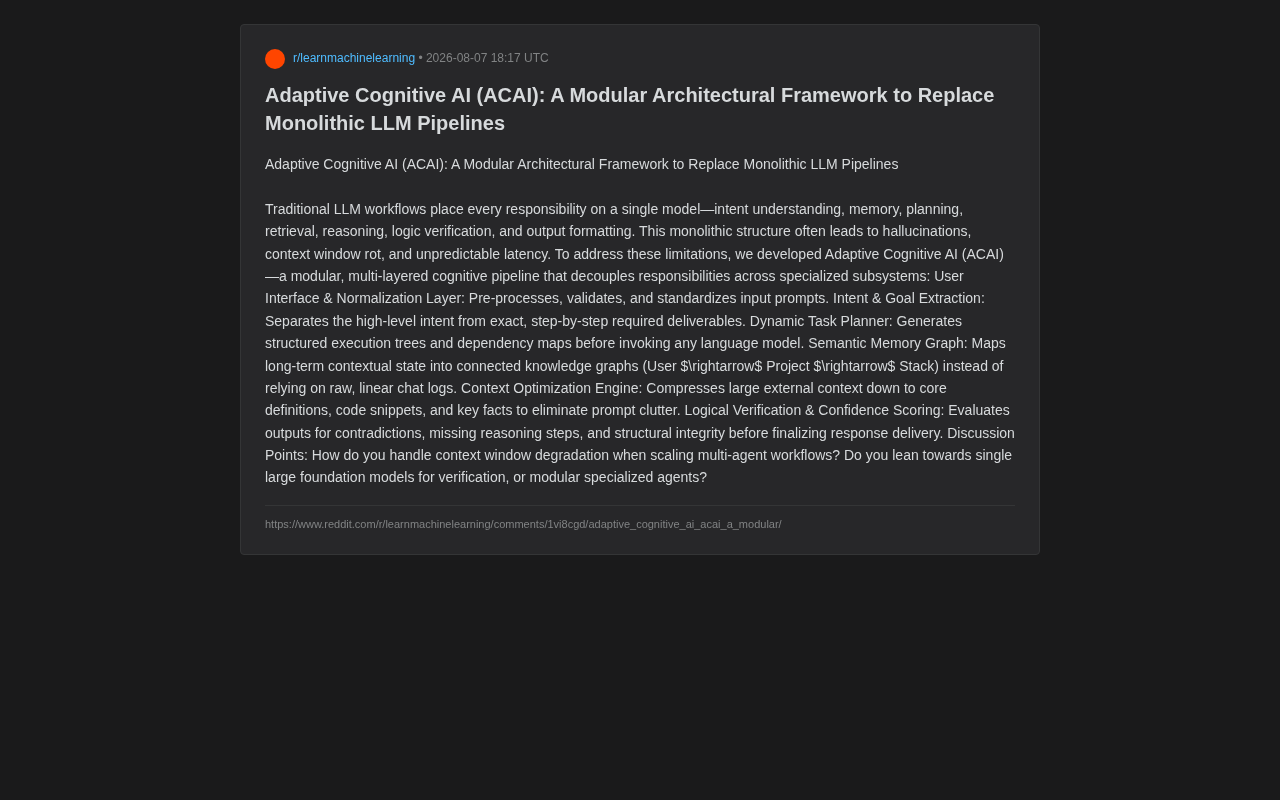
According to discussions shared on Reddit's developer community about an architectural framework called Adaptive Cognitive AI (ACAI), monolithic pipelines primarily introduce three chronic issues: hallucination, context window rot, and unpredictable latency.
Hallucination refers to large language models outputting factually incorrect or fabricated content with high confidence. The root cause lies in LLMs' generation mechanism, which is based on probabilistic next-token prediction rather than factual retrieval or logical deduction. Models learn statistical patterns of language during training, and when facing knowledge gaps, they tend to generate content that "looks plausible" rather than content that is "actually correct." Context window rot refers to the phenomenon where, as conversation turns increase or input context grows longer, the model's attention to earlier information gradually decays. This is related to the Transformer architecture's attention mechanism—in practice, models exhibit obvious "positional bias," with particularly weak retrieval capabilities for information in middle positions (the "lost in the middle" problem). When large amounts of irrelevant information is mixed into the context, key instructions and constraints can easily be "drowned out."
When all cognitive tasks are crammed into the same forward inference process, the model must simultaneously "figure out what to do," "remember what was said before," and "check whether it made mistakes"—the stacking of cognitive load ultimately leads to loss of control over output quality.
This actually reflects a deeper engineering intuition: coupling all responsibilities into a single component causes every weak link in the system to amplify each other. Decades of software engineering experience have long proven that Separation of Concerns is the fundamental path to managing complexity. This principle was first proposed by Edsger Dijkstra in 1974, with the core idea of decomposing complex systems into functionally independent modules, each responsible for only one clearly defined "concern." From MVC architecture to microservices, from Unix philosophy to domain-driven design, this principle has been repeatedly validated. Applying it to LLM system design means no longer letting a single model handle all cognitive tasks, but instead designing specialized processing units for each type of task, thereby reducing single-point complexity, improving testability, and reducing fault propagation.
ACAI's Core Design: Layered Cognitive Pipeline
ACAI's core idea is to decompose the responsibilities originally placed on a single model into multiple specialized subsystems, constructing a multi-layered cognitive pipeline. The entire architecture can be understood as a "cognitive factory" where each workstation handles only one thing—and does it exceptionally well.
Input Side: Standardization and Intent Extraction
The first layer of the pipeline is the UI & Normalization Layer, responsible for preprocessing, validating, and standardizing input prompts. This step may seem trivial, but it filters out a large amount of noise at the source, preventing dirty data from contaminating downstream stages.
Next comes the Intent & Goal Extraction Layer. Its responsibility is to separate "high-level intent" from "precise, step-by-step deliverable requirements." For example, when a user says "help me optimize this code," the high-level intent is "improve performance," while specific deliverables might include "reduce time complexity," "decrease memory usage," and "maintain interface compatibility"—multiple verifiable sub-goals. Separating these two aspects enables more targeted downstream planning.
Core: Dynamic Task Planning and Semantic Memory Graph
The Dynamic Task Planner is the key component that distinguishes ACAI from ordinary prompt chains. It generates structured execution trees and dependency graphs before calling any language model. This means the system "thinks through the steps first, then executes," rather than letting the LLM think and act simultaneously—the latter being a common cause of reasoning derailment.
This "plan-then-execute" paradigm has deep theoretical foundations. Execution trees define the hierarchical decomposition of tasks (similar to WBS—Work Breakdown Structure in project management), while dependency graphs explicitly map the predecessor/successor relationships and parallelization possibilities among subtasks (similar to DAG scheduling in compilers). This approach draws inspiration from classical AI planning (such as STRIPS, HTN—Hierarchical Task Network planning) and aligns with the Plan-and-Execute Agent architecture that has gained traction in recent years. Its core advantage lies in decoupling planning decisions from the execution process, allowing the system to discover logical gaps before execution and dynamically adjust plans based on intermediate results during execution, rather than waiting until the final output to discover that the entire reasoning chain has long gone off track.
The Semantic Memory Graph proposes a new approach to context management. Traditional solutions rely on raw, linear chat histories to maintain long-term state, while ACAI advocates mapping long-term context into interconnected knowledge graphs, forming hierarchical associations like User → Project → Tech Stack.
As a data representation method that organizes information in graph structures, knowledge graphs consist of nodes (entities) and edges (relationships), possessing natural semantic association capabilities. Compared to linear conversation history, graphs can quickly locate relevant context through graph traversal, support multi-hop reasoning, and efficiently perform local updates without affecting the global structure. In engineering practice, knowledge graphs are often used in conjunction with vector databases—the former handles storage and reasoning over structured relationships, while the latter handles semantic similarity retrieval. Graph databases like Neo4j and Amazon Neptune, as well as frameworks like LangGraph, provide mature infrastructure for such applications. This graph structure enables more precise context retrieval, fundamentally alleviating the context window rot problem.
Output Side: Context Compression and Logical Verification as Dual Safeguards
Before generating final results, ACAI establishes two critical defense lines to ensure output reliability.
Context Optimization Engine Reduces Signal-to-Noise Ratio
The Context Optimization Engine is responsible for compressing extensive external context into core definitions, code snippets, and key facts, eliminating redundant prompt noise. This design directly addresses the pain point that "the longer the context, the more likely the model is to get lost." Rather than dumping entire documents into the context window, it's better to distill the few key pieces of information that truly determine output quality—both reducing token costs and improving signal-to-noise ratio.
At the engineering implementation level, context compression has multiple strategies: summary-based compression (using small models to compress long documents into key summaries), selective compression (keeping only fragments most relevant to the current query based on relevance scores), and structured extraction (converting natural language into structured data like JSON/tables to reduce token consumption). Tools like LangChain's ContextualCompressionRetriever and LlamaIndex's SentenceWindowRetrieval already provide out-of-the-box compression solutions. Practical data shows that well-compressed context can not only reduce token consumption by 50-80%, but also significantly improve answer accuracy, because the model no longer needs to find a "needle in a haystack" of irrelevant information.
Logical Verification and Confidence Scoring Mechanism
The final layer is Logical Verification & Confidence Scoring. Before delivering a response, the system proactively checks whether the output contains contradictions, missing reasoning steps, or structural incompleteness. This is equivalent to adding a "quality inspection stage" to the entire pipeline, using an independent evaluation mechanism to review the products of the main pipeline—this is precisely one of the effective means of reducing hallucination rates.
Two Unresolved Engineering Challenges
The ACAI proposers also candidly raised two genuinely thorny problems worthy of collective community consideration.
First, how to handle context degradation when scaling to multi-agent systems? As subsystems multiply and interactions become more frequent, the context passed at each stage can introduce loss and distortion. ACAI uses semantic memory graphs and context compression to mitigate this, but these are not silver bullets—building and maintaining graphs is itself a complex engineering undertaking. Entity recognition accuracy, relationship extraction completeness, real-time graph update strategies, and retrieval efficiency as graph scale grows are all engineering challenges requiring sustained investment.
Second, model selection for the verification stage: large models or specialized agents? This is a classic architectural trade-off. Using large models for verification provides comprehensive capabilities but at high cost and latency; using specialized small agents is lighter and more controllable, but may lack coverage. The industry currently has no definitive answer, requiring trade-offs based on specific scenarios. One possible compromise is tiered verification: first using lightweight rule engines and specialized small models for quick validation (such as format checking, numerical range verification), then invoking large models for deep logical review on uncertain outputs, thereby striking a balance between cost and coverage.
From "Bigger Models" to "Smarter Architecture"
ACAI represents an emerging school of thought: rather than blindly pursuing larger monolithic models, it's better to squeeze the maximum capability out of existing models through clever architectural orchestration. Its value lies not in any single technical breakthrough, but in systematically introducing mature software engineering principles—separation of concerns, pipeline design, explicit verification—into LLM application development.
The rise of this school of thought has practical context. As the capabilities of models like GPT-4 and Claude converge, the marginal returns from simply scaling model size are diminishing. Meanwhile, Anthropic's Claude team in their system prompt engineering practices, OpenAI in their Assistant API design, and Google in their Vertex AI Agent Builder all embody similar layered design philosophies to varying degrees. ACAI integrates these scattered engineering intuitions into a systematic architectural methodology, providing developers with clearer design guidance.
For developers building production-grade AI systems, ACAI offers a highly valuable architectural blueprint. It reminds us: hallucination and context corruption are often not because the model isn't smart enough, but because the architecture isn't sound enough. When complex problems are decomposed into a series of verifiable, composable small tasks, even the same underlying model can deliver far more stable results.
Related articles

How Big Can Stars Really Get? The Physical Limits of the Largest Stars
Red supergiants are the largest stars by volume, with radii up to 2,000 times the Sun, engulfing the inner solar system. But there is no precise upper limit on stellar size—models predict up to 15,000 solar radii. The most massive blue stars are far smaller than red supergiants—biggest and heaviest are two different things.

Apple HomeView Smart Display Full Feature Breakdown: Wall-Mount or Desktop, $299
Apple launches HomeView, a $299 smart display with wall-mount and desktop options, 12MP camera for facial recognition, smart home control, music playback, and recipe step-by-step cooking. Full breakdown of watch faces, apps, privacy, and cooking integration.

Where Did the Promised New Studio Go? Craft Computing Answers After Five Years
Craft Computing's host responds to viewer questions: the new studio promised five years ago was shelved as construction costs soared from $30,000 to $75,000, and was replaced by a 168-square-foot garage conversion.