Accelerating Dropless MoE Training in JAX: A Deep Dive into NVIDIA Transformer Engine
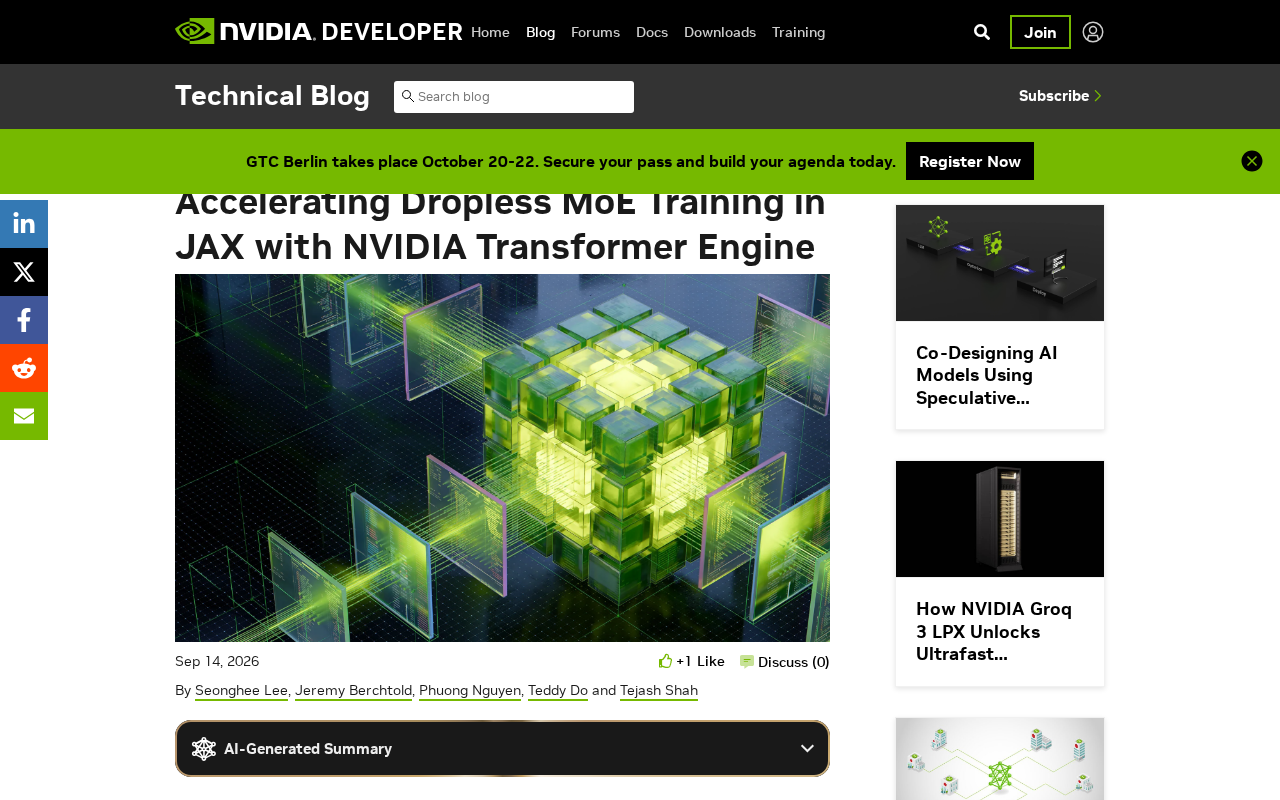
How to combine JAX and NVIDIA Transformer Engine for efficient Dropless MoE large model training.
MoE models use sparse activation to scale parameters without proportional compute increases, powering models like DeepSeek, Qwen, and Mixtral. Traditional MoE training suffers from token dropping due to router load imbalance, causing information loss and instability. Dropless MoE eliminates this but demands more from underlying operators. This article explains how NVIDIA Transformer Engine accelerates Dropless MoE in JAX via grouped GEMM, FP8 low-precision training, and integration with JAX's distributed parallelism primitives like `shard_map` for expert parallelism — delivering near-hardware-limit efficiency without sacrificing model quality.
Mixture of Experts (MoE) has become one of the most defining architectural trends in large-scale AI model training. A series of cutting-edge models — including DeepSeek, Qwen, and Mixtral — have all adopted MoE architectures. The core idea is to dramatically scale model parameter counts through sparsely activated expert networks, without a proportional increase in computational cost. How to train these models efficiently, especially implementing so-called "Dropless MoE" within the JAX ecosystem, is becoming a critical engineering challenge.
This article is based on a post from the NVIDIA Developer Blog, outlining the technical approaches and engineering value of accelerating Dropless MoE training in JAX using NVIDIA Transformer Engine.
Why MoE Has Become the Go-To Architecture for Large Models
The fundamental idea behind MoE is to replace the dense feed-forward layers (FFN) in traditional Transformers with multiple "expert" sub-networks, using a router (gating network) to dynamically select a small number of experts for each token. This allows the total parameter count to grow very large while keeping the actual parameters involved in computing any given token to a small fraction — resulting in relatively manageable compute costs at both inference and training time.
DeepSeek, Qwen, and Mixtral are all prime examples of this trend. Through MoE architectures, they push model capacity to hundreds of billions of parameters or beyond while keeping per-token compute constant. MoE has effectively transitioned from an academic exploration to one of the default choices in industrial-scale large model training.
Dropless MoE: Solving the Token Dropping Problem
One persistent challenge in traditional MoE training is load imbalance. When the router assigns tokens to experts, some experts tend to get overloaded while others sit idle. To keep the computation graph shape fixed and enable hardware parallelism, engineering implementations typically set a capacity limit (capacity factor) for each expert. When an expert receives more tokens than its capacity allows, the excess tokens are dropped and never processed by that expert.
This token dropping has two negative consequences: first, information loss — dropped tokens miss out on the expert computation they were routed to, hurting model quality; second, training instability — since the dropping behavior depends on the data distribution within each batch.
The goal of Dropless MoE is to eliminate this dropping behavior entirely, ensuring every token gets routed to its corresponding expert and fully processed. Achieving this requires support for variable-length, irregularly shaped computation (ragged/grouped computation), which in turn places much higher demands on the underlying operators and hardware scheduling.
The Role of Transformer Engine in JAX
NVIDIA Transformer Engine is a library designed specifically to accelerate training and inference of Transformer-based models. Its core capabilities include support for low-precision computation such as FP8, and highly optimized operator implementations for NVIDIA GPUs. Within the JAX ecosystem, Transformer Engine provides interfaces that integrate with JAX/Flax, allowing developers to enjoy hardware-level performance acceleration while retaining JAX's functional programming and automatic differentiation advantages.
For Dropless MoE training specifically, Transformer Engine's value shows up in several key areas:
Efficient Grouped Matrix Operations
Dropless MoE requires each expert to process a variable number of tokens — which is fundamentally a series of matrix multiplications at different scales (grouped GEMM). Transformer Engine includes specialized optimizations for this type of irregular computation, avoiding the wasted compute that would come from padding tensors to uniform shapes.
Low-Precision Training Support
With FP8 mixed precision, the massive volume of expert feed-forward computations in MoE can proceed with significantly reduced memory footprint and bandwidth pressure, while maintaining training stability. This is especially important for large-scale MoE models with potentially hundreds of experts.
Coordination with JAX Parallelism Strategies
JAX natively supports distributed parallelism primitives like pmap and shard_map. Transformer Engine operators can work in conjunction with expert parallelism and other sharding strategies, distributing different experts across different devices to fully utilize the compute capacity of multi-GPU clusters.
Engineering Significance and Practical Takeaways
Combining Dropless MoE, JAX, and Transformer Engine is fundamentally about striking a better balance between model quality and training efficiency. Eliminating token dropping improves model training quality and reproducibility, while Transformer Engine's hardware optimizations ensure that this "no dropping" guarantee doesn't translate into unacceptable computational overhead.
For teams currently training or planning to train large-scale MoE models, this technology combination offers a relatively mature engineering path: on a flexible and scalable framework like JAX, leverage Transformer Engine to achieve near-hardware-limit performance, while using the Dropless strategy to avoid the quality degradation associated with traditional MoE.
As models like DeepSeek, Qwen, and Mixtral continue to validate the effectiveness of MoE architectures, competition around the underlying toolchain for MoE training efficiency will only intensify. NVIDIA's investment in Transformer Engine within the JAX ecosystem is a direct reflection of this trend.
Summary
MoE architecture resolves the tension between parameter scale and computational cost in large models, while Dropless MoE goes further by addressing the token dropping problem during training. Within the JAX framework, NVIDIA Transformer Engine provides solid low-level support for efficiently training these models — through grouped GEMM, FP8 low-precision support, and tight coordination with distributed parallelism strategies. For engineers focused on cutting-edge large model training techniques, this is a practical path well worth exploring in depth.
Related articles
iOS 27, iPadOS 27, and macOS 27: The Information Gap Behind a Discussion
A Hacker News post about iOS 27, iPadOS 27, and macOS 27 sparked speculation about Apple unifying its version numbering. Here's how to read it with limited info.
ComfyUI Prompt Studio: A Workflow for Turning Reference Images into Production-Ready Prompts
ComfyUI Prompt Studio is an open-source workflow that auto-generates production-ready image prompts, multi-model custom prompts, and MiniMax video scripts from reference images.
K2 Horizon 7B: A Small Model Punching Above Its Weight
K2 Horizon 7B ranks between Qwen 3.6 27B and 35BA3b on the Artificial Analysis Intelligence Index, delivering near-mid-tier intelligence at 7B parameters — a strong local deployment option.